

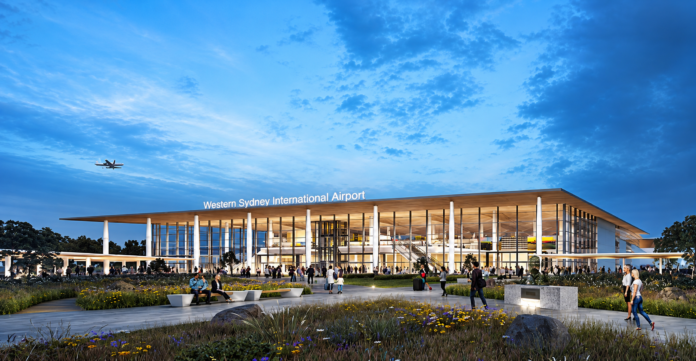
What if a large airport terminal could be built with fewer wet trades, longer floor spans and faster construction without relying on conventional concrete beam-and-slab systems? At Western Sydney International Airport, a structural innovation has helped make this possible. Developed through a collaboration between Fielders’ Design Solutions Group (DSG) and head contractor Multiplex, the terminal incorporates a twin-beam structural system that replaces conventional concrete beams and slabs with welded steel beams supporting composite floor decking.
At the heart of the solution is Fielders SlimDek 210, a deep-rib composite steel decking profile manufactured using BlueScope’s XLERPLATE steel. Its trapezoidal geometry allows unpropped spans of up to 7 metres, reducing the need for temporary supports during construction. This also allows fit-out activities on lower floors to proceed sooner, improving construction sequencing and site productivity.
The system was developed to meet the terminal’s demanding structural and construction requirements. Following technical assessment by structural engineering consultants Arup, the solution was adopted for the project. Approximately 32,000 sq. m of SlimDek 210 and 25,000 sq. m of KF57 decking were specified.
Beyond its structural performance, the approach offered practical construction advantages. Reduced propping, fewer materials and less site equipment helped streamline installation, while limiting wet trades contributed to construction efficiency.
Digital coordination was another important part of the wider terminal development. A multidisciplinary team of more than 500 engineers and designers across 26 disciplines used Building Information Modelling (BIM) and clash detection to coordinate design decisions and manage the fast-tracked delivery programme.
The project demonstrates how combining engineered steel beams with composite decking can rethink conventional floor construction. At an airport designed to accommodate future passenger growth, this approach offers a valuable example of structural innovation translating into tangible construction efficiencies.