

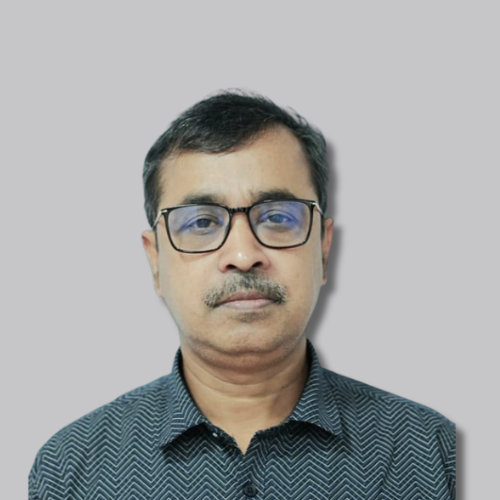
Introduction: In an in-depth conversation, BISWAJIT SARMA, Project Head at Guwahati Airport Terminal, traces a thirty-year career in management of high-end construction projects like Hospitals, Hotels and Airports across India. From delivering AIIMS Guwahati to steering the award-winning airport terminal, with its bamboo motifs, rhino-inspired forms and seismically engineered steel framework, Biswajit speaks with SSMB about the discipline of forecasting, the primacy of scheduling, and what it means to build for the people you grew up among.

You graduated from Jorhat Engineering College and went on to a thirty-year career managing some of the country’s most high-profile builds. Did you ever imagine, in that first year out of college, that you would one day be trusted to deliver your home state’s biggest airport terminal?
I never thought of it in those terms. Initially I was very interested in Architectural and Structural Design of RCC and Structural Steel and luckily, I got an opportunity to work with a Guwahati based Design firm and learnt Structural design. At that time, I got another chance to work with computers and got exposed to Windows-95. Later in a period of three years, I got involved in structural design works for various projects of CPWD, NBCC and IOCL. Later I shifted from Design Engineer to Execution Engineer and worked in many departments like Planning, QS, QA-QC and core executions. My first career as Project Manager began in 2009 for a GAIL project at Dibrugarh, Assam and the journey continued for projects for Clients like HSCC, OPGC, IOCL, HITES etc across various states. Gradually, I had built up a track record on large projects across India, and my first opportunity in Guwahati came with the AIIMS project, while I was posted in Paradip, Odisha for an IOCL Refinery Project. We delivered that, a project worth around 850 crores, and once it was complete, I moved to the Airport. One project led to the next. The journey simply continued.
The terminal’s design draws on bamboo, Japi motifs and rhino-inspired elements native to Assam. Translating that cultural and architectural vision into a structure that also has to meet strict international airport engineering standards must have been a real balancing act. How did you ensure the symbolism never came at the cost of structural performance?
Every building has two distinct layers. The first is the main structural system, structural steel and an RCC framework, and that must come first, always. All the architectural elements, whether fixed to the ground, anchored to the walls or suspended from the ceiling, are ultimately tied back to that structural base. So, before a single bamboo motif went up, the steel framework had already been designed and verified to withstand seismic loads, wind loads, imposed loads, everything the relevant codes require. Once that foundation of stability was in place, the cultural and architectural elements were fixed onto it. The symbolism and the engineering were never in conflict because we never allowed them to compete for the same priority.
“The symbolism and the engineering were never in conflict because we never allowed them to compete for the same priority.”
Before the airport, you led the construction of AIIMS Guwahati, a 750-bed medical institution. Hospitals and airports both demand zero tolerance for error, but for very different reasons. What did building AIIMS teach you that you carried directly into the airport project?
Both are large public buildings with enormous footfall at any given time, and that demands the same standard: construction that is simply error-free. On the airport, we worked in EPC mode, which meant the design responsibility sat squarely with us. We double-checked every structural design, steel and RCC alike, against all relevant code references, making sure nothing strayed outside the required technical parameters. That same rigour had been applied at AIIMS. Structural engineering was always the topmost priority, and we made certain there were no mismatches with technical parameters and that the structure was stable in every respect. The discipline was the same. The context changed.
Delivering a project of this scale in Northeast India comes with logistical realities that a project in Mumbai or Delhi simply does not face. What is the one challenge specific to building in Assam that people outside the region rarely appreciate?
Material supply. Most production facilities and warehouses are situated outside Assam, in South India, western India, Delhi, West Bengal. Getting materials from those locations to a site in Assam by road is a significant undertaking in terms of time and planning. That was the primary challenge. Manpower, to our credit, was managed well, but the supply chain demanded constant attention.
“A schedule represents a promise, and that promise does not bend.”
As project head, you are responsible for scheduling, engineering, procurement, construction and cost management simultaneously. When two of these start pulling against each other on a live site, which do you protect first?
Scheduling, without question. It is a matter of commitment. We commit to the project owners, who in turn have committed to the government or to the public at large. Cost can be managed, if everything is moving in the right direction, financial matters can be resolved in due course. But a schedule represents a promise, and that promise does not bend. Protecting it is not just about professional discipline; it is about honouring what we owe to our clients and, through them, to the people waiting on the other side.
The Guwahati Airport project has been recognised at national forums including IINA, CIDC and Build India. After three decades of work that largely happens behind the scenes, what does that kind of recognition mean to you personally?
It feels genuinely good to have hard work seen and acknowledged by professional bodies. But beyond personal satisfaction, it is also a source of confidence, a signal that we are capable of taking on projects that are even tougher and more complex. Recognition of that kind does not just mark what you have done. It tells you something about what you are ready to do next.
If a young civil engineer from Assam came to you today and said they wanted to one day lead a project as significant as this terminal, what is the single piece of advice from your thirty years that you would want them to act on?
Forecasting. You need the vision to see what a project will look like one month, one year, two years from now. If you can sense a risk on the horizon, you must know how to read it early and how to manage it as it approaches. Everything else, technical skill, site experience, can be developed over time. But the ability to think ahead, to anticipate rather than react, is what separates someone who delivers from someone who merely executes. That is the only advice I would give.
“The ability to think ahead, to anticipate rather than react, is what separates someone who delivers from someone who merely executes.”