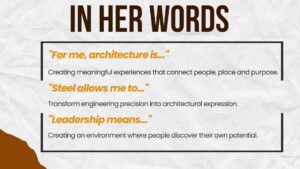


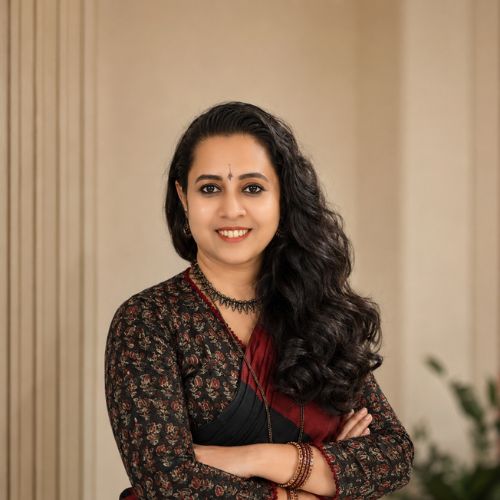
While many architects define themselves through a recognisable style, Bhavani Mohan, Chief Architect at L&T, believes design philosophy is shaped not only by aesthetics, but also by values. Over the course of her journey from a gold medallist at Anna University to leading some of India’s most ambitious infrastructure projects, she has learnt that architecture is ultimately about creating meaningful experiences while empowering the people who design them. In this conversation with SSMB, she reflects on leadership, resilience, structural expression, and why the true measure of architecture lies not only in what it creates, but in the people it inspires along the way.
Your journey from a gold medallist at Anna University to Chief Architect at one of India’s largest construction conglomerates has been remarkable. Looking back, which phase of that journey felt the most uncertain?
Honestly, I feel like I have only just begun. The most uncertain phase wasn’t at the beginning of my career, it came much later, when professional growth demanded personal reinvention. Until then, progress was relatively straightforward. Work hard, build technical competence and deliver consistently. Leadership, however, required an entirely different mindset.
The transition from solving problems myself to enabling others to solve them was both challenging and rewarding. It demanded empathy, influence and the ability to navigate uncertainty while creating an environment where people could realise their potential.
L&T’s leadership development initiatives, including Executive Education at IIM Nagpur, played an important role in shaping this perspective. They reinforced my belief that leadership is never simply a designation. It is a continuous journey of learning, adapting and creating opportunities for others to excel.
Looking back, every uncertain phase was also secretly holding an invitation to grow. Accepting that invitation and enabling others along the way has made the journey far more meaningful than I could have imagined.
“Leadership is not a position. It is a mindset that enables others to grow.”
As Chief Architect, you guide projects across vastly different scales and typologies. How do you maintain a consistent design philosophy while responding to such diverse contexts?
I have never believed that design philosophy is about developing a recognisable visual signature. To me, it is a set of values that guides design decisions, regardless of a project’s scale, typology or location.
Whether we are designing a high-speed rail station, an airport, an IT campus or a hospitality development, I always begin with the same questions. Who are we designing for? What experience should the space create? How can the project respond authentically to its context?
The answers naturally differ from one project to another, but the intent remains unchanged. The consistency comes from approaching design problems with the same sense of curiosity and enquiry. Every project teaches us something new, yet every project also reminds us that architecture is ultimately about how people experience it. When context and human experience remain at the centre of the design process, coherence follows naturally.
What, in your view, must good architecture achieve beyond aesthetics and functionality?
The structures we remember are rarely the ones that simply looked beautiful and functioned efficiently. They are the ones that resonated emotionally and made us pause.
Architecture has the remarkable ability to influence behaviour, shape emotions and create lasting memories. A thoughtfully designed transit hub, for instance, can transform an everyday commute into a meaningful experience. A public building can inspire pride, curiosity or even a sense of belonging.
For me, that emotional resonance is the third dimension of architecture. When a space continues to stay with people long after they have left it, when it evokes memories, emotions or moments of reflection, it moves beyond utility and becomes something much more enduring.
That is the kind of architecture I constantly aspire to create.
“Emotional resonance is the third dimension of architecture”
Large EPC projects are where design ambition often collides with budgets, timelines and engineering constraints. How do you protect architecture without losing practicality?
Constraints are often viewed as limitations, but I believe they frequently become the catalyst for inventive design. Large EPC projects demand constant negotiation between aspiration and practicality. Architecture doesn’t exist only in the final built form, it exists in every decision made throughout the process. The challenge is identifying which design intentions are essential and ensuring those survive despite changing priorities.
Protecting architecture requires adaptability rather than rigidity. It calls for the creativity to develop solutions that satisfy multiple stakeholders while remaining true to the project’s larger purpose. At times, it also requires the conviction to defend ideas that genuinely add long-term value.
It is rarely an easy process. Yet when you eventually stand before a completed landmark that has been shaped through this enduring process, 8/10 times you realise it was worth the effort. Those are the odds I am willing to bet on.
For me, protecting architecture isn’t about resisting constraints. It is about discovering possibilities within them.
Steel is often associated with industrial pragmatism rather than architectural expression. Has there been a project where steel surprised you, where it became something more than structure?
Absolutely. The project that immediately comes to mind is the Surat High Speed Rail Station on India’s first Bullet Train corridor.
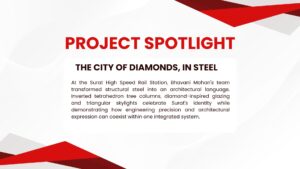
Steel was never intended to remain hidden within the structure. It became an integral part of the architectural narrative. The platform roof is designed as an exposed structural steel system supported by inverted tetrahedron tree columns, while triangular skylights introduce natural daylight into the platform below. Complementing this is a faceted triangular glazing system on diagonal structural steel network inspired by the geometry of a diamond – a tribute to Surat’s identity as the City of Diamonds.
What fascinated me most was steel’s ability to perform multiple roles simultaneously. It delivered the structural efficiency required for a project of this scale while also shaping the station’s architectural character and passenger experience. The interplay of light, geometry and structure created an environment that feels both functional and memorable.
That project reinforced my belief that when Architecturally Exposed Structural Steel (AESS) is thoughtfully integrated into the design process, it becomes an expressive material that can communicate identity, create emotion and elevate the overall experience of a place.
You lead multiple teams on projects of national importance. What, in your experience, is the difference between managing architects and truly leading them?
Simply put, managing architects focuses on meeting milestones and ensuring deliverables. Leading them is about unlocking their potential.
Every architect brings a unique perspective, talent and aspiration to a project. My role is not simply to direct them, but to kindle the fire within them and help them understand how their contribution fits into a much larger vision. When individuals see purpose in their work, they become far more invested in the outcome.
Leadership also requires creating an environment where people feel encouraged to explore ideas, ask questions and continue learning. It is less about providing answers and more about enabling growth.
Projects may be delivered through processes, but truly memorable architecture is created by people who feel inspired, trusted and empowered to leave behind something meaningful.
“Managing architects is about meeting milestones. Leading architects is about unlocking potential.”
Construction and infrastructure continue to be largely male-dominated professions, particularly at senior levels. What has your own experience been, and where do you believe meaningful change is still needed?
Diversity, Equity and Inclusion have always been causes I care deeply about. I have been fortunate to work alongside mentors and colleagues who valued capability above stereotypes, although I recognise that many women across the industry have not always had the same experience. In my view, the challenge is rarely about competence. It is about creating environments where opportunities for growth are genuinely equitable and visible.
As women in construction, we often carry an additional responsibility to make the journey a little easier for those who follow. Visibility matters because it encourages others to believe that leadership is possible.
What gives me optimism is the change I am beginning to see. Organisations are investing more consciously in leadership development and inclusion. Programmes such as L&T’s WINSPIRE initiative have played an important role in my own journey, while my association with the Real Woman Global Community has allowed me to contribute to mentoring and supporting women beyond the workplace.
Progress may be gradual, but it is real. My hope is that women leaders will become an integral part of our industry’s future – not as exceptions.
Which architect continues to influence the way you think about design, and what lessons do you still draw from their work?
I continue to return to the work of Santiago Calatrava. As a student, I was fascinated by the way his structures seemed almost weightless despite their immense engineering complexity. Years later, that fascination remains unchanged because his work consistently demonstrates that structural rigour and architectural poetry can coexist.
During my student years, our team won a national railway station design competition organised by INSDAG using a tensegrity and cable-strut system. That experience deepened my appreciation for steel as a material capable of expressing elegance as much as efficiency.
What Calatrava continues to remind me is that engineering should never limit imagination. Instead, it should enable architecture to create moments of wonder.
Every project I work on leaves me with the same question: can this building make someone pause, even briefly, and experience a sense of possibility? When architecture achieves that, it moves beyond construction and becomes an experience.
Outside architecture, which discipline has most influenced the way you think about design?
Without hesitation, I would say travel, photography and storytelling.
Travelling has taught me to observe rather than merely look. Every city has its own rhythm, shaped by its architecture, history, culture and the people who inhabit it. Experiencing these places has broadened my understanding of how spaces influence human behaviour and how design can create a sense of belonging.
Photography has further sharpened that perspective. It encourages me to notice details that often go unnoticed, the play of light, patterns, textures and the subtle relationship between people and the spaces they occupy.
Storytelling, whether through Travelogue or writing, allows me to reflect on those experiences. It helps me connect ideas, understand context and discover narratives that ultimately influence the way I design and lead.
For me, architecture does not begin on the drawing board. It begins with observing the details that tell a story.
If you could speak to your younger self, the gold medallist just stepping into the profession what would you tell her?
I would tell her that merit will certainly open doors, but it is gratitude that will help her appreciate the journey. This profession demands resilience, curiosity, and agility. Often, your greatest strength lies in trusting the journey and embracing the possibilities that unfold, especially when the ground beneath you feels shaky.
I would also remind her not to lose sight of the passions that exist beyond architecture. Continue travelling, continue writing, continue exploring – but always remember to pause, reflect, and be grateful. There will be setbacks and moments when uncertainty feels overwhelming. Yet those very moments often become the greatest opportunities for growth, gradually shaping the legacy you hope to leave behind.
“Merit may open doors, but gratitude illuminates the path ahead.”
SSMB Perspective
Bhavani Mohan’s perspective reinforces an important shift in contemporary architecture that enduring design is guided less by visual signatures and more by values, context and leadership. From demonstrating steel’s expressive potential in landmark infrastructure to advocating people-centric leadership, her journey reminds us that the future of architecture will be shaped not only by the structures we build, but by the values and people that bring them to life.
THE QUICK TAKE
- One material you enjoy designing with: Structural steel.
- The structures that continues to inspire you: Santiago Calatrava’s bridges – they’re frozen music.
- A design principle you question most: The idea that efficient design cannot also be experiential Your biggest
- creative influence outside architecture: Travel, photography and storytelling.