

The terminal was built before it arrived at the airport.
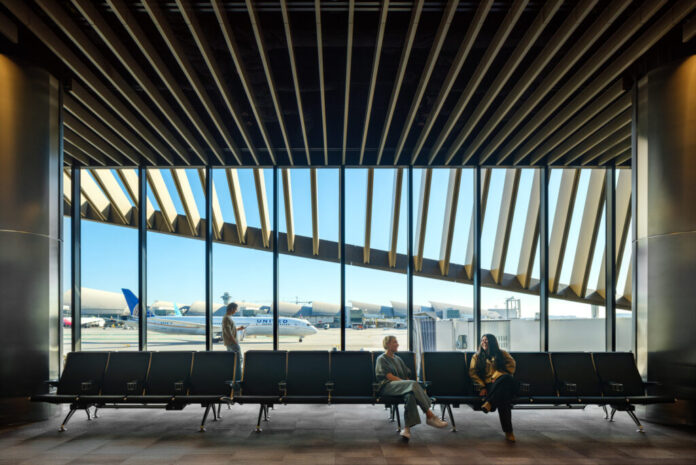
At Los Angeles International Airport, nine large sections of the Midfield Satellite Concourse South were constructed away from the active airfield and later transported 1.75 miles to their final position. The approach, known as Offsite Construction and Relocation (OCR), offered a radical answer to a familiar infrastructure challenge: how do you build major structures when the site cannot afford to stop operating?
Instead of turning the airfield into a conventional construction zone, the project shifted much of the work to a controlled offsite environment. Each structural segment was fabricated, fitted with architectural elements and coordinated with building services before being transported to the airport. This allowed complex work to progress away from aircraft movements, restricted work areas and the operational pressures of a live airport.
Getting these enormous modules into position required engineering precision at a completely different scale. Over 27 overnight operations, specialised self-propelled modular transporters moved the sections along a carefully planned route. Every movement had to be coordinated with airport operations, safety teams, utilities and regulatory authorities. The process was supported by extensive digital coordination, planning and rehearsals, with the preparation reportedly extending over 16 months.
The payoff was significant. By shifting work away from the airport and reducing the amount of construction required within the operational site, the OCR approach helped compress the programme by around seven months. More importantly, the modular strategy was developed with future adaptability in mind, allowing sections to be disassembled, relocated or modified rather than treated as permanent, immovable construction.
For infrastructure operating under constant time and space constraints, MSC South points towards a different construction equation: build where conditions are controlled, move when the site is ready, and assemble with precision. The real innovation is not simply that the terminal could be moved. It is that construction itself became less dependent on being where the building ultimately had to stand.