

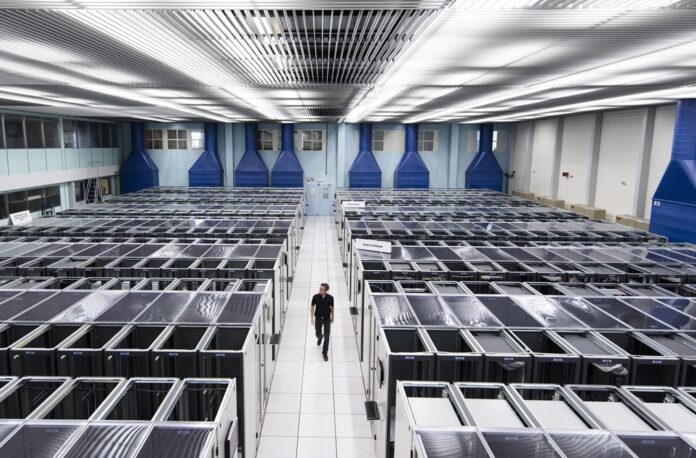
Data centres are often discussed through the lens of servers, cooling systems, and digital infrastructure. Yet beneath every hyperscale facility, AI-ready hall, and liquid-cooled compute environment lies a far more decisive enabler, steel. In this sharply observed and technically grounded article, Sandeep V. Dandekar explores how steel is no longer merely supporting the data centre industry but actively shaping its future. Drawing from decades of experience across technology infrastructure and hyperscale development, he examines the evolving role of advanced steel systems in enabling faster deployment, higher compute density, thermal resilience, and long-term operational efficiency in the age of AI-driven infrastructure.
Most people imagine a data centre incorrectly. Ask them to describe a modern hyperscale facility, and they will speak about blinking servers, humming CRAC units, fibre networks, and endless rows of racks. Rarely does anyone speak about steel. Yet steel, in its many evolved and increasingly intelligent forms, remains the structural backbone of every serious data centre ever built. From the early Netmagic rack rooms emerging around Mumbai in the 2000s to today’s AI factories rising across Navi Mumbai, Hyderabad, and Noida, steel has remained the one constant. Everything else has evolved around it.
Across more than 37 years in technology infrastructure, spanning the Y2K transition, the first generation of Indian colocation facilities, and now the current AI-led expansion cycle, one thing has become increasingly clear: steel is no longer merely a procurement item. It has evolved into a precision engineering discipline capable of determining whether a data centre project succeeds on time, on budget, and at the required performance benchmark.
The industry’s persistent failure to recognise this has already begun costing operators both time and money.
“Steel today is no longer simply the frame around digital infrastructure. Increasingly, it is becoming the infrastructure itself.”
WHY STEEL MATTERS MORE THAN EVER
India alone is projected to cross nearly 2,000 MW of commissioned data centre capacity by 2027, almost three times its 2023 installed base of roughly 700 MW. Every megawatt of capacity requires an estimated 400 to 700 metric tonnes of structural and fit-out steel. Extrapolate that across the global hyperscale and edge pipeline, and the industry is looking at a construction material supercycle that only a handful of steel analysts have begun fully accounting for.
But the larger disruption is not merely quantitative. It is fundamentally qualitative.
The role steel must now perform inside a modern data centre has been completely transformed by two parallel shifts: the AI-driven compute density revolution pushing rack loads from 8 kW to 80 kW and beyond, and the inevitable transition towards liquid cooling systems that follows. Together, these developments are driving steel specifications that would have appeared highly unconventional only a few years ago. Today, they are rapidly becoming baseline requirements across serious hyperscale developments.
SIX APPLICATIONS WHERE STEEL IS BEING REIMAGINED
- High-Strength Structural Steel (S460): When Specification Becomes Strategy
The transition from conventional mild steel grades such as S275 towards high-strength structural steel like S460 is no longer simply an engineering refinement. It has become a commercial and programme-level decision.
S460 enables column-free spans extending up to 18 metres within data halls, an increasingly critical requirement as liquid-cooled AI clusters demand uninterrupted overhead CDU manifold routing. The material also offers weight reductions of nearly 40 percent compared to S275, significantly reducing foundation loads while accelerating construction timelines.
On a 50 MW hyperscale facility, that difference can translate into a programme advantage of nearly three to four months alongside foundation savings estimated between ₹15 crore and ₹25 crore.
One NCR project review serves as a cautionary example. A developer had specified S275 across the primary frame, technically adequate in isolation. However, once the liquid cooling distribution network was mapped during fit-out, two intermediate columns directly conflicted with CDU header routing. The resulting redesign, involving relocated columns, revised foundations, and updated fire compartmentation drawings, ultimately delayed the project by nearly eleven weeks while adding approximately ₹6 crore in avoidable costs.
The problem was not the steel itself. The problem was coordination. Structural engineers had not been informed about future rack densities, while the MEP consultant had not been integrated into the structural brief early enough.
That siloed approach is becoming increasingly expensive.
Today, any primary frame specification relying solely on S275 for a modern hyperscale build raises immediate concerns, not because the material is inherently flawed, but because data centres are no longer conventional buildings.
- Pre-Engineered Steel Buildings (PEB): India’s Speed Imperative
Few innovations have accelerated data centre deployment across Tier-2 and Tier-3 India more significantly than the rise of pre-engineered steel buildings.
Factory-fabricated and site-assembled PEB systems can move from groundbreaking to white-space handover within 10 to 14 weeks, compared to 9 to 12 months for comparable RCC-based construction.
Concrete proponents correctly point out RCC’s advantages in areas such as acoustic damping, blast resistance, and fire compartmentation. Yet in a market where speed-to-power directly impacts revenue generation, and where hyperscalers increasingly penalise delays against SLA commitments, programme speed becomes commercially decisive.
On a greenfield hyperscale development review in Lilapur, Gujarat, an original RCC-based programme projected nearly 18 months for shell-and-core completion. A hybrid PEB strategy combining steel primary framing with precast concrete slabs reduced that timeline to nearly 11 months while generating estimated savings of approximately ₹40 crore on a 50 MW build.
Importantly, the seismic behaviour under IS 1893 conditions proved highly favourable. Unlike rigid RCC systems that resist and eventually crack under lateral loads, PEB structures dissipate seismic forces through controlled deformation, a particularly relevant advantage in regions such as Gujarat.
- Stainless Steel Secondary Fluid Networks (SFN): The Critical Next Frontier
As GPU rack densities continue moving beyond 50 kW, and platforms like NVIDIA Blackwell push beyond 120 kW per rack, air cooling has effectively reached its engineering ceiling.
Liquid cooling systems now require robust secondary fluid networks capable of circulating chilled water or dielectric fluid between facility plants and rack-level cooling systems. Within these environments, material selection becomes absolutely critical.
Carbon steel, particularly within glycol-water mixtures, introduces corrosion risks that release particulates capable of damaging pump seals and blocking cold plate microchannels, failures that can cost between ₹8 lakh and ₹12 lakh per rack.
SS-316L stainless steel has emerged as the preferred engineering solution. It eliminates contamination risks, supports operating temperatures up to 90°C at 16 bar pressure, and allows reliable coded welding without highly specialised certifications.
While SS-316L introduces a cost premium of roughly 35 to 50 percent over carbon steel, there is increasingly no viable alternative at scale.
India currently imports nearly 80 percent of these SS-SFN components. That dependency is unlikely to survive the next wave of hyperscale liquid cooling expansion.
- Galvanised Cable Tray Steel: Solving the EMI Challenge
Inside high-density AI environments, 400G and 800G optical interconnects frequently operate within inches of high-voltage PDU busbars. Under such proximity, electromagnetic interference becomes an operational risk rather than a theoretical concern.
Properly bonded and earthed galvanised steel cable trays provide passive EMI shielding capabilities that polymer trays simply cannot deliver.
Hot-dip galvanised steel also aligns effectively with long-term data centre depreciation cycles, offering nearly 25 years of corrosion resistance without mid-life replacement requirements. In contrast, polymer tray systems in humid coastal environments have, in several cases, required complete replacement within little more than a decade, a lifecycle cost rarely reflected in initial capital budgets.
- Cold-Formed Steel (CFS): The Quiet Workhorse of Data Centre Fit-Outs
Cold-formed steel sections have increasingly become standard across high-quality data centre fit-outs, particularly for internal partition systems, cable risers, and equipment support frameworks.
Compliant with NBC 2016 and NFPA 75, CFS systems are non-combustible, modular, and highly adaptable for future reconfiguration without requiring structural intervention.
While marginally more expensive than drywall or timber alternatives, operators who initially adopt CFS systems rarely revert back, particularly once future hall reconfiguration, meet-me room expansion, or cage realignment becomes necessary.
- Weathering Steel (COR-TEN): Addressing India’s Coastal Data Centre Challenge
Cities such as Chennai, Kochi, and Visakhapatnam are rapidly emerging as significant data centre hubs, but all three share aggressive coastal environments characterised by salt-laden humidity capable of severely degrading conventional painted steel within five to seven years.
COR-TEN steel addresses this challenge through its self-passivating oxide layer, eliminating repainting requirements over lifespans approaching four decades.
For generator canopies, equipment enclosures, and external façade systems, this is not simply a premium architectural choice. It is lifecycle cost optimisation.
Although the higher upfront cost often becomes difficult to justify within first-cost budget discussions, operators who adopted COR-TEN early have generally avoided the corrosion remediation cycles now affecting several conventional coastal installations.
THE MARKET NUMBERS: GLOBAL DC STEEL DEMAND
The data below draws on synthesis across JLL, CBRE, Cushman & Wakefield, and independent research developed for Wired Nation. Steel demand figures aggregate structural, fit-out, cable management, and mechanical steel across hyperscale, retail colo, and edge DC construction types.
Global Data Centre Steel Demand Forecast by Region, 2023–2030
| Market / Region | DC Steel Demand 2023 (MT) | Projected 2030 (MT) | CAGR | Primary Driver |
| India | 1.8 million | 6.2 million | 19.3% | Hyperscale + GDC policy push |
| GCC (UAE, KSA, Qatar) | 0.9 million | 3.1 million | 19.2% | AI cloud & national DC programs |
| Southeast Asia | 1.4 million | 4.4 million | 17.8% | Singapore overflow; Indonesia, Malaysia build-outs |
| USA | 4.6 million | 9.8 million | 11.4% | AI infrastructure arms race |
| Europe | 2.3 million | 4.6 million | 10.4% | Green DC mandates + liquid cooling retrofits |
| Global Total | ~11 million | ~28 million | 14.4% | AI, cloud, edge proliferation |
STEEL TYPES VS. DC APPLICATIONS: A PRACTITIONER’S MATRIX
The table maps each steel grade to its specific data centre function drawn from TDD reviews, project advisory briefs, and engineering specifications I have worked through over the past decade.
Steel Type vs. DC Application Matrix
| Steel Type | Primary DC Application | Key Performance Attribute | Cost Premium vs. Conventional |
| High-Strength Structural Steel (S460) | Main building frame, raised floor support grids | 40% weight reduction vs. S275; spans up to 18m without intermediate columns | +8–12% |
| Galvanised Cable Tray Steel | Power & fibre distribution across white space | Corrosion resistance: 25-yr lifecycle; supports EMI shielding | +5–7% |
| Stainless Steel (316L) | Secondary fluid networks (SFN) for liquid cooling CDUs | Zero particulate contamination; rated for 90°C fluid at 16 bar | +35–50% |
| Pre-Engineered Steel (PEB) | Modular data hall extensions; edge DC shells | Factory-built; deploy in 10–14 weeks vs. 9–12 months for RCC | –15–20% vs RCC |
| Weathering / COR-TEN Steel | Exterior facades, equipment enclosures in coastal/humid zones | Self-passivating oxide layer; eliminates painting over 40-yr lifespan | +10–15% |
| Cold-Formed Steel (CFS) | Internal partition walls, cable management risers | Non-combustible; modular reconfiguration without structural impact | +2–5% |
“The operator who understands steel controls programme, cost, and thermal performance together, not in isolation.”
PREDICTIONS: WHERE THE INDUSTRY IS HEADED
Having observed technology infrastructure cycles across India and the GCC for more than three decades, the steel-data centre intersection now appears to be entering a defining inflection point. Decisions taken over the next 18 to 24 months are likely to determine which developers lead and which struggle to catch up.
Steel Innovation Forecast for Data Centres
| Horizon | Innovation Theme | Steel Specification Implication | Sandeep’s Prediction |
| 2025–2027 | Liquid cooling goes mainstream (≥200 MW deployments) | SS-316L SFN adoption jumps; carbon steel CDU frames standardised | India will emerge as a stainless steel SFN manufacturing hub — driven by cost arbitrage and the ‘Make in India’ push. Expect 3–4 domestic SS-SFN OEMs to get funded by 2026. |
| 2027–2029 | AI factories at 40–100 MW per hall; ultra-dense GPU racks (80kW+) | Floor loading specs will leap from 12 kN/m² to 20+ kN/m²; reinforced steel raised-floor grids mandatory | Structural steel specifications for AI halls will be rewritten globally. India and GCC players who standardise early will gain a 2-year procurement lead over competitors. |
| 2029–2032 | Green & circular DC buildings; net-zero mandates | Green steel (EAF/H-DRI route), recycled content certified grades become tender mandatory | By 2031, at least 30% of DC steel procurement in Europe and 15% in India will require documented green-steel provenance — or tenders will be lost. This is not an aspiration; it is an inevitability. |
| 2032+ | Bio-integrated & smart buildings; AI-monitored structural health | Sensor-embedded steel (strain gauges, IoT nodes in structural columns) for real-time SHM | The boundary between structural steel and the building’s BMS will dissolve. Operators who treat steel as ‘dumb material’ today will face expensive retrofits in the next decade. |
THE GREEN STEEL RECKONING
Steel today contributes nearly 7 to 9 percent of global CO₂ emissions. Simultaneously, hyperscalers, institutional investors, and regulators are placing increasing pressure on data centre operators to demonstrate Scope 3 reductions across their construction supply chains. These two realities are now converging rapidly.
Green steel produced through renewable-powered electric arc furnaces or hydrogen-direct reduction pathways is already commercially available through producers such as SSAB and H2 Green Steel, while Indian manufacturers including JSW, Tata Steel, and SAIL continue progressing towards transition pathways of their own.
Whether Indian developers move fast enough voluntarily remains uncertain. At present, the commercial incentive alone may still appear insufficient. However, European hyperscaler procurement mandates are likely to force compliance much faster than many operators currently anticipate.
By 2028, it is increasingly likely that major Indian hyperscale developers will formally embed green-steel provenance requirements into standard construction contracts.
The operators establishing those supply-chain relationships today are effectively purchasing a competitive lead time that may not remain available later.
RESPECT THE FRAME
The earliest server rooms in Mumbai’s old commercial buildings were modest spaces, little more than raised floors, precision air-conditioning units, and optimism. The steel holding those rooms together remained largely invisible. Nobody specified it carefully because few believed it mattered. But it always mattered.
Today, when reviewing hyperscale projects involving investments worth hundreds of crores, the first technical parameter worth examining is often the steel specification itself. Not because steel exists in isolation, but because the quality of steel thinking almost always reflects the quality of the broader build programme.
Weak steel specifications rarely exist alone. They typically signal broader coordination failures across engineering, procurement, and execution. Conversely, projects that get the frame right usually get the rest right too.
The operators who specify carefully, procure early, and evaluate steel across its full lifecycle before the first column is erected are consistently the ones delivering quality assets, not merely on time and on budget, but at a performance standard capable of sustaining long-term client confidence.
Steel does not respond to boardroom optimism, programme pressure, or financial presentations. It responds through maintenance cycles, reconfiguration delays, corrosion surveys, and operational performance. It is always better to listen at the specification stage rather than at the remediation stage.
“Steel is patient. But it does not forgive careless specification.”
Contributed By:
Sandeep V. Dandekar,
Founder Director, Megha-Tantra Advisors
Author, Advisor, Mentor