

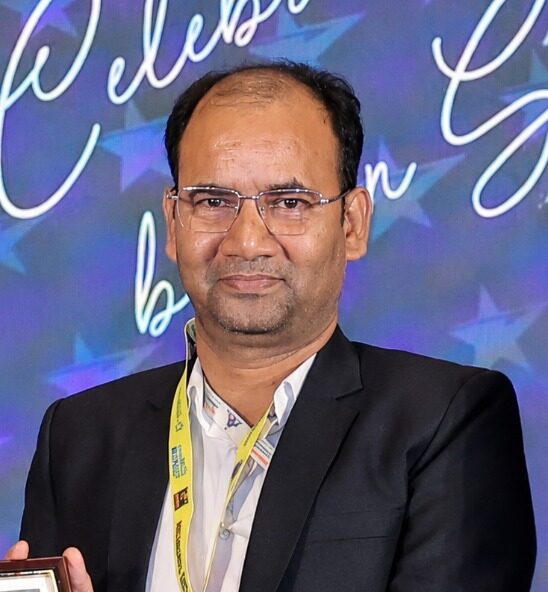
Your College: BIT Sindri, Jharkhand
Years of Experience: 19 Years
Your Inspiration: Delivering quality infrastructure that creates lasting value for society and continuously learning through challenging projects.
Your Mantra for Success: Hard work, consistency, and sincerity towards my job
You Want to be Remembered as: A dedicated professional who contributed honestly and effectively to nation-building through quality engineering works
Steel Projects You are Currently Working on: Execution and coordination of the terminal building project, at JPNI Airport, Patna.
Talking About Life’s Engineering Saga. ‘TALES’ is a segment that exclusively focuses on the top Project/Structural Consultants across the globe sharing their engineering journey in their own words.
In an in-depth conversation with SSMB, SARVESH KUMAR, AGM Civil at the Airports Authority of India, reflects on the making of one of Patna’s most ambitious infrastructure transformations, the Jai Prakash Narayan International Airport. Executed amidst uninterrupted flight operations, the challenges of a global pandemic, and a fifteenfold increase in passenger capacity, the project demanded exceptional coordination, resilience, and technical precision. Through this interview, Sarvesh offers an honest perspective on what it truly takes to modernise a live airport while keeping it fully operational.
As AGM Civil, what were your key responsibilities in the development of JPNI Airport?
My key responsibility was to coordinate among executing agencies, design consultants, and senior authorities to ensure smooth project execution. I reviewed drawings and designs, provided technical inputs, and facilitated timely incorporation of necessary corrections and modifications. A major aspect of my role was bridging the gap between consultant and agency, ensuring that the envisioned design and quality standards were effectively delivered at site.
What were the major civil engineering challenges encountered during the airport’s expansion, and how were they addressed?
The biggest challenge was executing a large-scale expansion while the airport remained fully operational. Flight operations, passenger movement, and airport services continued uninterrupted even as construction activities progressed simultaneously. This demanded parallel planning, phased execution, and constant coordination among all stakeholders to ensure safety and operational continuity.
The challenges became even greater during the COVID-19 period, when manpower and resource availability were severely constrained. Despite these limitations, construction activities continued without disrupting airport operations for a single day. More than the technical complexities, this phase tested our resilience, adaptability, and commitment, and through strong teamwork and coordinated planning, we were able to keep both construction and airport operations moving successfully
“The real challenge was not just constructing the terminal but doing so without disrupting a single day of airport operations.”
How did you ensure seamless coordination between AAI, contractors, and design consultants throughout the project?
Regular progress review meetings formed the backbone of project coordination. Representatives from AAI, contractors, consultants, and architects would come together to assess construction progress, identify emerging challenges, and collectively determine the next course of action.
Whenever critical issues or design modifications arose, they were escalated to higher authorities and the CHU team for approval. Once decisions were finalised, they were communicated back to the consultants and executing agencies for implementation. Many issues that could potentially have become major on-site problems were identified and resolved during these coordination discussions itself.
Which civil infrastructure improvements at JPNI Airport have had the most significant impact on passenger experience and operational efficiency?
Without question, the new terminal building has had the most significant impact. The earlier terminal handled approximately 0.7 million passengers annually within a built-up area of nearly 8,500 sq m. In contrast, the new terminal has been designed to accommodate around 10 million passengers per annum across approximately 65,150 sq m.
This is not merely an expansion in size, but a complete transformation in terms of space planning, passenger circulation, and overall user experience. The addition of expanded check-in infrastructure, elevated roads, and upgraded bridges has further enhanced operational efficiency and passenger convenience.
“The new terminal is not merely a larger building, it represents a complete transformation in passenger experience and operational capability.”
How were sustainability and long-term durability integrated into the airport’s civil works?
Sustainability and long-term durability were integrated from the design stage itself, with the objective of developing a green-rated airport. The civil works incorporated high-performance, high-strength glass, durable construction materials, and efficient wall block systems to enhance structural performance, energy efficiency, and longevity.
Water harvesting systems were included as part of the infrastructure, and green spaces were thoughtfully developed within the available areas to improve the overall environment. Generous ceiling heights and passenger-friendly design features were also adopted to enhance comfort and operational efficiency.
What quality control and site management practices were implemented to meet AAI standards?
A dedicated quality control team was engaged for this project. Every material and construction activity were tested strictly in accordance with the frequencies prescribed under CPWD and IS standards, and those benchmarks were consistently maintained throughout execution.
Third-party testing was conducted wherever required, and specialised materials such as structural steel underwent appropriate testing procedures to ensure compliance and reliability. Given the nature of airport infrastructure, there was absolutely no scope for compromise in quality or execution standards.
What key learnings from the JPNI Airport project would you carry forward into future airport modernisation initiatives?
Two key learnings stand out for me from the JPNI Airport project. The first is the importance of thoroughly finalising designs, drawings, and specifications before the start of construction. During execution at Patna, several revisions and design changes had to be incorporated, which added complexity and impacted construction planning and coordination.
The second major learning is that construction at an operational airport is best executed in phases wherever feasible. Working continuously within a live airport environment significantly increases operational and logistical challenges. A phased approach allows construction to be managed more efficiently while minimising disruption to airport operations and passenger services.
“In airport infrastructure, there is absolutely no room for compromise when it comes to quality and execution.”