


Introduction: In an in-depth interview, SOMNATH NANDAN, CEng FICE (UK), Senior Vice President, Engineering at Kalpataru Projects International Limited, reflects on a career that has taken him from pedestrian bridges in Kolkata to the Mumbai Trans Harbour Link, and from motorway bridges in the United Kingdom to metro rail networks across India’s fastest-growing cities. With seventeen years of advanced structural and geotechnical design experience, followed by over a decade of engineering leadership, Somnath brings to SSMB a rare combination of deep technical rigour and strategic vision, along with a strong belief that the industry must address both the shortage of skilled engineering talent and the growing overdependence on software, often accompanied by an inability to validate analysis results due to weak engineering fundamentals.
You began your career at K Raheja Universal, moved to Omkar Realtors, and eventually returned to the Raheja group through Chalet Hotels. Did that return feel like coming home, or had enough changed that it felt like joining somewhere new?
It was my time in the UK that shaped me the most. It gave me an excellent opportunity to learn from developed countries that are far ahead of us in infrastructure engineering and execution, and to bring that knowledge back to India. Those seven years were a period of genuine learning and growth, not just professional progression. When I returned, I was able to apply what I had learned to the scale of infrastructure India was beginning to build. The timing turned out to be right. The country had major projects coming up, and I had the experience to contribute to them in a way I could not have before.
Having designed motorway and railway bridges in the UK and Canada, how do design and construction practices there differ from India, and what could India adopt?
Developed countries tend to build proper due diligence into every stage of a project. There is a well-defined system, process, and review cycle that is followed with a high degree of discipline. In India, we often work at a pace that requires many activities to run in parallel, and while that helps deliver projects quickly, it can sometimes come at a cost. If projects went through more thorough due diligence upfront, the outcomes could be even better in terms of planning, design, safety, and execution quality. If there is one lesson I would like India’s infrastructure sector to adopt, it is the importance of giving due diligence the same priority as delivery speed.
Drawing on your experience as a structural engineer and as the head of an Engineering Centre of Excellence in the EPC industry, what do you see as the biggest challenges facing India’s infrastructure sector today?
There are two distinct challenges, and they sit at different levels. At the infrastructure level, I think we are trying to do too many things at once and often in too much of a hurry. We have multiple large construction projects either completed or running simultaneously, yet they do not always solve the problems they were intended to address. That points to gaps in master planning. Equally important is giving adequate time and due diligence to design and construction methods before breaking ground.
The second challenge is people. Infrastructure is a highly skilled profession, and genuinely trained engineers and workers are in short supply. That scarcity is a constraint that no amount of ambition or investment can easily overcome. Both issues need to be addressed seriously and systematically if we want better outcomes.
Where do you see steel and steel-concrete composite structures growing fastest in Indian infrastructure, and what is holding adoption back?
What holds adoption back is a combination of cost perception and awareness. The belief that steel is always expensive is widespread, but it is not entirely accurate. Material cost alone is not the right measure. When factors such as project duration, durability, sustainability, and site overheads for labour, formwork, and logistics are considered, steel is often the better solution. As India continues to develop, labour costs will rise and time will become even more valuable, making steel a more compelling option. There is also a need for greater awareness across the construction industry. Forums such as Steel Expo, where professionals come together to share case studies and experiences, play an important role. That is how awareness is built in our industry, through exposure, evidence, and informed discussion among practitioners.
“The belief that steel is always expensive is widespread, but it is not entirely accurate.”
You are currently working on many steel-intensive projects. Looking across your career, is there one steel project that stands out as particularly special to you, and why?
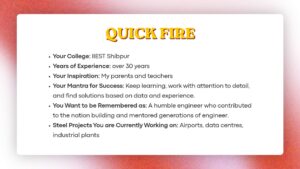
I am presently involved in data centres, airports, and industrial plants, which are among my favourites because of the challenges we overcome, the timely delivery we achieve, and how well they serve their purpose. But if I had to pick the most special project from my career, it would be the steel section of the Mumbai Trans Harbour Link. It is one of the most iconic infrastructure projects in India, involving thousands of tonnes of steel procured from multiple countries including India, fabricated, shipped, transported over the sea, and erected to create a structure of that scale and significance. What made it special was not just its complexity, but what it demonstrated: that Indian engineers are fully capable of delivering world-class steel infrastructure. That proof matters because it raises the bar for what we believe we can achieve as a profession.
You have cautioned that software can make a poor engineer dangerous. How should young engineers build their fundamentals, and how do you ensure that software and AI outputs are properly validated?
This is something I feel strongly about. Young engineers are becoming increasingly dependent on software tools and, now, AI. The basic problem with software is simple: if your input is wrong, your output will be wrong. An engineer must be able to validate the output and make corrections where required. With AI, the situation is a little different. These tools can reason and produce answers that sound credible, which makes validation even more important.
You cannot simply assume that an AI-generated answer is correct. You need a proper validation process, and that requires engineers with strong fundamentals who can independently check what the software or AI is producing. I have interacted with many structural engineers, many of them with post-graduation, and I often find gaps in their understanding of the basics. Some struggle to draw simple bending moment or shear force diagrams, explain why codes prescribe certain formulas, or validate software outputs. That is a worrying trend, and it is something our profession needs to address, starting at the university level.
What advice would you give young structural engineers, and if you could change one thing in India’s construction ecosystem to encourage steel, what would it be?
Ours is a vast and genuinely exciting profession. It covers suspension bridges spanning over a kilometre, long-span airport roofs, tall buildings, data centres, offshore structures, industrial plants, metros, tunnels, high-speed rail, cable-stayed bridges, ports, dams, underground stations and many more. Every structure behaves differently and presents its own engineering challenges. The stronger your fundamentals, the better equipped you will be to understand, innovate, and make sound engineering decisions throughout your career. Dare to explore beyond your comfort zone. Master hand sketches, free-body diagrams, and independent calculations. Be the kind of engineer who can feel how a structure behaves, not just model it. As for the ecosystem, steel education in universities needs to be strengthened significantly. I am associated with several institutions, and the steel design component is simply not given the emphasis it deserves. If steel is to see wider adoption in Indian construction, it has to start in the classroom.
“The basic problem with software is simple: if your input is wrong, your output will be wrong. An engineer must be able to validate the output…..”