

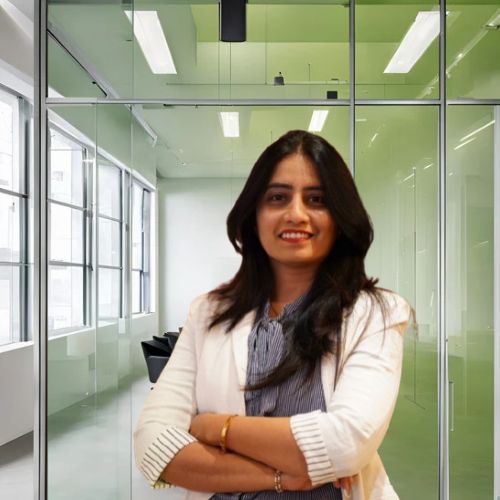
For Architect Reshma Shah, Director, Aarsh Design Studio, architecture is a responsibility before it is an art, one that balances creativity, function, and sustainability across residences, institutions, industrial facilities, and government projects. In conversation with SSMB for the Womentecture segment, she reflects on her early mentor, her design philosophy, the lessons of a multi-location project for Senegal, and what leadership means to her.
Every architect has a defining moment that sets their creative course. What was that moment for you?
For me, architecture was never just about designing buildings, it was about understanding people, their aspirations, and the way spaces influence their lives. Over time I realised that the real beauty of architecture lies in balancing creativity, practicality, and functionality while creating spaces that are aesthetically appealing and meaningful to the people who use them.
The moment I began looking beyond the appearance of a building and started thinking about how it would function, feel, and evolve with time, my approach to architecture became clearer. Today, whether I am designing a residence, an institution, an industrial facility, or a large government project, I see architecture as a responsibility, to create spaces that are purposeful, efficient, sustainable, and aesthetically pleasing.
You began your journey with an internship under Architect Girish Doshi, and you recently hosted him at your studio after nearly 22 years. What did that early mentorship teach you, and how does it still shape your work?
My internship under Architect Girish Doshi was an important part of my formative years. It gave me an early understanding that architecture is not merely an exercise in creating forms; it requires observation, sensitivity, discipline, and a deep understanding of the context in which we design. One of the most valuable lessons I carry forward is the importance of thoughtful design, understanding why something is being designed in a particular way rather than following a trend or creating an element simply for visual impact. Hosting him at my studio after nearly 22 years was a deeply meaningful experience. It brought back memories of the beginning of my professional journey and gave me an opportunity to reflect on how far I have come.
Your early training exposed you to energy-conscious architecture. How has that influenced the way you design today?
Energy-conscious architecture has influenced the way I think about a building from the very beginning of the design process. I believe sustainability should not be an additional feature introduced after the design is complete; it should be an integral part of the design itself. Orientation, daylight, natural ventilation, shading, material selection, and the relationship between a building and its surroundings can significantly influence its performance. These decisions can reduce dependence on artificial lighting and mechanical cooling while creating more comfortable spaces.
My approach is particularly conscious of the local climate and the practical realities of a project. A solution that works in one geographical or climatic context may not be appropriate in another.
“The architecture should respond to its purpose rather than forcing the purpose to fit the architecture.”
You have worked across residential, commercial, institutional, industrial, and government projects. How does your approach change from one typology to another?
The design language may change from one project to another, but my fundamental approach remains the same: understand the purpose, identify the challenges, and develop the most appropriate solution.
In residential architecture, the focus is on the people who will inhabit the space, their lifestyle, privacy, comfort, and emotional connection with their home. Industrial architecture brings a different set of priorities. Workflow, operational efficiency, structural systems, safety, future expansion, and construction timelines become especially important.
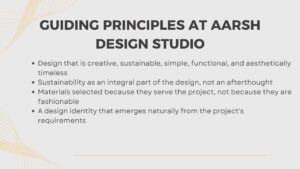
I do not believe in applying one signature style to every project. Instead, I believe in developing a design identity that emerges naturally from the project’s requirements. The architecture should respond to its purpose rather than forcing the purpose to fit the architecture.
What defines the design philosophy of Aarsh Design Studio?
At Aarsh Design Studio, our philosophy is rooted in the belief that good design should be creative, sustainable, simple, functional, and aesthetically timeless. I believe simplicity is not the absence of design; it is the result of thoughtful design. When a space functions beautifully, responds to its users, and communicates its character without unnecessary complexity, it achieves a certain elegance. Ultimately, we are not simply designing buildings. We are creating environments that support people’s lives, activities, ambitions, and experiences.
“I believe simplicity is not the absence of design; it is the result of thoughtful design.”
How do you approach material selection, and what role does steel play in your projects?
Material selection is a combination of design intent, technical performance, local context, cost, availability, maintenance, and durability. I believe a material should be selected because it serves the project, not merely because it is fashionable. Steel is particularly valuable in projects where speed of construction, structural efficiency, flexibility, and longer spans are important considerations.
It can be especially useful in industrial facilities, workshops, and large institutional buildings where functional requirements and tight timelines influence the structural design. However, I do not believe in favouring one material universally. Steel, reinforced concrete, masonry, and other systems each have their appropriate applications. The decision must emerge from a holistic evaluation of the project.
How do you integrate sustainability into your design process, and what has your association with the Indian Green Building Council taught you?
My approach to sustainability begins with asking a simple question: how can this building perform better throughout its life?
Sustainability is much broader than adding solar panels or incorporating a few green features. It involves making informed decisions at every stage, from site planning and building orientation to material selection, energy consumption, water management, construction methods, and long-term maintenance. My association with the Indian Green Building Council has reinforced the importance of approaching sustainability systematically rather than treating it as an isolated design feature. It encourages us to think about measurable performance, resource efficiency, and the broader environmental impact of the built environment.
Tell us about one project that challenged you the most and what it taught you.
Large-scale, multi-location projects are among the most challenging because they require us to coordinate design quality, functionality, technical requirements, budgets, and construction schedules simultaneously. One such significant undertaking has been our involvement in vocational training centre projects for Senegal, involving multiple locations and diverse training requirements. These centres needed to accommodate classrooms, administrative facilities, specialised workshops, and supporting functions, each with its own operational needs.
The scale of the assignment and the time constraints made it essential to think beyond conventional building solutions. The use of steel and pre-engineered building systems for appropriate components became an important consideration in addressing construction timelines, while the overall planning had to remain responsive to the different functional requirements. The experience reinforced an important lesson for me: creativity in architecture is not limited to the freedom to design; it is also the ability to find intelligent solutions within constraints.
“Creativity in architecture is not limited to the freedom to design; it is also the ability to find intelligent solutions within constraints.”
You have been practising for close to two decades across both metro and non-metro cities. What are the opportunities and challenges of building a practice in such varied markets?
Practising across metropolitan and non-metropolitan markets has given me an appreciation for the diversity of India’s built environment. Every location has its own aspirations, resources, construction practices, climatic conditions, and economic realities. Metropolitan markets may offer greater exposure to new technologies, specialised consultants, emerging materials, and evolving design trends. At the same time, they often come with intense competition, higher costs, and complex project expectations. Non-metropolitan markets present a different set of opportunities.
There is considerable potential to introduce better planning, contemporary design thinking, sustainable construction practices, and more efficient building systems. However, we must also be sensitive to local material availability, skilled labour, construction capabilities, and budgets. The challenge is to maintain design quality while adapting to practical constraints. The opportunity is to demonstrate that good architecture is not exclusive to large cities or expensive projects.
As a woman leading a practice, what challenges have shaped your journey, and how would you describe your leadership style?
Building an architectural practice is a journey of continuous responsibility. The challenges are not limited to designing buildings; they include understanding clients, managing teams, coordinating consultants, meeting deadlines, working within budgets, and ensuring that an idea can be translated successfully into a built reality.
As a woman leading a practice, I have also come to value the importance of self-belief, professional independence, and consistency. Credibility is built over time through the quality of your work, the commitments you honour, and the relationships you nurture.
My leadership style is collaborative but purposeful. I believe in listening to ideas, encouraging people to take ownership, and creating an environment where the team can contribute creatively while remaining accountable for the outcome. Architecture is rarely the achievement of one individual; it is the result of many people working together towards a common vision.
You were recently felicitated by the Lions Club Nagpur for your work under a women’s empowerment initiative. What did that recognition mean to you?
The recognition was deeply encouraging because it acknowledged not only professional achievement but also the larger idea of women creating opportunities, taking responsibility, and contributing meaningfully to society.
As a woman architect, I believe empowerment is closely connected to the freedom to make decisions, pursue one’s ambitions, develop financial independence, and build confidence through one’s work.
For me, empowerment is not just about being given a place at the table. It is about developing the confidence and competence to contribute, lead, and help shape the table itself.
“For me, empowerment is not just about being given a place at the table.”
What advice would you offer young women architects entering the field today?
My advice would be to develop a strong foundation, remain curious, and never underestimate the value of practical experience. Architecture is a profession in which ideas must eventually translate into reality. Learn to design well, but also understand drawings, construction, materials, services, coordination, budgets, and site execution. Spend time on sites, ask questions, observe how buildings are made, and learn from both successes and mistakes. For women entering the profession, confidence and persistence are especially important.
There will be moments when you must establish your credibility, take difficult decisions, and stand by your professional judgment. Build that confidence through knowledge, integrity, and consistency. Most importantly, do not feel compelled to choose between creativity and responsibility. Learn to balance your passion with the realities of practice, and remember that every project, irrespective of its scale or budget, is an opportunity to do meaningful work.
If you could sum up your approach to design in one line, what would it be?
Design with creativity, build with responsibility, and create spaces where simplicity, functionality, sustainability, and beauty exist in harmony.
WHY IT MATTERS
Reshma Shah’s practice reflects an approach where architecture is judged by how well it serves people, performs over time, and responds to its context. Working across residential, institutional, industrial, and government projects in both metropolitan and non-metropolitan markets, she makes a case for simplicity over spectacle and for sustainability that is practical rather than cosmetic. Her view that materials, including steel, must be chosen for what the project needs offers a useful lens for the profession. Her emphasis on site experience, coordination, and confidence is a roadmap for young architects, especially women entering the field.