


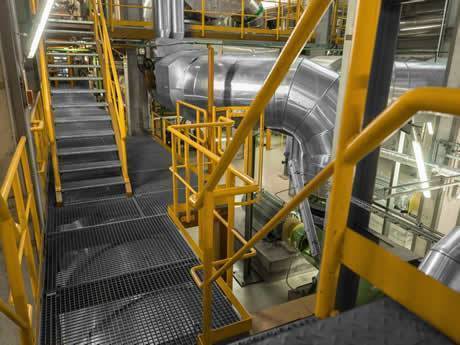
How steel gratings are quietly powering India’s industrial construction revolution…
BENEATH EVERY FACILITY
When engineers discuss industrial construction, the conversation naturally gravitates toward structural steel, cranes, pre-engineered buildings, roofing systems, and process equipment. Yet beneath almost every refinery walkway, battery plant platform, metro maintenance bay, airport service tunnel, and hyperscale data centre lies a component that rarely receives the same attention, and without which none of these facilities could function.
Steel gratings have moved well beyond their old identity as simple industrial flooring. They are now engineered safety systems that support maintenance personnel, enable ventilation, improve drainage, reduce dead loads, simplify upkeep, and enhance fire performance, quietly doing the work that keeps some of India’s most demanding facilities running.
A MARKET THAT HAS OUTGROWN THE REFINERY
India is currently investing across an unusually wide spread of sectors: data centres, semiconductor facilities, electric vehicle manufacturing, battery gigafactories, metro rail, airports, oil and gas, LNG terminals, chemical plants, pharmaceutical facilities, food processing, renewable energy, and warehousing and logistics. Each of these facilities requires thousands of square metres of steel gratings, and the demand is no longer confined to the refineries and process plants that once defined the product’s market.
NOT JUST A FLOOR ANYMORE
Engineers favour steel gratings for reasons that go beyond cost. Open mesh flooring improves anti-slip performance, keeps sightlines clear, prevents water from pooling underfoot, and doubles as an escape route in a fire. The same open structure improves ventilation, supporting air circulation, equipment cooling, smoke extraction, and natural lighting, particularly valuable inside data centres and enclosed industrial plants. And because gratings carry so much less weight than solid flooring, they ease the load on everything beneath them: secondary beams, primary frames, columns, and foundations.
THE WEIGHT PROBLEM
Jigar Shah, Director, Divya Consultants has watched this shift first-hand. “Steel grating has evolved from a largely commoditised flooring product into a structurally engineered interface between the primary framing system, MEP services, process equipment, and operational requirements of modern industrial facilities,” he says. Its specification, he adds, “can no longer be based solely on catalogue load tables; it requires an integrated assessment of strength, serviceability, durability, constructability, and safety.”
The numbers make the case for lighter flooring on their own. Heavy-duty steel grating typically imposes a dead load of 40-50 kg per sq m, Shah notes, against a dead load that can exceed 250 kg per sq m for conventional concrete flooring, depending on thickness and finishes. That reduction in permanent load, he explains, “directly influences the design of supporting secondary beams, primary frames, columns and foundations,” particularly on large industrial structures.
But the loads gratings are asked to carry have grown more complicated. Conventional platforms were designed mainly for uniformly distributed pedestrian and maintenance loads, in the order of 5 kN per sq m. Modern automated plants introduce concentrated wheel loads, maintenance trolleys, pallet movement, and Automated Guided Vehicles, all of which, Shah says, “can govern bearing-bar selection, panel configuration and local support detailing.” Grating design, as a result, now has to satisfy both Ultimate Limit State strength and Serviceability Limit State criteria, including bending, shear, local effects, and deflection, rather than relying on generic catalogue values.
ENGINEERING FOR THE SECTOR
Grating performance requirements, Shah points out, increasingly vary by industry. In data centres, lightweight, high-open-area grating systems support airflow and cooling strategies while still carrying rolling equipment and maintenance loads. Semiconductor facilities are a different problem altogether: cleanroom environments, he says, “may require stainless steel or suitably treated aluminium systems where conventional galvanised products are incompatible with contamination-control requirements.” In battery and chemical facilities, grating often forms part of the ventilation and hazardous-area infrastructure, which means open-area ratio, corrosion resistance, fire performance, and potential gas-release scenarios all have to be weighed together rather than considered separately.
AND THE SECTORS JUST ARRIVING
Other sectors are only beginning to generate their own grating specifications. In EV manufacturing, gratings show up around battery assembly lines, on paint shop platforms, and inside utility tunnels carrying services beneath the plant floor. Metro rail projects use them for station drainage, maintenance platforms, cable trenches, and ventilation systems, applications that barely existed for the Indian grating industry a decade ago. Hydrogen projects bring a different demand altogether: explosion-safe flooring, robust ventilation, and chemical resistance, given the nature of what is being stored and moved through these facilities.
THE MATERIAL AND THE COATING
Material choice sits behind most of these decisions. Mild steel remains the most economical option for general industrial use, while galvanised steel adds a layer of corrosion resistance that suits most outdoor and process environments. Stainless steel and aluminium, though costlier, become necessary wherever contamination control, extreme corrosion, or weight sensitivity rule out conventional coatings.
Hot-dip galvanising, in particular, has become close to a default specification for gratings exposed to coastal air, refinery atmospheres, chemical plants, ports, and airports, where untreated or painted steel would corrode within a few years. The choice ultimately comes down to a trade-off between upfront cost, lifecycle cost, maintenance frequency, and load capacity, a calculation that looks different for a warehouse than it does for an LNG terminal.
COORDINATED BEFORE IT IS CUT
A significant proportion of historical grating problems, in Shah’s experience, originated not from structural inadequacy but from late-stage coordination failures. “Unplanned MEP penetrations and site modifications frequently resulted in cutting bearing bars, compromising load paths, protective coatings and durability,” he says.
Building Information Modelling has begun to close that gap. Modern BIM-based coordination brings grating panels, support steel, MEP services, and process equipment into a common digital environment, resolving openings, penetrations, edge bands, removable panels, and support conditions before fabrication, with the approved geometry passed directly to CNC-controlled manufacturing. As Shah puts it, the underlying philosophy has shifted “from cut to fit on site, to coordinate, fabricate and install to design.” The same coordination increasingly extends to laser cutting, robotic welding, integrated kick plates, and stair treads, options that would once have needed a custom order are now closer to standard scope for a competent fabricator.
Standardisation plays a similar role. Designing support framing around commonly available grating panel dimensions, Shah notes, can substantially reduce the number of unique panels required, simplify procurement, minimise fabrication waste, and speed up erection, gains that add up well before a single panel reaches site.
BUILDING FOR THE LONG RUN
Steel gratings also make a quieter case for themselves on sustainability grounds. Steel is fully recyclable at the end of a structure’s life, gratings themselves have long service lives with minimal maintenance, and their use in place of solid concrete flooring reduces overall concrete consumption on a project, along with the embodied carbon that comes with it. For facilities designed around circular economy principles, a grating system that can be unbolted, reused, or recycled rather than demolished is not a minor detail, it is increasingly part of the specification itself.
WHERE THE SYSTEM STILL SLIPS
For all its advantages, the grating industry in India has not caught up with its own growth. Low-cost imports continue to undercut domestic manufacturers on price, often at the expense of consistent galvanising quality. Awareness at the design stage remains patchy, gratings are still specified late, procurement decisions are frequently made on price alone rather than lifecycle performance, and engineering approvals for project-specific detailing can lag behind construction schedules. Standardisation across the industry is still inadequate, and installation practices on site do not always match what was specified on paper, gaps that a fast-growing, technically demanding market can increasingly less afford to ignore.
WHAT COMES NEXT
The next phase of the industry looks considerably more digital. AI-assisted fabrication, robotic welding, and BIM-integrated detailing are beginning to move from pilot projects to standard practice, while smart asset tracking and corrosion monitoring promise to extend the working life of installed systems well beyond what periodic inspection alone can achieve. Prefabricated, modular access systems are also gaining ground, shrinking site installation time on projects where schedules leave little room for error.
THE SSMB TAKE
Steel gratings will likely never get the recognition given to a soaring roof truss or a dramatic cantilever. Once installed, most of them disappear from view entirely, buried under equipment, walk over without a second thought, and are only noticed when something goes wrong. But Shah’s account of where the industry is headed, engineered to load paths rather than catalogue tables, coordinated in a digital model before a single panel is cut, and increasingly judged on lifecycle performance rather than upfront price, suggests a product that has quietly outgrown its old reputation as a commodity. India’s next generation of data centres, battery plants, and hydrogen facilities will be built on steel skeletons that get all the attention. Underneath them, doing no less important a job, will be a floor that nobody photographs either.