

Why India’s factories need crane health management, not just new cranes
Introduction: Inside a manufacturing plant, movement is as important as production. Steel coils arrive at the shop floor. Heavy dies are positioned on machines. Fabricated structures are shifted between workstations. Finished components are lifted, transported and dispatched. Behind much of this seemingly routine activity is a machine that rarely commands attention: the industrial crane.
It lifts, moves, positions and lowers loads, often performing hundreds of operations over the course of a working day. Its contribution to production is fundamental, yet its importance is frequently acknowledged only when something goes wrong. A crane that has been operating reliably for years can suddenly bring an entire production process to a standstill. What follows is a familiar chain of consequences including delayed operations, disrupted schedules, emergency repairs and mounting costs.
This raises an important question for industrial operators: are cranes being managed as critical production assets, or are they simply being maintained as equipment that needs to work?
As India’s manufacturing ecosystem becomes increasingly automated, connected and productivity-driven, the answer is acquiring greater significance. The conversation around material handling is gradually moving beyond lifting capacity and installation costs towards equipment reliability, operational safety, maintenance discipline and lifecycle performance.
The real opportunity may not always lie in installing a new crane. Sometimes, it lies in giving an existing one a second life.
WHEN THE CRANE STOPS, EVERYTHING NOTICES
Industrial cranes are designed to perform demanding lifting operations, but their long-term reliability depends on much more than their original engineering specifications. The conditions in which they operate, the quality of maintenance they receive and the way they are used all influence their performance over time.
One of the recurring challenges faced by industrial operators is the tendency to treat maintenance as a response to failure rather than a continuous operational responsibility.
According to Muhil Service, companies commonly overlook three important aspects after installing a crane: routine preventive maintenance, proper alignment of runway rails and the deployment of trained operators. Individually, these may appear to be manageable operational considerations. Collectively, however, they can have a significant bearing on equipment reliability and safe operation.
A crane is a mechanical and electrical system in which several components must work in coordination. Braking systems, wire ropes, hoists, motors, electrical controls and structural elements all contribute to its performance. Wear, deterioration, misalignment or electrical faults can gradually affect the system’s ability to operate as intended.
The challenge is that not every developing problem announces itself through an immediate breakdown. Some issues emerge gradually, making regular inspection and timely intervention essential.
Operational practices matter just as much. An inadequately trained operator, inconsistent inspection routines or delayed attention to abnormal equipment behaviour can increase operational risks. In environments where cranes are integral to production, even seemingly minor oversights can have wider consequences.
India’s material handling industry has undergone a considerable transition over the past decade. Operations that were once heavily dependent on manual labour are increasingly adopting smarter, automated and more sustainable systems. This evolution has raised expectations from lifting equipment. Reliability, safety and operational continuity are no longer desirable additions; they are becoming essential considerations.
“The question, therefore, is not simply how much a crane can lift, but how consistently and safely it can perform throughout its working life.”
THE INTELLIGENCE BEHIND EVERY LIFT
The modern crane is steadily evolving from a conventional lifting machine into a more connected and intelligent piece of industrial infrastructure.
Automation, remote operation, improved braking systems and smart connectivity are changing how lifting activities are managed. These technologies are helping industries address some of the persistent challenges associated with conventional crane operations, particularly operator safety, precision and the management of repetitive lifting tasks.
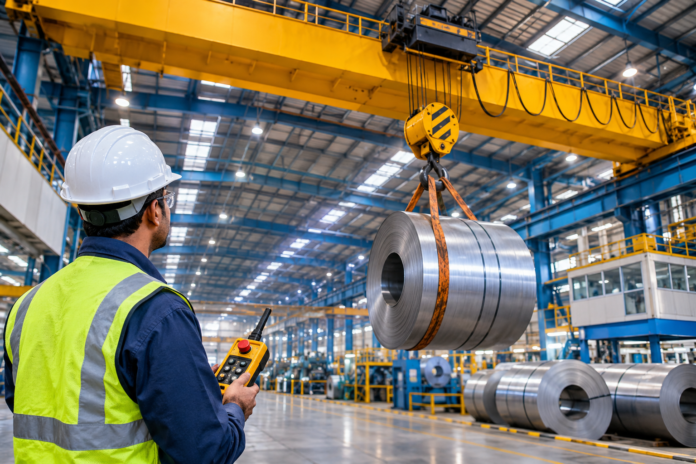
Remote-control systems, for instance, can allow operators to control crane movements without remaining physically close to the equipment. This can help improve visibility of the lifting operation and reduce the need to position personnel in potentially hazardous areas.
Similarly, modern braking systems play an important role in controlling crane movement and ensuring that loads can be handled with greater precision. Automation and safety-related controls can further reduce dependence on manual intervention during specific operations.
The underlying objective is straightforward: minimise avoidable human error, improve response times and create safer working conditions.
Muhil Service identifies advanced automation, smart connectivity and sustainable power systems as some of the technologies redefining material handling. The growing relevance of these developments reflects a larger change in industrial thinking. Equipment is increasingly expected to do more than perform its basic mechanical function. It must also contribute to efficiency, safety and better operational management.
An equally important development is the growing interest in predictive maintenance.
Traditionally, maintenance strategies have broadly followed two approaches. Preventive maintenance involves scheduled inspections and servicing to address wear and potential problems before they result in equipment failure. Reactive maintenance, on the other hand, begins after a fault has occurred.
Predictive maintenance introduces another dimension. By using available equipment data and condition-monitoring approaches, it seeks to identify indications of deterioration and potential failures before they interrupt operations.
Its value lies in the possibility of making maintenance decisions based on equipment condition rather than relying exclusively on fixed schedules or waiting for something to break down.
Muhil views predictive maintenance as an increasingly mainstream requirement rather than a technology reserved for a limited number of high-stakes industries. This changing perception is significant for crane owners, particularly those operating equipment that directly influences production schedules.
However, technology alone cannot guarantee reliability. Monitoring systems are useful only when their information is interpreted correctly and followed by appropriate maintenance action.
The combination of intelligent systems, experienced technicians and disciplined maintenance practices remains central to effective crane management.
REPAIR, RETROFIT OR REPLACE
When an industrial crane begins showing signs of ageing, replacement is not necessarily the only answer.
For plant owners, the decision to repair, modernise or replace equipment involves several considerations, including the nature of the fault, the condition of existing components, operational requirements, safety expectations and the economics of continued use.
A crane may have considerable useful life remaining even when certain components or control systems require attention. In such situations, targeted repairs or upgrades can offer an alternative to replacing the entire installation.
Modernisation can involve several interventions depending on the equipment’s condition and the specific operational requirement. These may include replacing worn components, upgrading electrical systems, improving braking arrangements, refurbishing hoists, replacing rope guides or converting conventional controls to wireless remote operation.
The objective is not to modernise equipment for the sake of introducing new technology. It is to identify where intervention can improve reliability, safety or operational suitability.
Muhil Service highlights the economic advantages of modernising existing cranes, particularly the potential to lower costs, reduce downtime and extend equipment life.
This is an important consideration for industries operating established material handling installations. A complete replacement may involve more than the cost of new equipment. It can also entail planning, installation, commissioning and disruption to existing operations. Where the existing crane structure and major systems remain suitable, selective modernisation may provide a more practical route.
That does not mean every ageing crane should be retained indefinitely. Equipment condition, safety requirements and the feasibility of upgrades must determine the decision. Where the underlying installation is no longer fit for purpose, replacement may be the more appropriate course.
The distinction lies in making an informed engineering assessment rather than treating replacement as the automatic response to ageing.
For crane owners, the larger shift is towards thinking in terms of lifecycle management. A crane’s working life does not necessarily end when its original components begin to deteriorate. With appropriate inspections, preventive maintenance, timely repairs and carefully selected upgrades, its useful service life may be extended.
Preventive maintenance is particularly important in this context. Muhil considers it vital for protecting high-value assets and ensuring safety, while reactive repairs are better suited to lower-cost, non-critical items.
“Maintenance expenditure should be viewed against the potential consequences of equipment failure, rather than treated merely as an avoidable operating cost.”
WHEN ENGINEERING EXPERIENCE MAKES THE DIFFERENCE
Technology, replacement components and diagnostic tools are important elements of crane maintenance. But when a complex system develops a fault, the experience of the service engineer can become the decisive factor.
An incident involving a Demag DR-based tandem hoist system illustrates this point. According to Muhil Service, the team encountered a challenging breakdown in which one of the hoists stopped functioning after its hoist card had been replaced. The system operated on CANbus controls, and the problem proved difficult to resolve through conventional troubleshooting attempts.
The complexity was further compounded by an EPROM-related issue in one of the hoists. Identifying the underlying fault required specialised diagnostic intervention. The team eventually used IDAPSY software to identify the problem and proceeded with reprogramming the system.
The process took several days, involving multiple attempts before the issue could be resolved and the system restored to working condition. What makes this case noteworthy is not simply the eventual restoration of the hoist. It is the nature of the challenge itself.
Modern lifting systems are increasingly dependent on integrated electronic controls and communication networks. Consequently, a problem that appears to originate in a single component may involve a more complex interaction between control cards, software and system programming.
Replacing a faulty component does not necessarily resolve every underlying issue. The system must also recognise, communicate with and operate correctly with the replacement component.
This is where technical familiarity with the equipment, diagnostic software and the ability to interpret system behaviour become particularly important.
Muhil attributes the resolution of this challenging breakdown to the experience and technical knowledge of its service engineers. The company also emphasises the importance of preparing engineers through structured field training under experienced trainers.
The episode offers a wider lesson for the material handling industry. As cranes become more technologically sophisticated, the capabilities expected from maintenance teams must evolve accordingly. Mechanical knowledge remains fundamental, but it increasingly needs to be complemented by an understanding of electrical controls, communication systems and software-assisted diagnostics.
The service engineer is no longer simply the person called in after a breakdown. In a technology-intensive lifting environment, the engineer’s ability to diagnose, interpret and resolve complex faults is an important part of maintaining operational reliability.
THE FUTURE BELONGS TO CRANES THAT ARE MANAGED, NOT JUST MAINTAINED
The next phase of industrial material handling will be shaped by the convergence of automation, connectivity, safety and sustainability.
As factories become more integrated and production requirements more demanding, cranes will increasingly be expected to function as dependable elements of a larger industrial ecosystem. Their performance will need to align with production workflows, maintenance schedules and increasingly stringent operational expectations.
The growing adoption of remote controls, automated systems and connected technologies points towards a future in which lifting operations can be monitored and managed with greater precision. Predictive maintenance could further change how industries plan interventions, moving attention towards early identification of potential problems rather than emergency responses.
Yet the fundamentals will remain unchanged. Proper installation, runway alignment, trained operators, regular inspections and preventive maintenance will continue to determine how reliably a crane performs.
For industrial operators, the opportunity is to bring these elements together into a more structured approach to crane health management.
Muhil Service’s perspective reinforces this point: extending crane life is not dependent on one intervention or a single technological upgrade. It requires consistent maintenance, multi-tiered inspections, timely modernisation and technically competent service personnel.
The second life of a crane, therefore, is not necessarily about making an old machine look new. It is about making an existing asset relevant, reliable and capable of meeting evolving operational requirements.
In an industry where every movement matters, the smartest investment may not always be the newest crane. It may be the engineering attention given to the one already doing the job.
“The smartest lift is not merely the one that moves the heaviest load. It is the one that delivers reliability, safety and continuity.”