


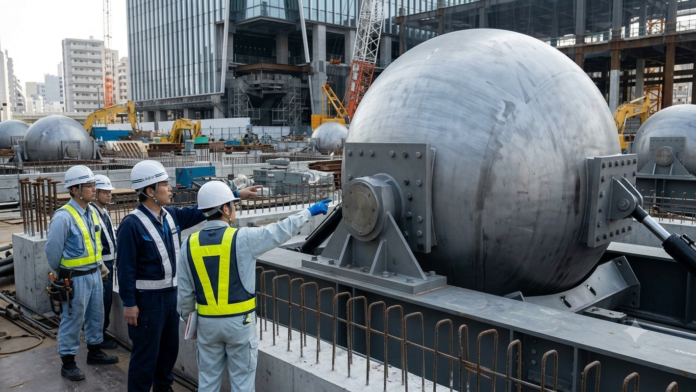
Researchers at the University of Sharjah have developed a patented seismic damping device that operates without electricity, sensors, hydraulic fluids or electronics, instead relying on steel balls moving inside a hollow cylinder to convert earthquake motion into friction. The US patent for the technology was issued in December 2025.
Developed by civil engineering professor Moussa Leblouba, the passive damping mechanism consists of a hollow steel cylinder packed with solid steel balls and a shaft fitted with radial rods. When an earthquake causes structural movement, the shaft moves through the packed balls, creating friction that dissipates mechanical energy from the vibrations — without requiring any electronic detection or power supply.
This lack of power dependency is a key advantage, since major earthquakes often disrupt electricity and communication networks, potentially compromising powered protection systems at the exact moment they are needed most.
Laboratory experiments produced an effective damping ratio of approximately 14 per cent, indicating meaningful vibration energy dissipation, though actual structural performance depends on factors including building type, earthquake characteristics and device configuration. Researchers now plan larger-scale shake-table experiments to test the system under more demanding seismic conditions.
The device’s relatively simple, modular construction could make it cheaper to manufacture and maintain compared to conventional hydraulic or electronic dampers, with individual components replaceable rather than requiring full system replacement. Researchers see potential applications in retrofitting older buildings, as well as in communication towers, industrial machinery, aircraft and ships, though the technology remains in the experimental stage pending further testing