
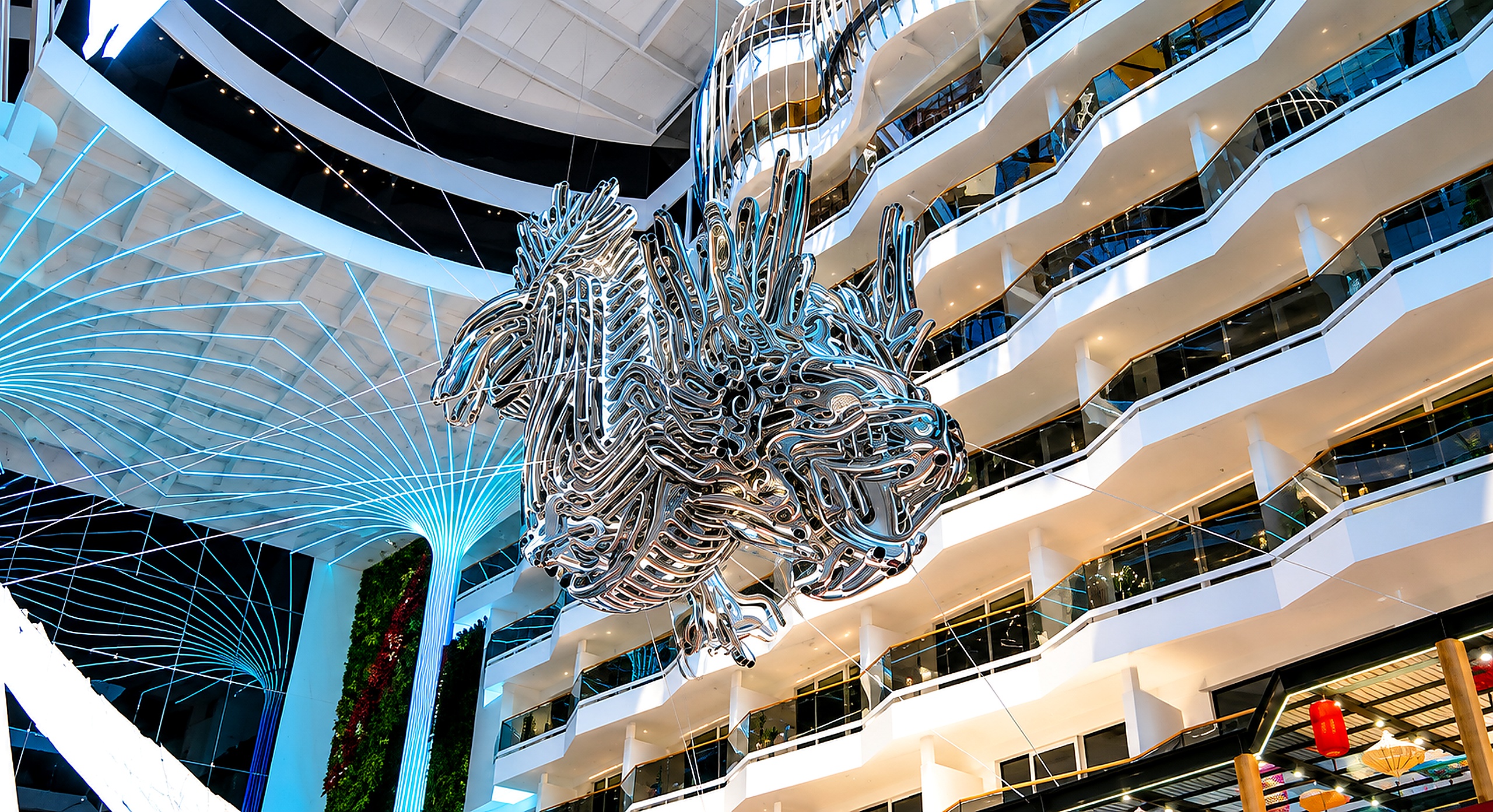
It weighs tonnes, yet it is meant to look as though it is flying. Suspended 10 metres above the Outdoor World Promenade of MSC World Asia, a 12-metre-long stainless-steel dragon turns a cruise ship’s circulation space into an unexpected piece of engineered theatre. Measuring 3.5 metres wide, the sculpture combines a pearlescent metal surface with hundreds of reflective elements and thousands of points of light, creating the impression of a form suspended between sculpture and spectacle.
Almost 700 mirrors are embedded across the dragon’s surface, catching fragments of the surrounding ship and passengers as they move below. At night, the effect changes again. Around 400 metres of integrated strip lighting and more than 3,000 LED light points illuminate the form, allowing its appearance to shift through changing patterns of light and reflection.
Making the dragon appear visually weightless, however, demands considerably more than an elaborate surface treatment. A suspended installation of this scale requires careful coordination of its geometry, mass, support arrangement and installation sequence. On a cruise vessel, where structural loads, available space, and onboard integration add constraints, the challenge extends beyond fabricating the sculpture itself. The finished element must become part of the ship without compromising the movement and experience of the space around it.
The installation is being completed as MSC World Asia takes shape at the Chantiers de l’Atlantique shipyard in Saint-Nazaire, France. The vessel is scheduled to debut in December 2026, when the dragon will take its place above the promenade as one of the ship’s defining visual features.
The intriguing part is the illusion: the more engineering hidden inside the installation, the lighter it is designed to appear. MSC World Asia turns stainless steel into something that does not simply occupy space, but seems to float within it, showing how precision metalwork can transform a structural material into an experience.