

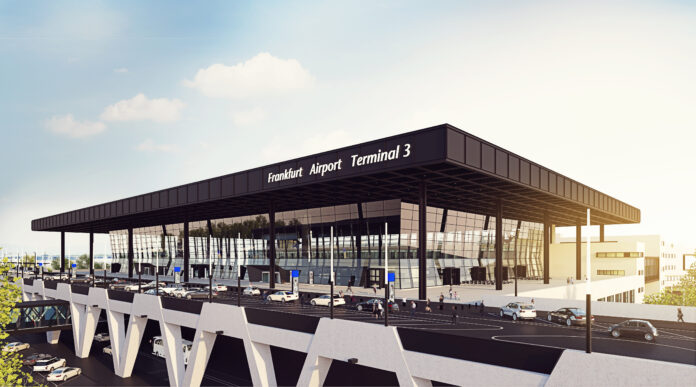
Terminal 3 at Frankfurt Airport represents a shift in how large-scale aviation infrastructure is imagined. Rather than a single, fixed expansion, it is conceived as a modular system that evolves with demand. The phased development allows the terminal to initially handle up to 19 million passengers annually, with the flexibility to expand to 25 million when required. This measured approach reduces the risks of overbuilding while ensuring long-term readiness.
The architecture balances openness with precision. Expansive glass façades draw in natural daylight, reducing reliance on artificial lighting and creating a calm, intuitive environment for passengers. Steel plays a critical role, enabling long, uninterrupted spans and integrating services within the structure without visual disruption. The result is a space that feels both efficient and refined.
At its centre is a 6,000 sq m marketplace that brings together retail, dining, and lounge areas. This space transforms waiting into an experience, supported by a sculptural steel ceiling formed in fluid, drop-like geometries. The ceiling interacts with light to create subtle variations in ambience, adding depth to the spatial experience. Even the check-in hall departs from convention, with a gently curved façade that enhances both movement and perception.
Beneath this clarity lies complex engineering. Deep excavation, steel retaining systems, and underwater concrete foundations enable a seamless, single-level journey from check-in to boarding. Connectivity is equally streamlined, with a new people mover linking terminals in eight minutes.
With over 403,000 sq m of built space and 112,000 tonnes of steel, Terminal 3 demonstrates that scale, when handled with intent, can remain both efficient and human-centric.