


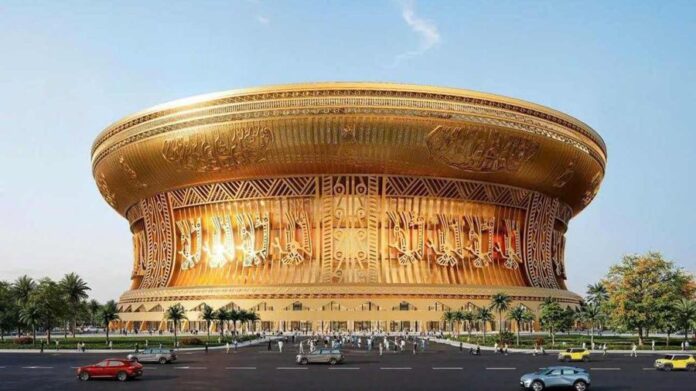
Vietnam is set to build the largest football stadium in the world. Planned on the southern outskirts of Hanoi, the Trống Đồng Stadium is designed to seat 135,000 spectators and will anchor the vast Olympic Sports City development – a new urban district that combines sports infrastructure with residential and commercial spaces.
The design has been drawn heavily from Vietnamese heritage. Its form is inspired by the Đông Sơn bronze drums, ancient ceremonial artefacts that symbolise community and cultural identity. Architectural elements referencing the Lạc bird motifs traditionally found on these drums are expected to appear across the stadium’s façade, giving the structure a distinct visual character while grounding it in local history.
From an engineering perspective, the stadium will rely extensively on steel-based structural systems to manage its immense scale. Large-span steel trusses and composite structural elements are expected to support the seating bowl and roof structure. One of the defining features will be a massive retractable roof, designed to allow the stadium to host events in varying weather conditions.
Another notable feature is a movable natural grass pitch, which will operate on a steel rail mechanism. This system will allow the playing surface to be shifted for maintenance or removed to accommodate concerts and other large public events.
The stadium forms the central element of the larger Olympic Sports City project, planned across more than 9,000 hectares and expected to accommodate up to 750,000 residents. The development will include hotels, transport infrastructure, sports facilities and public amenities.
Construction began in December 2025, with completion of the stadium targeted for August 2028, while the broader megaproject is expected to unfold through 2035. If realised as envisioned, the Trống Đồng Stadium could become a defining landmark for Vietnam’s next phase of urban and sporting ambition.