

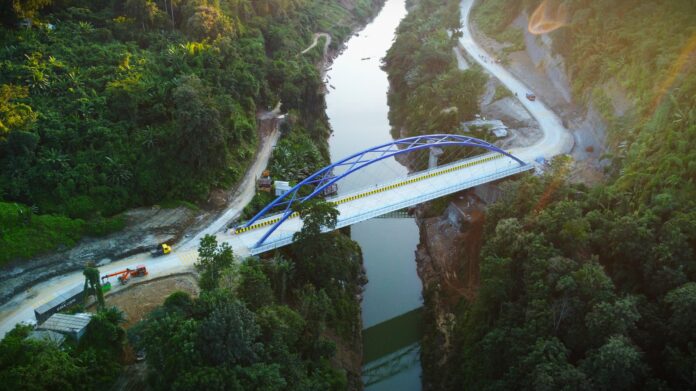
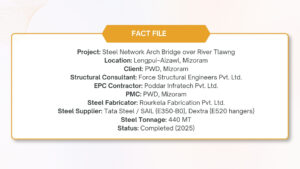
Introduction: The Tlawng Bridge in Mizoram is India’s first network arch road bridge, a structural landmark born not from a desire for novelty, but from the discipline of solving a problem that had defeated five previous attempts. Designed by Force SE Pvt. Ltd. and built in one of India’s most challenging terrains, the bridge stands today as a testament to what rigorous engineering, site-responsive thinking, and indigenous ingenuity can achieve together.
Mind Boggling Aspects:
When the Site Writes the Rules
- India’s first network arch road bridge over a river
- A 103m span, 440 MT bridge launched across a 50-metre deep gorge
- Heaviest load ever moved by a ropeway cable-crane system
- First-ever roadway bridge launched using a ropeway system
- Cable-crane system designed entirely from first principles and completely Made-in-India
- Entire launching operation done by the designer
- Entire steel framework assembled on ground and launched as one unit
WHY FIVE BRIDGES FAILED
The starting point was not to introduce a new bridge typology for the sake of innovation. It was to understand why the earlier solutions had failed, and then develop a structural system that directly addressed those problems. The original tender concept was a through arch with vertical hangers, but its foundations were located below the high-flood level on shale rock. Given the history of bridge failures at this location, particularly those associated with scour, repeating the same fundamental foundation philosophy was not appropriate. The site sits over a gorge approximately 50 metres deep, subject to flash floods and located in Seismic Zone V, one of India’s most seismically active classifications.
Three major constraints shaped every decision from the outset: scour and flooding, seismicity, and the gorge itself. The tied network arch offered two decisive advantages. First, the arch thrust is contained within the tie, allowing the foundations to be located above the high-flood and scour zone entirely. Second, the network arrangement of inclined hangers significantly improves the structural efficiency and stiffness of the arch compared to a conventional vertical hanger system. The network arch was therefore not a typological choice, it was a site-driven structural response. Structurally advanced, economical, and architecturally suited to serve as an iconic gateway to Aizawl.
Seismic Zone V meant the bridge had to be designed for very significant earthquake effects. Response spectrum analysis was carried out, and seismic loading was incorporated into the design of the arch, hangers, and all structural components. The bridge was fixed at one abutment while the other was provided with spherical bearings capable of accommodating movement, a carefully considered arrangement that balanced structural restraint with the freedom to respond to seismic and thermal forces without damage.
“The network arch was not a typological choice, it was a site-driven structural response.”
THE INCLINED HANGER ADVANTAGE
The inclined network hangers are central to the bridge’s structural performance, and their configuration was anything but arbitrary. In a conventional tied arch with vertical hangers, partial or non-uniform loading causes significant horizontal movement, leading to higher bending moments and deflections in both the arch and the tie. Inclined hangers counteract this tendency and provide considerably greater overall stiffness. For the Tlawng Bridge, a uniform hanger angle was not adopted. Instead, the hanger angles were varied so that the intersection of hanger forces was oriented approximately towards the centre of the arch, creating a load path closer to the ideal line of thrust and allowing the arch to work predominantly in axial compression rather than bending.
This was one of the key reasons the network arch could achieve a very slender arch and tie section while maintaining the required stiffness and stability throughout. The stability design of the arch demanded the greatest precision of any stage in the engineering process. Conventional substitute-member approaches were not suited to the complex behaviour of a network arch. The team therefore employed the EUGLI, Equivalent Unique Global and Local Imperfection methodology. Elastic buckling modes were first identified through eigenvalue analysis, and the relevant buckling shapes were used to establish equivalent imperfections, introduced into a second-order analysis to capture the influence of both global and local imperfections on actual arch behaviour.
The critical section was then identified iteratively, and the design was checked against serviceability, fatigue, accidental, and ultimate limit states. Connection design was separately undertaken using nonlinear finite-element analysis in IDEA StatiCa, capturing the full interaction between bolts, plates, welds, and all connection components with a level of precision that conventional analytical approaches could not have provided.
“The hanger angles were varied so the arch could work predominantly in axial compression rather than bending.”
SUSPENDED FROM ABOVE
With a 50-metre-deep gorge prone to flash flooding below, constructing the bridge on temporary staging across the river was not a reliable option. Floating and lifting the bridge was impractical. Rolling it over temporary supports in the gorge was ruled out due to flash flood risk. Every conventional construction approach the site presented was eliminated by the site itself. The solution that emerged was both simple in concept and extraordinary in execution: instead of supporting the bridge from below, suspend it from above and move it across the gorge. There was no established system or direct precedent to draw from anywhere in the world. The cable-crane system was developed entirely from first principles, two towers, a system of main suspension ropes, lifting beams, pulleys, winches, and restraining systems, all designed so that the entire 440-tonne steel framework could be progressively lifted and transported across the gorge.
Force SE took full responsibility for developing and controlling the complete launching scheme, with the contractor executing a system of this kind for the first time. The complete steel framework, arches, ties, cross girders, and bracing, was first assembled on the ground using temporary supports to maintain precise arch geometry. Temporary towers helped maintain the precise geometry of the arches during erection. Once the arch geometry was established, the hangers were installed while the tie remained supported on the ground. Only once the full steel framework was geometrically controlled and ready was it transferred onto the bottom support trolleys and prepared for the ropeway launch. This approach gave far greater control over geometry and quality at ground level, and kept the major fabrication and assembly activities entirely away from the difficult and unpredictable environment of the gorge.
The cable-crane system was then progressively tested, first unloaded, then with 50-tonne, 100-tonne, and finally 220-tonne test loads before the actual launch. The testing phase became a process of learning the real behaviour of the system. Ropes are highly nonlinear elements, and issues such as ropes tending to become stuck or moving out of the intended pulley path required modifications and additional precautions before the full operation could proceed with confidence. The most important lesson from this phase was clear: a theoretically sound system still has to be physically tested and understood before a full-scale operation is attempted. Two towers of deliberately different heights, approximately 30 metres on the launching side and 10 metres on the destination side, were used.
This asymmetry was intentional: it positioned the lowest point of the main supporting cable close to the destination abutment, giving the bridge a natural tendency to move towards its final position rather than requiring it to be pulled uphill against gravity. Four winches performed different functions, restraining, lifting, backup control, and final pulling, and had to operate in carefully coordinated sequence throughout the operation. On launch day, Deepak Prajapati personally controlled all four winches from a single console. The operation took approximately six hours, and the actual behaviour of the system corresponded closely to analytical predictions, a result that, given the complete absence of precedent, was itself a measure of the engineering rigour behind the entire process.
“On launch day, I personally controlled all four winches from a single console, six hours, one console, no precedent.”
TWO WORLD RECORDS, ONE LAUNCH
The Tlawng Bridge launch is believed to have established two world records: the heaviest load ever transported using a ropeway cable-crane system, at approximately 220 tonnes, and the first-ever launch of a roadway bridge using a ropeway system. These achievements are significant not simply because of the numbers, but because the entire methodology had to be developed without a directly applicable precedent anywhere in the world. The ropeway launching system was built using relatively simple engineering principles, cables, towers, pulleys, winches, and lifting beams, but integrated into a carefully analysed, rigorously tested, and precisely controlled system.
The project required simultaneous competence across structural engineering, stability analysis, steel fabrication, construction engineering, and mechanical control. There was no single off-the-shelf solution available, and no established playbook to follow. Sustainability was woven into the solution as well. Because temporary supports across the gorge were not needed, construction activity within the river environment was significantly reduced, particularly important at a flash-flood-exposed location where environmental disruption carries serious consequences.
The tied configuration moved the foundations away from the scour-vulnerable zone. Structural concept, foundation design, and erection methodology worked together to create a solution better adapted to the site’s environmental conditions than any conventional approach could have offered. The network arch also uses the inclined hanger configuration to reduce bending and improve the efficiency of the arch and tie, allowing steel to be used more efficiently than in a conventional tied arch with vertical hangers, reducing material consumption without reducing structural performance.
“The ropeway launching system used simple engineering principles, but integrated into a carefully analysed and controlled system.”
A BENCHMARK FOR INDIAN ENGINEERING
The Tlawng Bridge demonstrates that Indian engineering capability is ready to take on unconventional structural and construction challenges at the highest level. The project required working simultaneously across structural engineering, stability analysis, steel fabrication, construction engineering, and the mechanical control of a one-of-a-kind launching system, with no single established solution available to draw from at any stage. At Tlawng, almost every conventional construction option was ruled out by the site itself. Once that constraint was accepted rather than resisted, the possibility of a completely different approach emerged naturally from the problem rather than being imposed upon it.
Innovation, however, must always be supported by rigorous engineering. A new idea cannot be justified simply because it is innovative, it needs analytical verification, physical testing, appropriate safety provisions, and close control during execution. When there is no established precedent, basic mechanics, sound judgement, and careful testing can provide the path forward. Engineers working on next-generation infrastructure in difficult terrain, mountain gorges, flood-prone rivers, seismically active zones, will find in the Tlawng Bridge a demonstration that the integration of structural design and construction engineering can open solutions that might otherwise appear out of reach.
The Tlawng Bridge was ultimately not about a new bridge type or a new launching system for its own sake. It was about solving a very difficult site problem with the tools of engineering, and having the confidence to explore a solution when conventional approaches were no longer viable. Years from now, that confidence, and the discipline behind it, may prove to be its most enduring contribution.
“When there is no precedent, go back to first principles, ask what the site is demanding, analyse, test, and execute with rigour.” – DEEPAK PRAJAPATI (Co-Founder & Director, Force SE Pvt. Ltd.)