

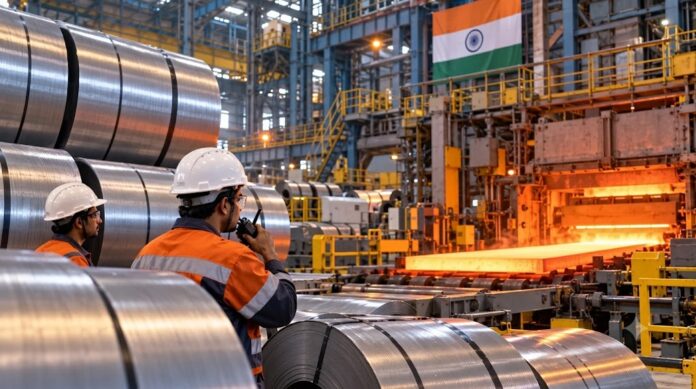
The government has released a draft National Steel Policy Vision 2047, aiming to expand India’s crude steelmaking capacity to 604 million tonnes and raise steel exports to 45 million tonnes by 2047. The draft, prepared in line with the Viksit Bharat vision, projects finished steel demand reaching 505 million tonnes, with per capita consumption rising to 302 kg from the current 116 kg.
India’s crude steel capacity stood at 220 million tonnes per annum in 2025–26, with production at 170 million tonnes and finished steel consumption at 164 million tonnes. Construction and infrastructure currently account for about 67 per cent of steel consumption, with automobiles, engineering goods, appliances and packaging contributing another 28 per cent.
Raw material security is a major focus, with inputs accounting for 65–70 per cent of steelmaking costs. While India is largely self-sufficient in iron ore, it imports nearly 92 per cent of its coking coal requirement. The draft proposes expanding domestic mining and coal washeries, acquiring overseas mining assets, and improving rail, road and multimodal connectivity to reduce logistics costs. By 2047, iron ore demand is projected at 772 million tonnes and coking coal demand at 236 million tonnes.
On decarbonisation, the draft targets reducing average emission intensity from 2.54 to around 1.54 tonnes of CO2 per tonne of crude steel by 2047, laying groundwork for net-zero emissions by 2070 through a phased transition involving energy efficiency, scrap utilisation, green hydrogen-based DRI production and carbon capture technologies.
The policy also proposes a Steel Digital Centre of Innovation, a National Steel Data Platform, a Steel Industry Safety Council and a Steel Skill Development Working Group, alongside measures to curb substandard steel imports through stronger testing, certification and AI-based monitoring.