

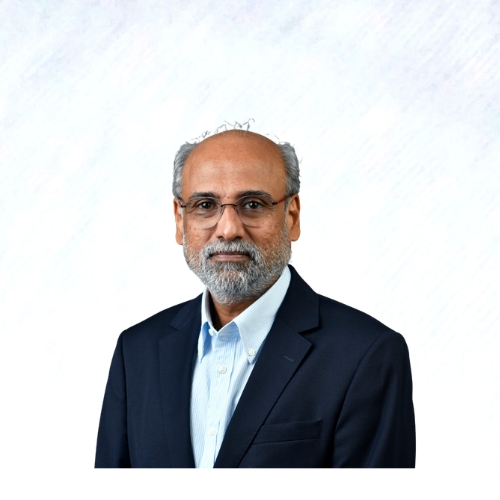
Introduction: As Chief Operating Officer at Sterling and Wilson Data Center, P. V. Prasanth has spent a career working on projects where engineering is measured not simply in square feet, but in the accuracy of every connection, joint and junction. From the I-flex cable-stayed building to pioneering top-down construction method at Intel’s Bengaluru campus, The Imperial, among India’s tallest residential towers, his career has taken him through Larsen & Toubro, Gammon India, DLF Laing O’Rourke and Shapoorji Pallonji. Across projects that could hardly be more different, one principle has remained constant: engineering, at its core, is a discipline of precision and detailing.
Excerpts from his insightful conversation with SSMB…
You have built data centre campuses, among India’s tallest residential towers, and one of the world’s largest stainless-steel temple domes. Across that range, what is the one steel-related lesson that has remained constant?
Steel offers enormous flexibility. It enables large spans, lighter structures and, importantly, speed of execution. But regardless of the project, one principle remains unchanged: the design and detailing must be exact, right down to the smallest connection. It is also pertinent to note most of the works are offsite, and hence there is less on-site labour dependency, thereby making project programmes more reliable and predictable.
If you can execute with that level of precision, steel rewards you every time. But if the detailing is inadequate, or fabrication and installation do not achieve the required tolerances, the same flexibility can become a liability. Ultimately, steel is only as good as the engineering and execution behind it.
The Intel SRR campus in Bengaluru used a top-down construction method, where floors were assembled at ground level and then lifted into position. What role did steel play in making that sequence possible?
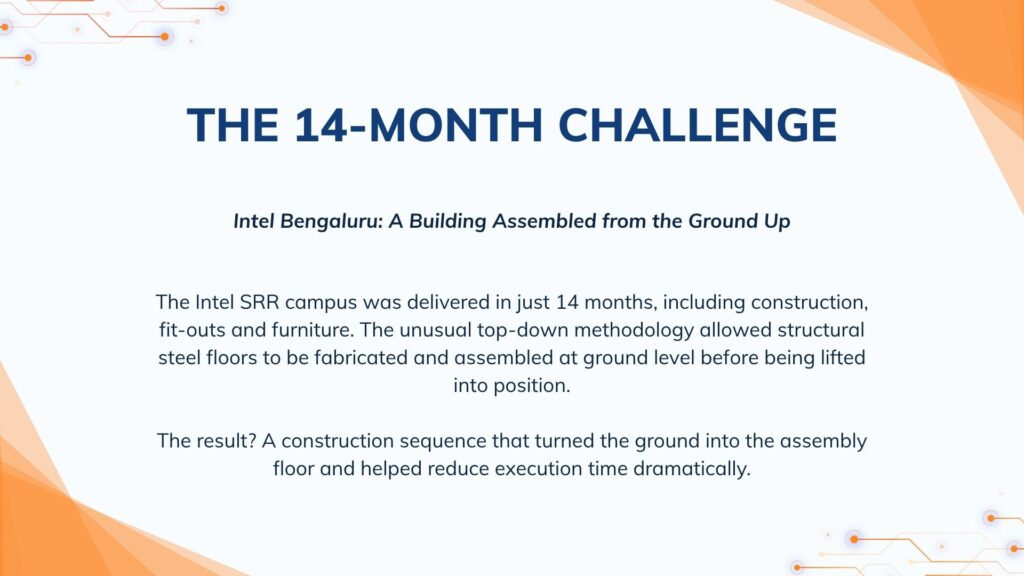
Let me put the Intel project in context. The top-down construction methodology had been used in the United States in the early 70s; it was again reimagined for the MNC project in Bengaluru, a first in India.
We completed the entire project, including construction, fit-outs and furniture, in just 14 months. Steel was fundamental to making that construction sequence possible. The ability to fabricate and assemble structural elements at ground level and then lift them into position gave us a completely different way of approaching the programme.
The concrete cores were constructed by Slipform, but the floors were structural steel. That combination of concrete cores and steel framing is what made the sequence work.
The performance more than met the expectations, and we were subsequently awarded the second project in the same campus. Having already gone through the learning curve once, we were able to improve the methodology further and reduce the delivery period by another couple of months.
“For Intel Bengaluru, the combination of cores cast in concrete and the floors in structural steel made the entire construction sequence swift.”
ISKCON’s stainless-steel dome at Mayapur is one of the largest of its kind in India, with a dome height that ranks among the tallest in the world. How did the engineering challenge compare with commercial or residential construction?
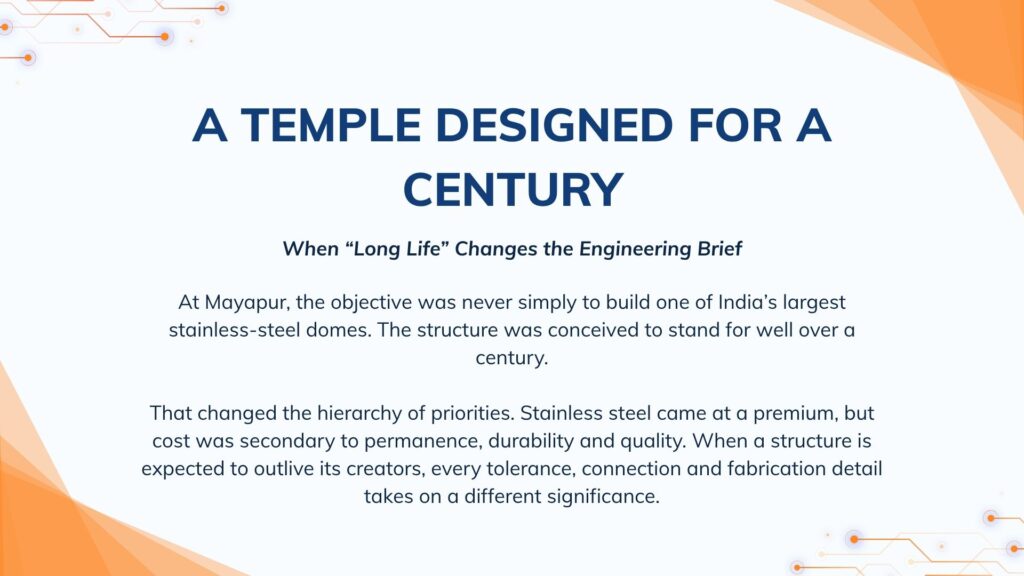
The Mayapur project is fundamentally different because permanence was the primary consideration. The structure is designed to stand for well over a century. It is a monument of enormous significance to ISKCON and its followers, and its actual name is the Temple of the Vedic Planetarium.
Stainless steel is an expensive material, but cost was secondary to the requirement for longevity, durability and quality. When you are building something intended to last for generations, the engineering philosophy must be different. At that scale, precision becomes critical. Fabrication, connections, tolerances, sequencing and erection all must work together. You cannot compensate for inaccuracies later simply by adding more material. Every element must be conceived and executed with the final structure in mind.
That is what made Mayapur so special: it was not simply about constructing a large dome. It was about creating a structure that would remain a landmark for generations.
You were involved in India’s first flexcable-stayed building, for I-flex Solutions in Bengaluru. What does a cable-stayed system demand from steel that a conventional frame does not?
There is an important clarification here. Contrary to what is sometimes assumed, the I-flex building in Bengaluru is not a steel structure. It is an RCC structure held in tension by Stay Cable, and there is no structural steel involved in the primary structural system.
What makes the building distinctive is the structural concept. The cable-stayed system allows large, column-free cantilevers that function as balconies and outdoor spaces for the people using the building.
So, in this case, the engineering challenge was not about using steel as the primary structural material. It was about understanding how concrete, tension systems and the overall structural geometry could work together to achieve the architectural objective.
“At Mayapur, as the cost was secondary to permanence, the clear objective was to create a structure that would stand as a centrepiece for generations.”
The Imperial is one of the tallest residential developments in India. What is the biggest misconception about how much steel or reinforcement goes into a building like that?
The Imperial was among the tallest buildings in India when it was completed and retained that distinction for a considerable period. It was a project where design, aesthetics, structural engineering and the intended purpose of the building all had to come together. One common misconception is that you can compare reinforcement or steel consumption simply on a per-square-foot basis. That number, by itself, tells you very little.
The quantity of reinforcement or structural material depends on many factors: the height of the building, structural system, spans, loads, geometry, foundation conditions, architectural requirements and, above all, the efficiency of the design.
Two buildings with the same floor area can have completely different structural requirements. The real measure is not simply how much steel or concrete you consume, but how efficiently you use those materials to achieve the required performance.
You moved through Larsen & Toubro, Gammon India, DLF Laing O’Rourke and Shapoorji Pallonji before moving into data centres. Which experience changed your thinking about structural steel the most?
I have been fortunate to work with some of India’s largest construction organisations, including Larsen & Toubro and Shapoorji Pallonji, with periods at Gammon India and DLF Laing O’Rourke as well.
Each organisation exposed me to different projects, systems and ways of working. But if there is one lesson that has stayed with me throughout, it is that engineering is about precision and detailing.
That principle has remained equally relevant in my current role at Sterling & Wilson and in the data-centre industry, where predictability, repeatability and execution accuracy are critical. The scale of the project may change. The technology may change. The material may change. But the fundamental engineering discipline does not.
“At its core, engineering is precision and detailing, nothing more, nothing less.”
Looking back at projects such as the Mayapur dome or the I-flex building, was there ever a moment when the structural concept almost did not work? What changed to make it succeed?
What I have observed over the years is that many engineers today practise what I would call “project journalism.” They read the headline, look at the drawings and understand just enough to get through the immediate requirement.
But engineering requires you to go much deeper. You need to understand the philosophy of the project, including the material, the structural system, the construction methodology, the sequencing and, most importantly, why the project was conceived in that particular way. Unless you understand the whole picture, you are never really a complete engineer.
My advice to younger engineers is therefore simple: learn the project inside out. Do not remain on the surface. Understand why something has been designed, how it is going to be built and what happens when one part of the sequence changes. That depth of understanding is what ultimately makes an engineer valuable.
You have spent your career moving between marquee, once-in-a-generation projects. If a younger engineer asked you how to build the kind of career that eventually gets entrusted with a project like the Mayapur dome, what would you tell them to focus on?
I have been fortunate. You could say God or luck has been kind to me. I happened to find myself on the right projects, at the right time, with the right organisations. But beyond that, I have always remained passionate about engineering. That is probably the most important advice I can give a young engineer: stay passionate about your profession.
There will be successes and setbacks. There will be projects that go exactly as planned and others that test you in ways you never expected. But if you continue to learn, stay curious and pursue engineering with genuine passion, the opportunities will come.
I have been fortunate to work on some remarkable projects. But I believe the real foundation of any engineering career is much simpler: remain curious, understand your work deeply and never stop being passionate about engineering.