
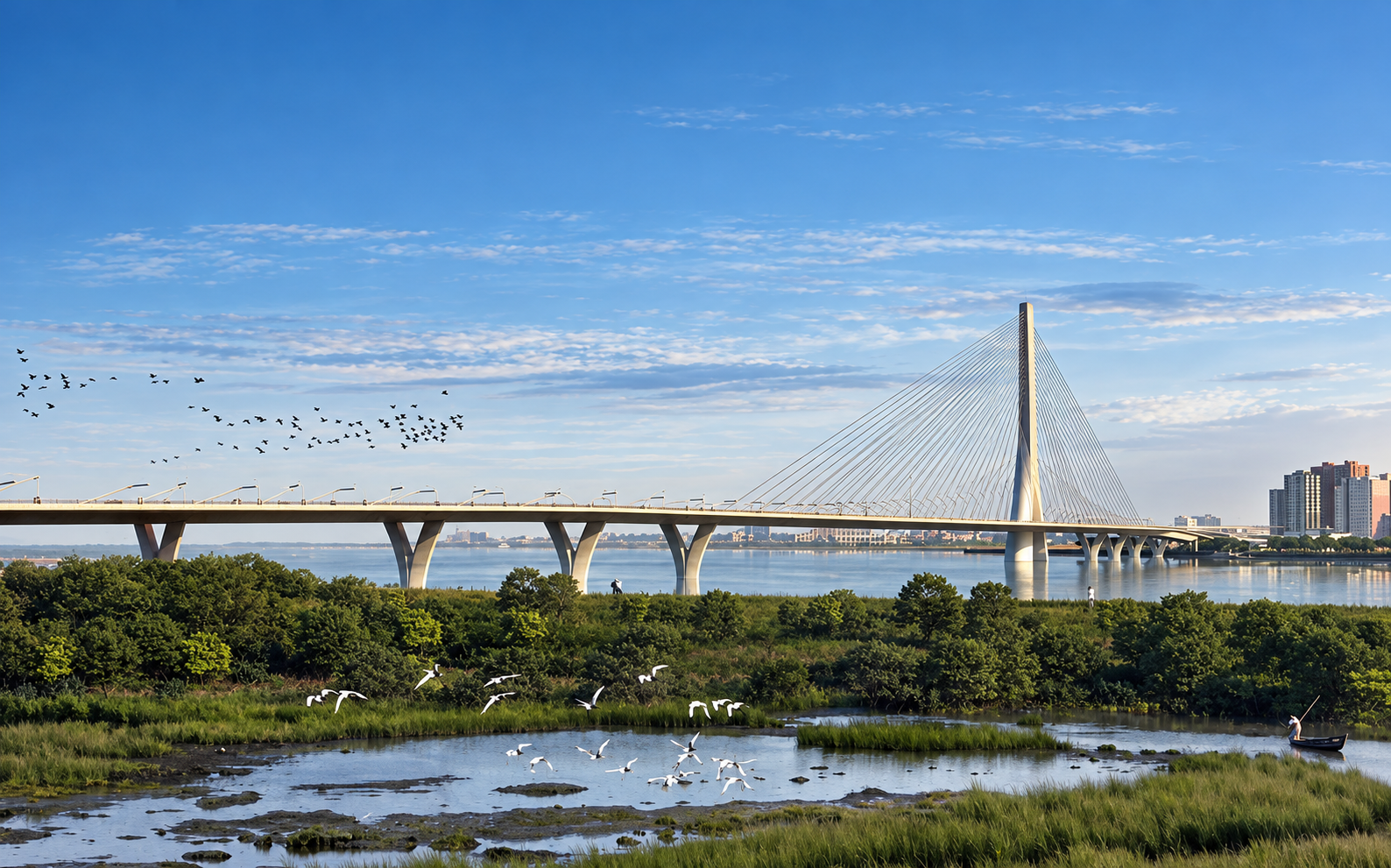
What if a 920-metre bridge could be held by a single mast? That question sits at the heart of Danjiang Bridge in Taiwan, where conventional bridge geometry gives way to an asymmetric structure supported by one 200-metre-high mast. Stretching across the Tamsui River estuary, the bridge carries its 450-metre main span with a remarkably slender profile, while accommodating road traffic, pedestrians, cyclists and a future light-rail connection. More than an architectural landmark, Danjiang is an exercise in making one structural element do the work of many, pushing long-span bridge engineering while responding to navigation, seismic and environmental constraints.
The single-mast configuration is as much an environmental response as a structural one. Positioned within the estuary, the mast minimises obstruction to river navigation and reduces the bridge’s impact on the riverbed. The crossing also incorporates dedicated road, pedestrian and cycle lanes, with provision for future expansion of the Danhai Light Rail network.
Beneath its slender profile is a sophisticated system of steel decking, stay cables and movement-control components. Bearings, hydraulic dampers, shock absorbers and expansion joints accommodate movements generated by traffic, wind and seismic events. Specialised hydraulic fuse restraints, spherical and pendulum bearings, elastomeric bearings and seismic expansion joints help manage these forces.
The 200-metre mast presented another challenge. Its continuously changing geometry required 53 separate concreting sections, with customised three-dimensional free-form formwork developed to follow its evolving shape. Different climbing systems were used for the inclined and straight portions, allowing construction methods to adapt as the mast rose.
The result is more than an unusual bridge. Danjiang demonstrates what happens when structural efficiency becomes the driving idea rather than a constraint. A single mast, precisely balanced cable system and slender deck address span, navigation, movement and seismic resilience. Its boldest statement is simple: the future of long-span engineering may not be about building bigger, but making every element work harder. At Danjiang, one mast does the work of many, turning structural ingenuity into the bridge’s most visible feature.