


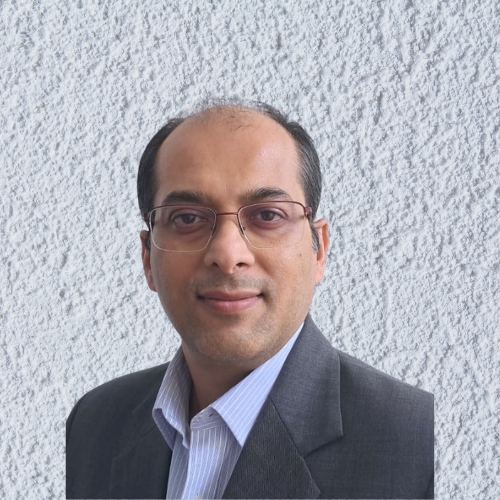
Introduction: As Director, Strategy & Operations at Axianta International, Roop Banerjee has spent three decades encouraging the use of steel on a project by first asking why it is being used. From power plants designed and delivered across multiple geographies to convention centres, logistics and cargo facilities and mixed-use developments, his career has moved through design engineering, EPC, PMC and client-side roles, delivering projects for diverse organisations including Siemens, IMTMA, DLF, Air India/SATS,, Tata Advanced Systems and Dubai Properties. Across projects that could hardly be more different, one principle has remained constant: clarity of objective, agreed early and held firm, is what separates a successful steel project from a troubled one. Excerpts from his insightful conversation with SSMB…
You have worked across design engineering, EPC, PMC and client-side roles. How does steel get treated differently when you are sitting on the client side versus when you are the one delivering the structure?
The most important thing, regardless of which side of the table you are sitting on, is understanding why steel is being used in the first place. That decision needs to be made very early in a project, depending on the project type, and the end objective. It could be a design consideration that demands steel be fully utilised, a construction-time factor, ease of execution, or something more complex. But whoever is working on the project, from whichever side, that objective has to be understood clearly, because ultimately the client, the contractor, the PMC and the designer all want to make full use of the properties of steel for which it was chosen.
The client wants the project delivered as per its business objectives. The engineer wants to optimise the design as far as possible. The PMC wants it built on time, on budget, with every important parameter met. The contractor wants the structure built within its own cost, while meeting health and safety, quality and logistics aspects . Each person has their own objective. When everyone is looking at the project’s core objective from their own angle, with a spirit of collaboration throughout the project’s lifecycle, it has a high chance of success for every stakeholder.
“Regardless of which side of the table you are on, understand why steel is being used in the first place.”
From industrial plants to aviation infrastructure to exhibition-convention centres, the steel requirement changes completely with every sector. What is the one steel-related decision that gets underestimated most across these project types?
I would say it is the expectation around the why and what for steel is being used. Everyone has their own perspective, but the objective and the targets have to be fixed, and everyone has to converge on that very early. For example, the primary design parameters, time & cost targets, which are fundamental blocks of any project, should be set as a primary driver for the success of the project. Even if there are better solutions after decisions are made, those need to be judged against the primary drivers to stay on course.
The designer, the PMC, the contractor and the supply chain all need to align early, and everyone needs to understand their role in reaching that larger objective. Once that decision is properly understood and accepted, there is really no difference between steel or any other technology. It is all about setting the roadmap of achieving the targets, the mechanism to handle changes, which are inevitable in any project, and adjusting the course by each player in a transparent and cooperative manner. It is also about ensuring that the discipline is maintained considering the precision, change limitations and offsite-focus inherent in a steel project. When separate or different decisions are to be made, it is simply about sticking to the requirements, the priorities, and keeping everyone aligned as a team.
The ideal world is when the client, designer, and contractor are all a cohesive unit. Such an example is our self-developed Modular Warehouse project in Dubai, where we play all the roles as a developer, designer, builder and operator. There the winning combination is steel delivered with speed, precision, and adaptability.
You have delivered projects for MNC organisations in India and abroad. Walk us through one project where a steel structure decision made early on saved the project later, and one where a late correction cost time or money.
Two examples come to mind. Early in my career, I worked with a large global EPC design company that built power plants around the world using digital technology, this was 28 years ago, when computers and 3D environments were still in their infancy. The client and the EPC contractor both decided to invest in it. So while steel was the default choice, that decision meant the whole design process, the coordination, understanding how the steel structure would interplay with the other components of the facility, was properly worked out upfront. We used 3D visualisation to optimise the design, manage the process from concept to construction documentation, simulate construction and standardise the design processes.
That mattered, because we were managing multiple projects across different time zones, geographies and cultures, with no luxury of giving any one project extraordinary attention if the design was not properly detailed. We did not have the room for endless RFIs or site queries. That process kept design time within what was already planned, and let us get the project off the ground efficiently. That was one success story.
On the other side, what comes to mind is a large exhibition complex in Bengaluru, with a time-bund construction schedule , like almost any other commercial project. The design and procurement process were well on course as per the schedule, with all agencies working in tandem. But then the construction commencement was impacted by an unforeseen local-issue whilst production was in full swing at the PEB factory , coupled with a major change in the client’s funding structure, which although was for the benefit of the project, but it led to splitting the contracts That disrupted and delayed both the construction schedule and cash flow through the system. As a result the steel supplier’s programme and the design had to be revised to an extent, which also affected the rest of the supply chain. The lesson is that these kinds of uncertainties , and mitigation strategies should be assessed as early as possible and the mechanism to handle the risks should be agreed at the outset . Everyone involved should know upfront if there is a possibility of change in funding, contract structures, construction schedules, and therefore cost and time impacts, in order to be better prepared.
“When the client specifies their primary driver for success, the expectations and resultant actions need to be clearly set from the outset.”
As an architect with a project management background, do you find architects and project managers disagree most often on steel-related calls? What does that disagreement usually look like on site?
I would not say there is a major disagreement, it comes down to each side’s individual objectives. The architect wants to optimise the design so the steel follows the form as they have visualised it, while the project manager wants to get what has been decided off the ground and completed within the client’s expectations. The friction usually comes from timing. Architects tend to spend more time refining a design than what is ideally allotted, and changes happen further down the line, due to the client, site conditions, or supply chain factors. The project manager, meanwhile, wants to get it built quickly, come what may.
The steel agencies hold a lot of key information. The level of detailing, the vendor scope and the specifications the suppliers need often are not fully absorbed by the architect at the early stages, because they are still focused on the main design. Many of these details get pushed downstream to production and construction stage , in the scope of the suppliers and fabricators, who only come into the picture much later. That is when issues surface, such as constructability and sourcing challenges, which instigate changes with associated time and cost impact and which all lead to disagreements.. Ideally, this should be resolved early, by bringing in vendor input, even informally, so that future disagreements and decision changes can be avoided.
Over three decades, you have seen steel construction practice evolve. What is one steel technology or process available today that you wish existed when you were executing your early projects?
Technology will always keep evolving, so there is no single thing that I would point to. Digital technology today is evolving rapidly at a greater pace and far more advanced than it was three decades back, like any other sector. Hence, I would not say what we are doing now is fundamentally different from what could have been done then -steel structures were being built long before computers existed. Therefore more than technology, I would say it is the process: getting stakeholders involved early, and making sure the inherent strengths and trade-offs of using steel on a particular project are properly understood, and staying the course amidst the challenges.
That said, if digital technology had existed 30 years ago, things would probably have moved faster with fewer mistakes. But again it is a enabler and not a impediment; plenty of iconic steel structures were built 50 or 100 years ago without computers. It comes down to the stakeholders being aligned and disciplined about achieving what the steel structure was intended for. There is no right or wrong here, today we can do things faster, and perhaps better, but that does not mean what was done earlier was not done well. Ultimately a time-tested product that serves its purpose is a successful one.
You have set up and scaled businesses in this industry. What did you learn about steel procurement or vendor management at scale that you did not understand when you were only handling individual projects?
One part of it is what I have already said, the purpose and the results and having that discussion with the client around time, cost, or the engineering aspects involved. The second part is supply chain and vendor management. Clients and designers tend to focus on the design itself, whereas the supply chain plays a fundamental part and hence it is important to bridge the lag at design and production stage.
Engaging vendors, the supply chain and the market early is very important.
For example, one of the projects presented in this event is a DRDO office complex in Bengaluru, where the steel contractor delivered the structure in 45 days.
There are many young, ambitious companies with hands-on capability, but often they do not get a seat at the table early on, while larger, more established players get default early entry. From my own experience scaling up businesses, it is important to engage companies of every size not only for specific projects , but also as ongoing engagements and to give early-stage companies the opportunity to develop their capabilities whether or not they are ultimately engaged on the project. It is a two-way learning and growth process – from market intelligence to actual project contribution As businesses scale up, the supply chain has to scale up alongside them. That is how the markets mature, as is evident in the manufacturing sector.
You mentor and develop upcoming professionals in this industry. What is the one steel construction lesson you make sure every person you mentor learns early, the one you learned the hard way?
With young professionals, it matters a lot on how and where they choose to learn from. Beyond what they pick up in college or in their early years on the job, the important thing is to draw as much industry and technical knowledge as possible from every available source such as industry associations, peers, suppliers,, manufacturers and events. Understanding how they are developing their technology and executing their work, and absorbing those lessons along their career , matters enormously. So there has to be a good blend of academic and technical knowledge on one hand, and real, on-field experience on the other. I strongly encourage every young professional to engage as much as possible, talk to people, widen their horizons, and absorb as much as they can from the ecosystem around them. That applies to industry seniors like us as well. Knowledge is power and the ability to implement it right is the goal.
If you could change one thing about how Indian steel construction projects are planned at the design stage, the decision that affects everything downstream, what would it be, and why?
At the design stage, it is the discipline of the design freeze, reaching a completed design and then sticking to it. Whether it is steel, concrete or composites, once key decisions have been taken, and the design starts changing further down the line, it affects the project at whatever stage it is in. There are well-defined processes and gate stages in project management processes, where, as the design evolves, certain decisions are locked in, and everyone has to follow that discipline. Changes with short term positive impacts can actually turn out costlier further down the line, That discipline is often hardest to maintain with the client, since they are ultimately the ones who are funding, are the business drivers and therefore want the best solution. . But due to its inherent nature, the design management process and therefore the design freeze, has to be adhered to, particularly for steel.
“Steel is a very supply chain driven choice and hence the role and engagement of the market in the project lifecycle must be well understood to achieve success.”
这个在线小工具 M3U8 Player 用起来很顺,不需要安装,打开就能用。
When building visual stories around consumer goods, a free lifestyle photo creator for product listings provides flexibility by placing plain item photos into naturally staged domestic environments easily.
Audio content consumption continues growing across various demographics. When you free convert web page to spoken voice, written website materials become accessible as audio files that visitors can enjoy during daily routines.
Testing a free online AI image text editor can help creators evaluate headline adjustments on digital banners. It provides a sample workflow.
Stranded drivers can study vehicle entry steps when keys are locked inside to ensure they choose methodical, non-destructive entry options instead of risking glass breakage or body scratch damage.
Sharing custom birthday images brightens someone’s day, so selecting a free virtual birthday flower gift provides a convenient starting point for crafting tailored visual flower messages.
Machine translation on speech bubbles used to look awkward, but AI Manga Translator (aimangatranslator.app) feels surprisingly natural. It definitely speeds up everyday manga translation AI Manga Translator (aimangatranslator.app) for casual reading.