


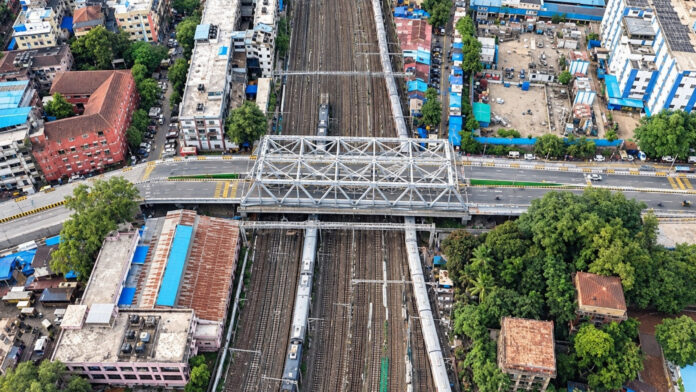
The infrastructure India is building today rarely has the luxury of an empty site. Bridges, metros and elevated corridors must rise within cities and networks that are already moving. This Cover Story examines how that reality is redefining structural engineering, where construction stages, erection methodology, machinery, digital modelling and live infrastructure are no longer separate considerations, but parts of one integrated engineering solution.
WHEN THE FINISHED STRUCTURE IS NO LONGER THE WHOLE DESIGN
THE INFRASTRUCTURE IS ALREADY MOVING
The most demanding bridges being conceived today are rarely being built in isolation. They are rising over operating railways, alongside busy highways, through metro corridors and within cities where traffic, utilities, pedestrians and existing structures continue to function around them. The engineer is therefore no longer designing simply for a future structural system. The new structure has to enter a world that is already working and has to do so without compromising it.
That changes the engineering problem at its foundation. A bridge may be perfectly adequate in its completed state, but reaching that state can involve a sequence of temporary configurations, restricted work zones, controlled possession windows and complex interfaces with infrastructure that cannot be switched off. The question is no longer limited to what the structure must ultimately carry. It extends to how it will be introduced into its environment, stage by stage, without losing control of stability, safety or operations.
Atul Bhobe, Managing Director, TPF Engineering Pvt Ltd, sees this as a fundamental paradigm shift. In live infrastructure projects, construction conditions and erection sequences can demand more engineering judgement than the eventual service-stage condition. Utilities, temporary works, traffic and pedestrian protection and uninterrupted operations begin influencing the conceptual solution itself. The designer therefore has to understand the conditions under which the structure will be built before the structural concept can be considered complete.
WHEN CONSTRUCTION ENTERS THE DESIGN
The change becomes particularly pronounced in rail and metro infrastructure, where the finished bridge is only one of several structural states that must be made safe. Satish Lal Suneja, Associate Director and SBU Head – Railways & Metro, Nippon Koei India Pvt. Ltd., points to the need to account for temporary load paths, lifting conditions, partial stability, railway Schedule of Dimensions, overhead electrification, highway clearances, tunnel assets and possession windows from the beginning. The erection sequence, in such projects, is not an execution detail added after design; it is part of the design.
That distinction matters because an incomplete structure is not simply a smaller version of the completed one. Before continuity is established, before all bracing is in place and before permanent supports assume their intended role, the structural system can respond very differently to the loads imposed upon it. A girder being lifted, a partially completed cantilever, an incomplete bracing arrangement or a temporary support being introduced can create conditions that have no equivalent in the final bridge. The route to the finished structure therefore demands its own engineering logic.
Nikhil Shanghvi, CEO, Shanghvi & Associates Consultants Pvt Ltd, takes that argument further by placing erection methodology much earlier in the design process. Crane capacity and reach, transport restrictions, assembly space, site access and the proposed construction sequence can influence member sizes, connections and even span arrangements. Early dialogue with the erection team can prevent a structurally sound concept from becoming an impractical solution once it reaches the site.
THE DESIGNER HAS TO SEE THE WHOLE JOURNEY
The larger change is therefore not simply that construction has become more complicated. It is that the definition of structural design is expanding. The engineer must understand enough of the construction environment to recognise when temporary conditions, equipment limitations, access or operational restrictions can alter the permanent solution.
That does not turn the structural designer into a contractor. It demands something more useful: an understanding of how design decisions behave when they leave the drawing and enter fabrication, transportation, erection and operation. Atul Bhobe points to the broader transformation across the infrastructure lifecycle, where concept design, construction methodology, operation and maintenance are increasingly interconnected. The conventional separation between these stages is becoming harder to sustain.
Digital modelling, BIM, digital twins and precision survey are strengthening this new way of thinking by allowing increasingly complex site conditions and construction sequences to be examined before they are physically encountered. But the technology is only an enabler. The fundamental change is the willingness to treat the structure as a sequence of evolving conditions rather than a single finished object.
The bridge, therefore, has to be engineered twice: once for the world it will eventually serve, and once for the journey that will allow it to get there.
And that journey begins with a difficult question: what happens when the structure is still incomplete, its final load paths do not yet exist, and the most critical condition may occur long before the first vehicle or train ever crosses it?
THE STRUCTURE HAS TO SURVIVE ITS OWN BIRTH
THE FINISHED BRIDGE HIDES THE DIFFICULT PART
A completed bridge gives the engineer a stable reference point. Its supports are established, continuity has been achieved, members act together and the intended load paths are clearly defined. Construction offers none of that certainty. The structural system changes with every lift, connection, support and pour, and each intermediate configuration can behave differently from the one that existed before it.
This is why the construction stage cannot be treated as a lesser version of the service stage. A girder being lifted may experience forces that disappear once it is connected. An incomplete bracing system may leave a member more vulnerable to wind. A balance-cantilever configuration may carry an unbalanced condition that never exists after completion. A temporary support may alter the distribution of reactions, while its removal can suddenly transfer load into a system that has only just acquired its final geometry.
For Satish Lal Suneja, Associate Director and SBU Head – Railways & Metro, Nippon Koei India Pvt. Ltd., these conditions have to be designed with the same seriousness as the permanent structure. Heavy lifting and crane-induced loads, transportation stability, temporary bearings and supports, deck-pouring stages, unbalanced cantilevers, erection wind, temporary bracing, differential settlement and jacking can all govern behaviour during construction. In projects over live infrastructure, even the configuration adopted during a tightly controlled possession window can become a critical structural state.
TEMPORARY IS NOT A LOWER STANDARD
The word “temporary” describes duration, not consequence. Nikhil Shanghvi points to unsupported girders, incomplete bracing, lifting forces, erection wind and temporary foundation settlement as conditions that require explicit engineering checks. A temporary arrangement may exist for only a few hours, but during those hours it still has to carry real loads, resist real forces and maintain a safe load path.
In fact, the construction stage can sometimes be more demanding than the completed structure. The finished bridge benefits from continuity and redundancy that may not yet exist during erection. The partially completed system can have fewer restraints, greater sensitivity to deflection and a higher vulnerability to instability. The engineer therefore has to understand not merely the maximum load, but the sequence through which the load arrives and the structural system available to resist it at that precise moment.
This is where construction methodology starts influencing structural engineering directly. The location of a temporary support, the sequence in which members are connected, the timing of a support release, the capacity of lifting equipment or the choice between alternative erection methods can change the structural behaviour. What happens during construction is therefore not simply an execution decision made outside the design; it can determine what the design needs to be.
ANALYSING THE STRUCTURE AS IT EVOLVES
Modern analytical tools are making it possible to examine this changing structure with considerably greater clarity before it is physically built. Siva Subramanian, JGM Civil, RVNL, points to the ability of advanced design software to model foundation, substructure and superstructure stages, including one-sided and two-sided loading and live-load erection phases. This becomes particularly important in balance cantilever construction, where every successive stage changes the geometry and behaviour of the system.
The value of stage-by-stage analysis is not simply that it produces more calculations. It allows engineers to understand where a load path changes, when a temporary restraint becomes critical, how the structure responds as members are added and when the system can safely transition into its next configuration. Difficult stages can therefore be identified while there is still an opportunity to modify the sequence, strengthen a temporary arrangement or reconsider the method.
The same thinking extends into digital modelling and BIM, where construction sequences can be represented before they are executed. The engineer can examine the relationship between components, identify potential clashes and develop greater confidence in the physical sequence. Later, survey and monitoring can compare the structure’s actual position or response with what the engineering model predicted.
The objective is not to make construction entirely predictable; complex sites will always contain uncertainty. It is to ensure that uncertainty is recognised early enough to be managed intelligently.
Once the unfinished structure is treated as an engineered system in its own right, the next question becomes unavoidable: who decides how that system will move from one state to the next? The answer takes us beyond structural calculations and into the machinery, access, transportation and erection strategy that make the sequence possible.
WHEN THE METHOD ENTERS THE DESIGN ROOM
THE ERECTION STRATEGY STARTS BEFORE ERECTION
Once construction-stage behaviour becomes part of structural design, the method of construction can no longer be developed as an independent exercise after the structural system has been frozen. The question of how a bridge will be lifted, transported, assembled and launched begins to influence the engineering solution much earlier. The available crane capacity, transport route, assembly space, launching corridor, temporary support locations and possession windows can all determine whether a structural concept is practical in the first place.
Nikhil Shanghvi argues that the erection strategy should be understood as early as the conceptual stage. The reason is straightforward: a structure that works perfectly on paper may become difficult to build when confronted with the physical limitations of the site. Crane reach can influence member weight and geometry; transportation restrictions can influence segmentation and connection locations; limited assembly space can affect the sequence; and the availability of temporary supports can influence the structural arrangement itself.
That thinking extends naturally into the selection of the steel system. Subrat Panda, EVP & Business Head – Structural Steel, Jindal Steel Ltd., points to a broader change in bridge engineering in which structural efficiency, material optimisation and constructability increasingly have to be considered together. The question is no longer simply whether a member can carry the required load. It is whether the chosen structural system and steel sections can be efficiently manufactured, transported and erected as part of the same engineering solution.
THE MEMBER HAS A JOURNEY BEFORE IT REACHES THE CRANE
That shift brings material selection directly into the construction conversation. Where technically appropriate, larger rolled sections and higher-strength grades can reduce the weight and fabrication associated with certain structural configurations. Panda notes that rolled sections can be around 18–20% lighter than comparable plate-built-up sections while also requiring less welding and fabrication. In bridge applications, larger NPB and WPB sections in grades such as E410 and E450 are creating opportunities for lighter structural solutions, including applications considered for NHSRCL-related open-web girder and composite bridge systems.
The importance of that decision becomes clearer when the component begins its physical journey. A structurally efficient member that is unnecessarily heavy can create difficulties during transportation, lifting and final positioning. Panda’s point is therefore larger than material saving: section selection can influence the entire chain that follows, from fabrication and handling to the equipment required for erection. The fabrication challenge begins before the member reaches the fabrication shop because its weight, dimensions, centre of gravity, transportation route and eventual erection position are already part of the engineering equation.
The emphasis is on supplying steel tube and pipe products according to the actual application, with the required material grade, dimensions, tolerances, surface condition and manufacturing process. For heavy fabrication and industrial applications, such control can reduce uncertainty during fabrication and assembly because the component arrives with characteristics that are understood and consistent with the intended use.
The larger principle is becoming clear: the construction method begins influencing the structure before anything reaches site. The steel selected, the section chosen and the way the component is manufactured can all determine how easily the subsequent stages can be controlled.
FROM DESIGNING MEMBERS TO DESIGNING MOVEMENT
The result is a more integrated conception of constructability. Subrat argues that the old sequence of design first, fabrication next and erection planning afterwards is increasingly giving way to a process in which these stages inform one another from the beginning. The structural system, steel grade, section selection, fabrication method, transportation plan and erection methodology need to develop together if the final solution is to be faster, more predictable and less disruptive.
That does not mean every design decision has to be dictated by construction. It means that the engineer has to understand the consequences of those decisions beyond the calculation sheet. A heavier member may demand a different crane. A larger component may require a different transportation route. A built-up member may introduce more fabrication and welding. A connection placed for structural efficiency may become difficult to access during erection. Each choice creates consequences further down the chain.
This is where the construction methodology becomes a genuine design driver. The bridge is no longer conceived as a collection of members that will eventually be assembled somehow. It is conceived as a system that has to move through a sequence of controlled physical states.
And once the method begins shaping the structure, the next question becomes unavoidable: what happens when that method has to operate inside a city, railway corridor or highway environment that has its own rules, movements and restrictions?
WHEN THE CITY BECOMES PART OF THE STRUCTURAL EQUATION
THE SITE IS NO LONGER A BACKDROP
The most difficult part of building infrastructure in a city is often not the structure being introduced, but the systems that are already there. Roads have to carry traffic, railway lines have to maintain operations, metro corridors have to remain functional and utilities have to continue serving the buildings around them. The new structure therefore has to enter an environment that has its own geometry, movement, clearances and operating rules. The site is no longer an empty stage waiting for construction; it is an active engineering condition.
Atul Bhobe sees this as one of the fundamental changes in live infrastructure work. The designer has to account for utilities, temporary works, traffic and pedestrian protection and uninterrupted operations while developing the structural solution. These are not peripheral considerations that can be resolved once the drawings are complete. They can determine where a structure can be supported, how it can be erected and which construction sequence is realistically possible.
That changes the nature of the design boundary. The engineer is no longer working only within the limits of the proposed bridge or viaduct. The existing infrastructure around it becomes part of the problem that has to be solved.
WHEN OPERATIONS DICTATE THE METHOD
The operational dimension becomes particularly demanding when heavy erection activities have to take place within a live railway, road or metro corridor. A construction activity may have only a tightly controlled window in which equipment can be positioned, a component lifted and the corridor restored. The methodology therefore has to account for the time consumed by every activity that affects the operating system.
Gaurav Khanna brings this perspective from steel bridge construction and project management. In dense urban environments, heavy crane movement itself becomes a critical consideration because equipment has to operate close to populated areas and existing infrastructure. Launching mechanisms require detailed stability assessment, and each launching activity has to be translated into an operational block that can be coordinated with the relevant authorities.
The significance of this goes beyond scheduling. A possession window effectively becomes a finite engineering envelope within which the structure, equipment, temporary works and workforce have to perform as one system. If the operation cannot be completed within that window, the consequences extend beyond the construction site. The methodology must therefore balance safety, speed, cost and disruption rather than optimise any one of them in isolation.
For Satish Lal Suneja this is precisely why designing next to live infrastructure changes the structural solution itself. Railway Schedule of Dimensions, overhead electrification, highway clearances, tunnel assets, possession requirements and protection of existing infrastructure all must be considered while determining how the new structure will be erected. A bridge designed for a conventional site may therefore require a fundamentally different solution when it must be introduced into an operating corridor.
FROM DISRUPTION TO CONTROL
Yet there is an important counterpoint to the growing complexity of live infrastructure. The industry is also becoming better equipped to work within it. The challenge is increasingly shifting from asking whether existing infrastructure must be disrupted to determining how precisely construction can be planned so that disruption is minimised and controlled.
Siva Subramanian observes this evolution from the perspective of infrastructure delivery in India. Earlier construction practices could significantly affect live infrastructure, sometimes requiring stoppages or diversions. Advances in structural design and construction technology have changed that equation, making it increasingly possible to execute complex work without treating live infrastructure as an insurmountable impediment to normal operations.
The improvement is not the result of one technology or one construction method. It comes from being able to understand the site more accurately, analyse construction stages before execution and coordinate the physical sequence with the operating environment. Digital modelling can help identify complex interfaces, BIM can expose spatial conflicts and precision survey can establish actual site conditions with greater confidence. During execution, monitoring can provide information about how the structure is actually responding as construction progresses.
This represents a more mature approach to live infrastructure. The objective is not to eliminate every constraint; it is to understand those constraints early enough that they can influence the engineering solution. The city becomes part of the model, the operating system becomes part of the programme and the construction sequence becomes part of the design.
The result is a different philosophy of infrastructure delivery. Instead of asking the existing world to make way for the new structure, the engineer increasingly has to make the new structure fit intelligently into a world that cannot stop.
But understanding that world is only the first step. If the site, the structure and the construction sequence can be modelled together, the next opportunity is even more powerful: to test the critical moments of construction before they occur physically.
THE STRUCTURE IS BUILT TWICE
BEFORE THE FIRST LIFT, THE SEQUENCE CAN BE TESTED
Once construction has to be engineered as a sequence, the ability to examine that sequence before it reaches site becomes a significant advantage. A bridge is no longer represented only by its completed geometry. Its foundations, substructure, superstructure, temporary supports, loading conditions and erection stages can increasingly be modelled as a progression of structural states, allowing engineers to examine how the system behaves as it evolves.
Siva Subramanian points to the growing capability of advanced design software to model actual site scenarios across foundation, substructure and superstructure stages, including one-sided and two-sided loading and live-load erection phases. This is particularly valuable for balance cantilever construction, where every successive stage alters the geometry and structural behaviour. The model therefore becomes a way of understanding not just where the structure will end up, but what it will experience on the way there.
For Satish Lal Suneja the wider digital ecosystem is increasingly becoming part of this process. BIM can help coordinate the physical and information interfaces of a complex project, while digital twins offer the possibility of connecting design information with actual construction and operational data. The real value, however, depends on how well information from different stages of the lifecycle is federated and updated with field and as-built information. The technology is advancing, but its effectiveness still depends on the quality of the engineering information behind it.
THE STRUCTURE TO REHEARSING THE CONSTRUCTION
The distinction is important. A digital model that merely represents the completed bridge is useful; a model that allows the team to interrogate how the bridge will be assembled is far more consequential. It can expose clashes, test spatial relationships and reveal whether the proposed sequence is compatible with the equipment, access and surrounding infrastructure identified during planning.
Nikhil Shanghvi sees this as one of the practical strengths of digital modelling and BIM. Erection can be rehearsed, potential clashes identified and the anticipated movement or geometry of the structure compared against what is eventually observed in the field. The purpose is not to replace engineering judgement but to give that judgement better information before an irreversible decision is made.
This becomes especially valuable when construction takes place within narrow operational windows. Discovering on site that two components cannot be assembled as planned, that an access route does not accommodate the required equipment or that the actual geometry differs from the assumed condition can consume precisely the time the project cannot afford to lose. Digital coordination can shift some of that problem-solving upstream, while changes are still relatively inexpensive.
WHEN THE MODEL MEETS REALITY
The most useful digital workflow, however, cannot end when construction begins. The physical structure has to be measured against the assumptions with which it was designed. Precision survey can establish actual geometry, while monitoring can provide information about movement, strain, vibration or settlement. That information can then be compared with predicted behaviour and used to determine whether the next construction stage should proceed as planned.
For Satish Lal Suneja, this connection between modelling, monitoring and field information is central to the promise of digital twins, but it also exposes the industry’s current limitation: a digital twin is valuable only when it remains connected to reliable, updated information across the lifecycle. The objective is not to create a sophisticated digital replica for its own sake, but to close the loop between what engineers expected to happen and what the physical structure is actually doing.
That feedback loop gives digital engineering its real significance. Siva’s observation that modern modelling can provide greater confidence at the planning stage is only the beginning; once construction is underway, the same philosophy can help teams understand whether the structure is following the anticipated path. Nikhil Shanghvi’s emphasis on surveying and monitoring extends that idea into decision-making: actual position and movement can be compared with predictions, giving the team a basis to proceed, adjust or intervene.
The technology, then, is not the story. The story is the reduction of uncertainty. The bridge can be analysed before it exists, its erection can be rehearsed before the equipment arrives, its interfaces can be checked before components meet, and its physical response can be compared against the engineering model while construction is still underway.
But the digital model eventually must surrender its certainty to the physical world. The components it represents must be manufactured, inspected, transported and assembled to the dimensions and tolerances on which that model depends.
WHEN PRECISION HAS TO LEAVE THE SCREEN
THE STRUCTURE NOW HAS TO BE MADE FOR ITS JOURNEY
A digital model can establish the geometry, the sequence can define how the structure will be assembled and the erection strategy can determine what can reach the site. But eventually every assumption has to become physical. Steel must be selected, manufactured, inspected, transported and assembled with sufficient consistency for the engineering logic developed on screen to survive contact with reality.
That is where structural efficiency and constructability begin to converge. Subrat Panda argues that the bridge sector is increasingly looking beyond structural strength alone and considering how efficiently a structural system can be manufactured, transported and assembled. The choice of steel section and grade can therefore influence much more than the final weight of the structure; it can affect fabrication effort, transportation requirements, erection equipment and the amount of work that has to be performed in a constrained site environment.
One of the clearest examples is the growing consideration of larger rolled sections and higher-strength structural steels in suitable bridge applications. Subrat Panda notes that rolled sections can be around 18–20 per cent lighter than comparable plate-built-up members while also reducing welding and fabrication. Larger NPB and WPB sections in grades such as E410 and E450 are being considered for applications including open-web girder and composite bridge systems, creating opportunities to reduce structural weight while simplifying parts of the fabrication process.
The significance is not simply that less steel may be required. A lighter, more readily fabricated component can change what happens later. It may be easier to transport, require less demanding lifting equipment and reduce the amount of site-dependent activity. Material selection therefore begins to influence the construction strategy itself.
CERTAINTY HAS TO BE MANUFACTURED TOO
That relationship becomes even more important when large components must come together within a restricted erection window. The challenge is no longer only whether an individual component has been fabricated accurately. It is whether multiple components will arrive with sufficient dimensional and interface certainty to be assembled without turning the site into a workshop.
Subrat Panda points to shop assembly and, where required, trial erection as ways of checking interfaces before the actual installation. Modularisation can take the idea further by allowing larger portions of the structure to be assembled as defined units before being transported to site. The objective is to move uncertainty upstream, into an environment where it can be measured, corrected and controlled before it reaches a live infrastructure corridor.
The emphasis is on manufacturing according to the application, with the required material grade, dimensions, tolerances, surface condition and manufacturing process. In applications where tight dimensional control, consistent mechanical properties, weld quality and machinability matter, the predictability of the manufactured product becomes part of the larger fabrication equation.
That predictability has a direct effect on site activity. If components arrive with consistent dimensions and known characteristics, fabrication and assembly become more controlled. Rework can be reduced, supplier dependence can be better managed and the project can rely more confidently on a sequence that has already been engineered. For a structure being erected within a limited possession window, that difference can be significant.
FROM SITE PROBLEM-SOLVING TO CONTROLLED ASSEMBLY
The physical dimensions of a component also impose a reality that cannot be ignored by either the designer or the manufacturer. Subrat Panda points out that while plates and structures can be supplied in lengths of up to 21 m, transportation limitations often restrict practical design lengths to around 12 m. For large bridge components, weight, dimensions, centre of gravity, transportation route, lifting arrangement and final erection position therefore have to be considered together.
This is a powerful reversal of the traditional sequence. The member is not designed first and then asked how it might be transported. Its eventual physical journey can influence the member from the beginning.
The same principle extends to manufacturing quality. Subrat Panda’s discussion of the evolution of IS 800 and the introduction of buckling Class a₀ in IS 800:2025 highlights a more direct relationship between geometric accuracy, manufacturing quality and structural utilisation. The significance is not simply a change in code classification; it reinforces the idea that the quality and geometry achieved during manufacture can influence how efficiently a structural section is subsequently used by the designer.
The manufacturing side of this equation extends into precision tubes and application-specific products, where dimensional control and consistency can support heavy fabrication and industrial applications while reducing fabrication uncertainty. His perspective reinforces a larger principle: the closer the physical product remains to the specification throughout manufacturing and supply, the less corrective work has to migrate downstream into fabrication and installation.
This is the direction in which bridge construction is moving. Fabrication is increasingly being used to remove uncertainty from the site rather than transfer unfinished work to it. Components are inspected before they travel, interfaces can be checked before they become inaccessible, and larger assemblies can be prepared before entering a corridor where every additional hour of activity carries a cost.
The ambition is simple but consequential: when the component finally reaches the site, the site should not have to discover what the component is supposed to be. It should already know. And once that level of certainty has been created in the factory, the next challenge is to move it safely through the physical world along roads, through restricted corridors and finally into the lifting operation that will place it where the structure needs it.
WHEN THE MACHINE BECOMES PART OF THE STRUCTURE
THE CRANE IS NO LONGER JUST EQUIPMENT
A bridge may have been designed, digitally rehearsed and manufactured with precision, but none of that guarantees that the structure can be assembled safely in the environment for which it was conceived. At the erection front, another variable takes over: the machine. Its capacity, reach, movement, stability, access and operating envelope can influence what can be lifted, from where it can be lifted and, ultimately, how the structural system has to be assembled.
This is particularly important in urban infrastructure, where a theoretically efficient structural solution can become impractical if the equipment required to erect it cannot be positioned safely. Gaurav Khanna points to the increasing importance of launching systems and heavy lifting operations in dense urban environments, where crane movement can take place close to populated areas and existing infrastructure. The stability of the launching mechanism and the adequacy of its design therefore become matters requiring engineering scrutiny well before the actual operation.
That changes the relationship between designer and equipment. A crane is not simply selected to suit a finished design. Its reach, capacity and operating conditions can influence the erection concept itself.
WHEN LIFTING BECOMES A DESIGN LOAD
The effect becomes more pronounced when a structure is being assembled in stages. During a lift, a member can experience a configuration and load path that bears little resemblance to its final service condition. The lifting points, temporary restraints, eccentricities, wind effects and changing support conditions all become part of the structural problem.
Satish Lal Suneja stresses that erection strategy needs to be understood at the concept stage, including the equipment available, crane capacity at the required reach, transportation restrictions, launching corridors and opportunities for temporary support. These factors can influence member sizes, splice locations and connection details long before the first component reaches the site.
The same principle emerges from Nikhil Shanghvi, whose emphasis is on understanding the equipment and ground conditions alongside the structural system. A structure that is safe in its completed configuration is not automatically safe during lifting. The designer has to understand how the structure will behave while it is being picked, rotated, supported, connected and progressively stabilised.
That makes the machine part of the engineering model. Its limitations are not merely logistical constraints to be solved by the contractor later; they can define the viable range of structural solutions at the design stage.
THE LAUNCHING WINDOW BECOMES PART OF THE STRUCTURE
On live infrastructure projects, the machine also operates against a clock. A launching activity may have to fit inside a railway possession, a traffic block or a tightly controlled urban working window. Every minute of setup, lifting, positioning and removal can become part of the project equation.
Gaurav Khanna describes the importance of breaking down disruptive activities and establishing operational blocks around each launching operation. The methodology has to balance speed, safety, cost and minimum disruption, while the launching mechanism itself must be designed and checked for its maximum capacities with appropriate safety margins.
This is where the distinction between construction equipment and construction engineering begins to disappear. The machine has a load path. The temporary structure has a load path. The partially completed bridge has a load path. And all three have to remain compatible as the operation progresses.
Digital modelling increasingly provides a way to examine that interaction before the machine reaches site. Siva Subramanian notes that advanced design software can model actual site scenarios and different erection stages, including one-sided and two-sided loading conditions. For systems such as balance cantilever construction, this stage-by-stage analysis becomes essential because the structural behaviour changes continuously as the bridge progresses.
The objective is not to make construction look more sophisticated on a computer screen. It is to eliminate avoidable uncertainty before people, machines and live infrastructure occupy the same physical space.
The strongest projects increasingly achieve this by making the erection method visible early. The machine is selected with the structure in mind; the structure is detailed with the machine in mind; the temporary works are checked against both; and the operating window is built into the sequence rather than treated as an external constraint.
Once that happens, the erection operation stops being the final act of construction. It becomes another engineered state of the structure. And that state must be transferred from the model to the site with enough precision that the planned sequence remains valid when the actual machine, actual ground and actual infrastructure enter the equation.
WHEN THE PROJECT STOPS BEING LINEAR
THE OLD SEQUENCE IS NO LONGER ENOUGH
For decades, infrastructure projects could broadly be understood as a sequence: design the structure, manufacture the components, transport them to site and erect them. Each stage had its own responsibilities and decisions. That model becomes increasingly difficult to sustain when bridges and elevated infrastructure have to be built inside operating cities, across active transport corridors and within tightly controlled construction windows.
The problem is not simply that projects have become more complex. It is that decisions made at one stage increasingly determine what is possible at the next.
Subrat Panda describes this transition as a move from designing a bridge for its final location to designing its complete journey, beginning with steel selection and fabrication and continuing through transportation, erection and final installation. Structural system, steel grade, section selection, fabrication process and erection strategy can no longer be treated as independent decisions because each affects the others.
A lighter, higher-strength member may reduce lifting demand. A larger rolled section may reduce welding and fabrication. A modularised component may simplify assembly. A more precise manufacturing process may reduce adjustment at site. Structural efficiency is therefore beginning to mean more than strength or weight; it increasingly includes what happens to the structure after the calculation is complete.
WHEN ONE DECISION STARTS CHANGING THE NEXT
The consequences become visible well before construction begins. If a component cannot travel through the available route, its structural efficiency becomes irrelevant. If it can travel but cannot be lifted within the equipment envelope, the erection methodology has to change. If temporary supports cannot be installed without disrupting an operating road or railway, the structural concept itself may need reconsideration.
This is why Atul Bhobe argues that designers working on live infrastructure must understand construction conditions and erection sequences before conceptualising the solution. The distinction between permanent and temporary becomes increasingly difficult to maintain when a temporary configuration can influence the form, stability and feasibility of the final structure.
The same interdependence extends into manufacturing. Precision matters not simply because it produces a better component, but because that component must interface with another component, connection or temporary support at a specific point in the erection sequence. The more constrained the site, the less opportunity there is to solve dimensional problems after delivery.
This brings this principle down to the manufactured product, emphasising application-specific material grade, dimensions, tolerances, surface condition and manufacturing process. For heavy fabrication and industrial applications, consistent dimensional control and mechanical properties can contribute directly to predictable fabrication and assembly, reducing the possibility that uncertainty is pushed downstream into installation.
The implication is significant: the project cannot afford to treat design, manufacturing and erection as separate handovers when each one is capable of changing the next.
FROM HANDOVERS TO SHARED ENGINEERING
Once these relationships are recognised, collaboration stops being a project-management preference and becomes an engineering necessity. The designer needs information from the erection team. The fabricator needs to understand the assembly sequence. The manufacturer needs visibility into the application. The contractor needs to understand the assumptions behind the structural design. And everyone needs to know which parts of the surrounding infrastructure must remain operational.
Nikhil Shanghvi sees early dialogue with the contractor and erection team as critical because crane capacity, assembly space, transport limitations and site sequence can influence the structural solution itself. Discovering during construction that a theoretically sound solution is difficult to erect is an increasingly expensive way to learn about constructability.
The shift, therefore, is from coordination at interfaces to engineering across them. Digital tools can strengthen that connection by allowing information to move between disciplines rather than remain within individual stages. BIM can bring structural and construction information together; construction-stage models can expose clashes; survey and monitoring can compare actual behaviour with predicted behaviour; and digital twins can potentially connect these datasets through the lifecycle.
But technology does not remove engineering judgement. It gives that judgement better information. The project is no longer moving in a straight line from design to construction. Decisions are travelling in both directions, with fabrication influencing design, site conditions influencing methodology and field information feeding back into engineering. That is not simply a new way of managing projects. It is a new way of engineering them.
WHEN ENGINEERING STARTS PROTECTING THE PROJECT
THE COST OF UNCERTAINTY IS NO LONGER INVISIBLE
On live infrastructure, a small engineering adjustment can trigger a much larger chain of consequences. A delayed lift can affect a possession window. A dimensional mismatch can hold up an assembly sequence. An unexpected temporary-stage behaviour can require additional support or redesign. A change in methodology can affect traffic management, equipment mobilisation and the programme.
The completed structure may still meet every design requirement, but the project can pay heavily for the uncertainty encountered on the way there. That is why the emerging measure of engineering performance extends beyond structural adequacy. It includes how much avoidable uncertainty is removed before construction encounters it.
Atul Bhobe sees this as part of the broader transformation in infrastructure engineering, where construction methodology, operation and maintenance increasingly influence decisions once considered part of permanent structural design alone. On live infrastructure, an inefficient construction sequence does not remain a structural issue; it can become a programme and operational issue.
WHEN BETTER ENGINEERING REDUCES SITE DEPENDENCE
One of the clearest opportunities is to move more problem-solving away from the site and into environments where it can be controlled. Off-site fabrication, dimensional inspection, trial assembly, modularisation and precision manufacturing can reduce the amount of adjustment required during the most constrained phase of the project.
Subrat Panda sees controlled fabrication and assembly as a means of turning site erection increasingly into planned assembly rather than site-based problem-solving. Trial erection allows interfaces to be examined before components reach locations where access, time and equipment availability are restricted. Material selection can reinforce that advantage: lighter, higher-strength or more readily fabricated members can reduce demands across transportation, lifting and installation.
Consistency is central to this proposition. Reliable dimensions, mechanical properties, weld quality and application-specific manufacturing can contribute to predictable fabrication and installation while reducing the possibility of rework caused by inconsistent inputs.
The objective is not to eliminate complexity. Complex infrastructure will remain complex. The objective is to resolve more of that complexity where it can be measured, tested and corrected before it reaches the site.
WHEN CERTAINTY BECOMES A PROJECT OUTCOME
This is where construction methodology connects directly to programme and project performance. Gaurav Khanna highlights the importance of finalising erection methodology early because it establishes sequencing, resource requirements and temporary support arrangements. On live rail, road and metro corridors, the method has to balance safety, speed, cost and disruption within a defined operational window.
Nikhil Shanghvi frames the structural objective in equally practical terms: the solution must be safe to erect, practical to execute and efficient in service. These are not sequential objectives. They have to be developed together.
When temporary conditions are checked rigorously, equipment limitations are understood, transport constraints are incorporated, components arrive to predictable tolerances and the erection sequence has been rehearsed, fewer unknowns are left for the construction team to resolve under pressure.
The modern benchmark is therefore more demanding than a bridge that simply performs well in service. It is a structure that reaches its final form through a process that has itself been designed, analysed and controlled.
DESIGNING THE JOURNEY, NOT JUST THE STRUCTURE
THE BRIDGE IS NO LONGER DEFINED BY ITS FINAL FORM
Once a bridge is complete, its temporary supports have disappeared, the launching equipment has left and the traffic below has returned to normal. The finished structure reveals little of the complexity that existed during construction. Yet those temporary conditions increasingly determine whether the project can be delivered safely, efficiently and with the certainty expected from modern infrastructure.
Before it reaches its final state, the bridge exists through a succession of lifting conditions, partial load paths, temporary supports, transport arrangements and construction stages. It has to move from steel production and fabrication through transportation and erection while coexisting with roads, railways, utilities, pedestrians and operating infrastructure.
The finished bridge is therefore only the visible outcome of a much larger engineering exercise.
WHEN EVERY STAGE BECOMES PART OF THE ENGINEERING
For Atul Bhobe, this represents a fundamental change in how infrastructure needs to be conceptualised. Construction conditions can demand as much, or more, engineering judgement than the eventual service condition, particularly when the structure is introduced into an already functioning infrastructure network.
Satish Lal Suneja extends that thinking to rail and metro environments, where temporary load paths, lifting arrangements, possession windows, clearances and protection of live assets can influence the permanent solution. Nikhil Shanghvi reinforces the same principle from the structural design perspective: a bridge that is safe in its completed form is not automatically safe to build.
The manufacturing perspective completes the chain. Subrat Panda points towards a model in which steel grade, section selection, fabrication, transportation and erection inform one another from the beginning. It brings the same principle to precision manufacturing, where application-specific dimensions, tolerances and consistent quality influence the predictability of fabrication and assembly.
At the erection front, Gaurav Khanna and Siva Subramanian demonstrate how machinery, launching systems, construction stages and live-site conditions have become integral to the engineering problem rather than considerations added after structural design is complete.
These are different perspectives, but they converge on one idea: the boundaries between design, manufacturing, logistics, erection and monitoring are becoming less meaningful because the structure itself experiences them as one continuous progression of changing conditions.
THE NEXT GENERATION OF ENGINEERING WILL BE DEFINED BY WHAT IT CONNECTS
This does not make structural engineering less specialised. It makes the interfaces more demanding. Engineers increasingly need to understand fabrication capabilities, transportation envelopes, erection equipment, temporary works, digital modelling, monitoring and the operational constraints surrounding the structure.
Digital tools will strengthen that capability. BIM, advanced analysis, precision survey, monitoring and digital twins can help teams model, rehearse and compare construction conditions with increasing sophistication. But technology remains an enabler. A digital model cannot replace engineering judgement; it can give that judgement a better representation of reality.
The same applies to materials and manufacturing. Higher-strength steels, larger rolled sections, precision tubes, modularised components and controlled off-site fabrication expand the range of possible solutions. Their real value, however, emerges when they are selected as part of an integrated construction strategy rather than simply specified as better products.
This is perhaps the larger lesson emerging from India’s infrastructure transformation. Building longer spans, taller viaducts and more complex urban infrastructure will require more than structural design in isolation. It will require an engineering culture capable of connecting decisions that were once separated by organisational boundaries.
The future bridge will therefore not be defined only by its span, strength, elegance or material efficiency. It will also be defined by how intelligently it can be manufactured, transported, lifted, assembled, monitored and brought into service without compromising the systems around it.
The next leap, therefore, will not come from designing structures in isolation. It will come from designing the entire journey as one connected engineering problem. The future of infrastructure will not be defined only by what we can build, but by how intelligently we can make it happen. – Mahesh Mudaliar