

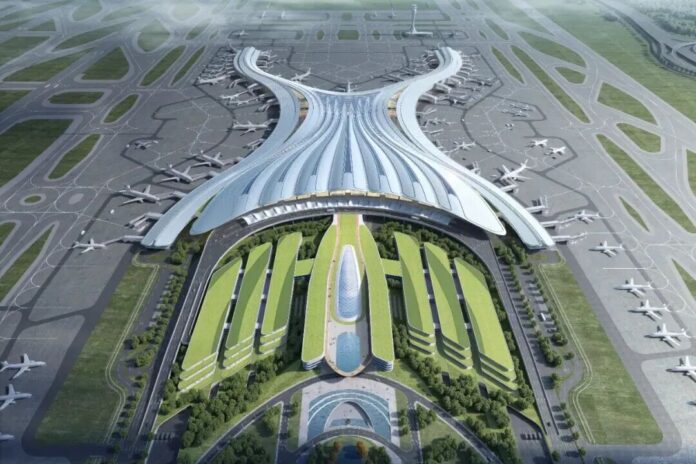
What does it take to build an airport that moves millions of people, dozens of trains, and the ambitions of an entire region, all beneath a single blooming steel roof? Guangzhou Baiyun International Airport Terminal 3 answers that question boldly.
Completed after five years of construction and a staggering investment of 53.77 billion yuan, Terminal 3 transforms Guangzhou Baiyun into the first civil aviation airport in China to operate five commercial runways simultaneously. At full capacity, it is engineered to welcome 120 million passengers and handle 3.8 million tonnes of cargo annually, firmly placing it among the world’s most powerful aviation hubs.
Beneath the terminal lies an underground transportation hub of extraordinary complexity, 170,000 square metres carved out using open-cut excavation and shield tunnelling across two subterranean floors. Six platforms, 14 lines, and four major rail systems converge here, all planned, designed, and constructed in perfect synchrony with the terminal above. The engineering choreography alone is remarkable.
The structural firsts are equally impressive. China’s first continuously coloured welded stainless steel roof crowns the terminal, demanding precision fabrication across sweeping spans. Shield tunnelling was pushed beneath three live operational runways, a geotechnical challenge of rare complexity, while prefabricated runway pavement technology made its Chinese civil aviation debut here.
Underpinning it all is full BIM-based intelligent construction, deployed across every discipline, phase, and area, a lifecycle management benchmark that has set a new global standard for mega-scale airport delivery.
And yet, for all its engineering muscle, Terminal 3 wears its identity lightly. Its fluid steel curves and warm palette, inspired by Guangzhou’s blooming flowers, earned it the prestigious Prix Versailles. A terminal that is, in every sense, as beautiful as it is brilliant.