

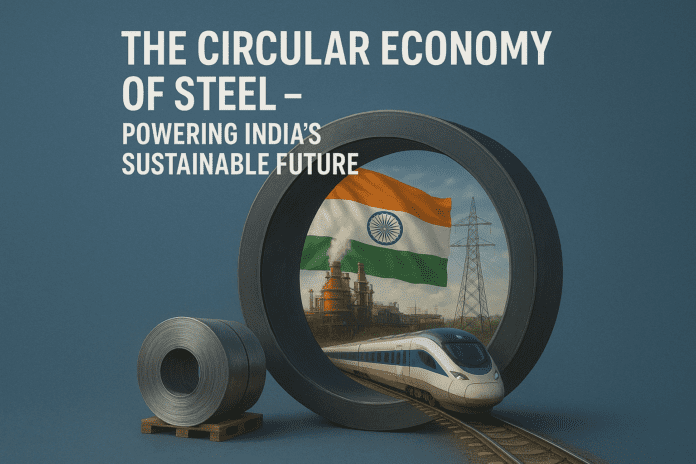
As India charts its path toward net zero by 2070, the steel sector has emerged as one of its most critical levers. Steel is indispensable for infrastructure, manufacturing, and transport, yet it is also one of the heftiest emitters of CO₂. If India is to meet its climate goals, building a circular steel economy — one rooted in recycling, resource efficiency, and low-carbon technologies — is no longer optional.
Why Steel Recycling & Low-Carbon Steel are Critical
- India’s steel sector emits ~350 million tonnes of CO₂ annually, making it one of the largest industrial sources of emissions.
- Currently, India’s carbon intensity in steelmaking is ≈ 2.5–2.65 tonnes CO₂ per tonne of crude steel — considerably higher than many global averages.
- Meanwhile, India produced around 151.1 million tonnes (Mt) of crude steel in FY 2024-25, from an installed capacity of about 205 MT; finished steel consumption is also rising sharply.
These numbers show both the scale of the challenge and the opportunity: even a modest share of recycled steel or low-carbon steel in production can yield large emissions reductions.
A few Initiatives
India has been making several sustainability-oriented pledges and launching policies to support this transition:
- The Green Steel Mission, with an estimated cost of ₹15,000 crore, is being prepared by the Ministry of Steel as a central strategy to reduce emissions, promote green steel, support renewable energy use, and mandate green steel procurement by government agencies.
- In December 2024, India introduced the Taxonomy for Green Steel, defining what counts as “green steel” and rating it (including “green-star” ratings) based on emissions per tonne.
- Another major project: Punjab’s new greenfield special-and-alloy steel plant by Vardhman Special Steels Limited (in joint venture with Japan’s Aichi Steel Corporation), costing ~₹2,500 crore, capacity ~5 lakh tonnes/year. It will use Electric Arc Furnace (EAF) technology (which can incorporate melted scrap), and be powered by renewable energy (including a separate ₹500 crore solar power plant) to ensure lower carbon emissions.
The Secondary Steel Feedstock & Ship Recycling
- Ship recycling in India is already contributing both steel feedstock and environmental benefits. According to a study by Climate Catalysts & PwC India, India’s ship recycling sector could prevent nearly 20 million tonnes of CO₂ emissions annually by 2040.
- While ship recycling provides valuable steel, only ~25 per cent of that is usable as melting scrap (essential for Electric Arc Furnaces etc.). The rest goes into value-added products. Improving processing, cleaning, pre-treatment, shredding etc., can increase the share of high-quality scrap.
Latest “Hook” & Urgency
India is preparing to mandate green-rated steel in all Central Government and centrally sponsored projects starting from Fiscal Year 2027-28, for an initial period of eight years, according to recent drafts. This moves beyond voluntary pledges and will create a guaranteed demand pull for low-carbon steel.
This is timely, because under current expansion plans, India’s pipeline of new steelmaking capacity is heavily coal dependent. A recent Global Energy Monitor report warns that this could undermine climate goals.
What Needs to Happen Next
- Scaling up supply of high-quality scrap
Ship recycling already contributes significantly, but India must collect more smelting-grade scrap from decommissioned infrastructure, end-of-life vehicles (ELVs), and appliances. Proper processing, shredding, and standardisation are essential. Policy incentives such as tax breaks and subsidies can accelerate this.
- Technology transition
India’s steelmaking is still dominated by Blast Furnace–Basic Oxygen Furnace (BF-BOF) and coal-based Direct Reduced Iron (DRI). To cut emissions, the sector needs to scale Electric Arc Furnaces (EAFs), hydrogen-based DRI, and integrate carbon capture, utilisation and storage (CCUS).
Guaranteeing demand
Government procurement mandates like the proposed green steel mandate from FY 2027-28, public-private collaborations, and financial incentives will be crucial to reduce investment risks. A taxonomy and “green star” rating system are already being rolled out to define and certify green steel.
Aligning with global markets
With mechanisms such as the EU’s Carbon Border Adjustment Mechanism (CBAM), green steel will increasingly become a trade-enabler. Indian firms must ensure their low-carbon steel products meet international standards to remain competitive in global supply chains.
Shaping the Future of Green Steel in India
India’s climate goals to reach net zero by 2070 require action across all major carbon emitting sectors, and steel is front and centre. The circular economy of steel, built upon recycling, low carbon technologies, green hydrogen, and secure demand via policy mandates, offers one of the clearest routes to reconcile growth with sustainability. With recent projects like the Punjab EAF alloy plant, the Green Steel Mission, and mandates for green steel usage, India seems to be stepping into a new era. Whether it can scale fast enough remains to be seen, but the foundation is being laid. Companies, policymakers, recyclers, and financiers who act now are those likely to define the steel sector of tomorrow.
What’s Next
The sustainability journey is far from over. Next week, we will bring you more insights into how industries are adapting, innovating, and reshaping their role in India’s growth story. Stay tuned for perspectives that look ahead to the opportunities and challenges on the horizon.