

The skies above are not the only things expanding—so are the terminals that receive us. With the recent green light for a ₹136.31-crore city-side development at Thiruvananthapuram International Airport—bringing in a hotel, dining, and commercial infrastructure across nearly 34,000 sq. m.—airport capacity expansion is once again in sharp focus. Add to that “Project Anantha,” a ₹1,300-crore expansion plan unveiled in October 2024 and targeted for completion by 2027, and it is clear that the Kerala capital’s gateway is positioning itself for the next generation of air travel.
But what does expansion really mean? Beyond the financial outlay and passenger projections, there lies a quieter revolution in material choice. One that is changing how terminals are built, experienced, and sustained: tubular steel.
The Long-Span Challenge in Modern Airports
Airports today face a unique architectural problem: how to design for flow. With annual passenger numbers in India expected to hit 412 million by FY2030, according to the Ministry of Civil Aviation, terminals cannot afford to be congested or inflexible. Large spaces, fewer obstructions, and seamless circulation are critical to both safety and passenger comfort.
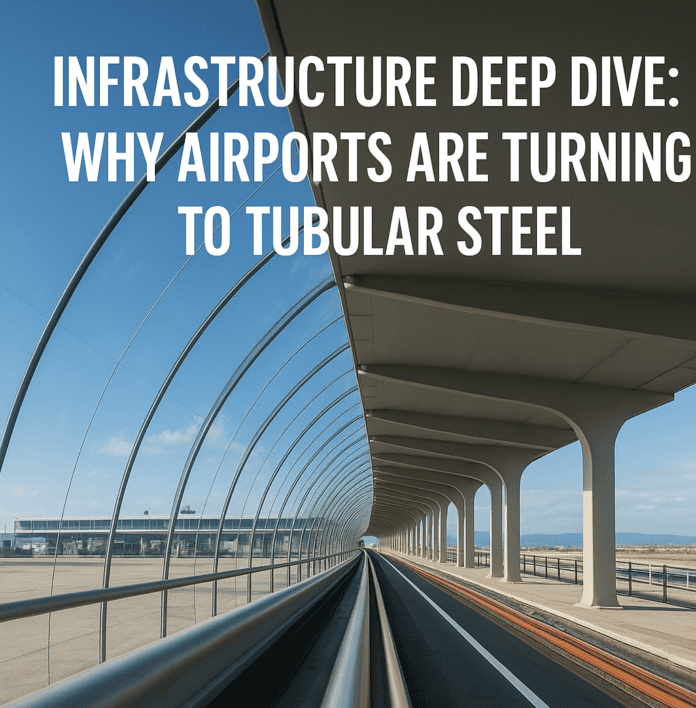
This is where long-span structures come in. By reducing the number of internal columns and maximising open space, they create vast halls with uninterrupted sightlines-a necessity when handling tens of thousands of people daily.
At Thiruvananthapuram, the upcoming expansion is expected to serve over 10 million passengers annually by 2030, up from the current ~4.5 million. Achieving this requires not just more space but smarter space, and tubular steel provides exactly that.
Why Tubular Steel?
Tubular steel sections are circular, rectangular, or square and offer unique structural and aesthetic advantages:
- Superior strength-to-weight ratio: Tubular members can span longer distances without buckling, allowing roofs to cover areas exceeding 60–70 metres in a single stretch.
- Aesthetics and lightness: The slender, curved appearance of tubular frames lends itself to the open, airy design that passengers increasingly expect.
- Efficiency under stress: Tubular structures distribute loads uniformly, making them highly resistant to wind, seismic forces, and heavy roof loads—a crucial factor in coastal regions like Kerala.
- Sustainability: Steel is 100 per cent recyclable, and tubular sections minimise material use compared to conventional rolled beams.
In practice, this translates into airy concourses, column-free waiting halls, and visually striking roofs that combine performance with elegance.
Case Study: Global Lessons and Local Relevance
Globally, airports such as Beijing Daxing and Heathrow Terminal 5 have used long-span tubular trusses to achieve column-free interiors of more than 80–100 m spans. In India, Mumbai’s Terminal 2 stands as a case study: its roof structure, supported by feature columns spaced at ~64 m × 34 m, showcases how tubular steel makes both engineering and passenger sense.
For Thiruvananthapuram, the lesson is clear. The airport’s Phase-III expansion can draw on these precedents to design a terminal that balances Kerala’s cultural identity with world-class structural solutions. The ability to move large numbers of passengers smoothly, while giving them unobstructed views of check-in counters, retail zones, and boarding gates, will directly impact customer satisfaction.
Passenger Experience: More Than Just Aesthetics
Air travel is stressful enough. Passengers notice when a terminal feels cramped, poorly lit, or difficult to navigate. According to the Airport Service Quality (ASQ) survey by Airports Council International, passenger satisfaction correlates directly with terminal layout, wayfinding, and perceived spaciousness.
Long-span tubular steel structures make this possible:
- Clear sightlines help passengers orient themselves, reducing anxiety.
- Natural lighting is maximised through wide-span skylights and glass façades supported by tubular frames, cutting energy use while improving comfort.
- Flexibility in space allocation means retail, lounges, and security areas can be reconfigured as passenger needs evolve.
For Thiruvananthapuram, which serves as a gateway not just for Kerala’s tourism but also for the state’s significant diaspora in the Middle East, this flexibility is vital.
Expert Takeaway
According to reports, the Airports Authority of India and private airport operators are targeting about ₹ 98,000 crore in capital expenditure over the next five years to develop new airports, expand existing terminals, strengthen runways, and improve other infrastructure.
Building for Tomorrow’s Passenger
The expansion of Thiruvananthapuram International Airport is more than a local infrastructure upgrade, and it is a window into the future of aviation design in India. By embracing tubular steel for long-span performance, the airport can ensure that it not only handles rising traffic volumes but also delivers an experience that is open, efficient, and memorable.
As the city prepares for its ₹1,436-crore twin investments—Project Anantha and the city-side commercial development—the message is clear: tomorrow’s airports will be built on steel but designed for people.
As India accelerates towards its aviation goals, airports like Thiruvananthapuram are becoming more than transit points as they are evolving into symbols of design innovation and engineering foresight. In our next Infrastructure Deep Dive, we will explore how similar material choices and long-span strategies are shaping metro projects and high-speed rail hubs, redefining the passenger journey across the country. Stay tuned—because the future of travel is being built right now, and it’s a story worth following every day.