

Hook: Steel Meets Intelligence on the Expressway
This month, India unveiled its first AI-powered Advanced Traffic Management System on Delhi’s Dwarka Expressway, a real-time adaptive platform that uses predictive algorithms to manage congestion and enhance safety. It is a milestone that underscores a growing truth: digital intelligence is now as critical to infrastructure as steel and concrete.
Steel Meets Intelligence on the Expressway
While specific figures on steel usage in the ATMS components have not been disclosed, the project’s sheer scale and technical complexity point to extensive reliance on steel. From the structural frameworks that support high-tech equipment to the durable enclosures protecting sensitive systems, steel likely plays a central role in ensuring the system’s stability, resilience, and long-term performance.
Steel in the Infrastructure Backbone
The ATMS infrastructure comprises high-resolution PTZ cameras, radar units, vehicle-actuated speed displays, and variable message signboards. These elements are typically housed in robust steel frames and enclosures to ensure durability and resilience against environmental conditions. In addition, the central control centre and associated structures likely employ steel in their skeletal frameworks, providing the necessary strength and stability to support sensitive electronic equipment.
Steel’s Role in Modernising Highways
Beyond the ATMS, steel is integral to the wider development of the Dwarka Expressway. The project includes tunnels, flyovers, and underpasses, all of which rely heavily on steel reinforcement and structural elements to meet safety and design standards. For comparison, the Mumbai Trans Harbour Link, another major infrastructure project, utilised approximately 96,250 tonnes of structural steel, underscoring the material’s essential role in large-scale civil engineering projects.
In summary, steel serves as the silent yet steadfast backbone of the Dwarka Expressway’s transformation into a smart highway, seamlessly integrating with advanced AI technologies to enhance safety and efficiency.
Bridging Progress: Virtual Models Meet High-Strength Steel
Consider the Chenab Railway Bridge, inaugurated in June 2025 which is the world’s tallest rail bridge, holding 29,000 tonnes of fabricated steel and rising 359 metres above the riverbed. SAIL’s Bhilai plant alone supplied 16,000 tonnes, a feat of both engineering and material science.
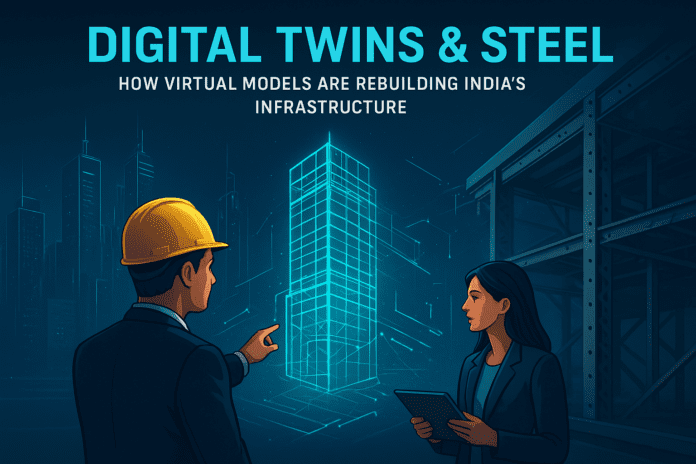
Now picture a digital twin layered onto this massive structure, a living, virtual replica that tracks structural performance, monitors wind loads, and simulates seismic stress. Such systems could flag maintenance needs, safety thresholds, or potential wear-and-tear well before they pose risks. In essence, digital twins are reshaping how we manage steel-heavy assets: from construction marvels into continuously monitored, future-ready infrastructure.
BIM: India’s Digital Backbone for Smarter Infrastructure
Earlier this year, Autodesk launched the “BIM Package for Viksit Bharat”, tailored to Indian standards—from MoRTH and IRC to Indian Railways codes. With localised tools in Revit and Civil 3D, BIM workflows now embed compliance directly into design.
At the Viksit Bharat Summit, policymakers emphasised how this synergy with steel on-site, digital models in the cloud, can deliver infrastructure faster, safer, and with fewer bottlenecks. By hardwiring compliance into design, BIM reduces rework and accelerates India’s goal of building at global benchmarks.
Digital Twins Advancing Beyond Design
The shift is not limited to design stages. At Bentley’s Innovation Day in Hyderabad, digital twin systems were showcased for transportation and water infrastructure, highlighting how these “living models” go beyond planning to drive real-time decision-making.
By integrating AI, GIS, and IoT sensors, digital twins continuously evolve alongside their physical assets. The result: resilient infrastructure that can adapt to stresses, optimise operations, and stay one step ahead of challenges.
India’s Live Digital Twin Deployments
The future is already here in select projects:
- Mumbai Trans Harbour Link: Digital twins enabled real-time monitoring during construction, allowing engineers to correct delays or quality issues instantly.
- Nagpur Water Network: Platforms combining hydrological modelling, GIS, and SCADA data reduced leaks and curbed non-revenue water, saving resources and costs.
These case studies highlight the shift from static, one-time blueprints to dynamic, data-driven infrastructure management.
Steel Meets Smart: The Future of Infrastructure
When applied to steel-intensive projects, the combination of BIM, AI, and digital twins offers a new playbook:
- Precision & Compliance: BIM ensures alignment with Indian standards from the outset.
- Lifecycle Savings: Digital twins extend asset life by predicting stress and maintenance needs.
- Risk Mitigation: Virtual testing against earthquakes or wind loads enhances safety.
- Sustainability: Predictive maintenance reduces material waste, aligning with climate goals.
- Collaboration & Efficiency: Unified models connect teams across geographies and disciplines.
Steel remains the skeleton of India’s mega-projects, but digital systems are becoming the nervous system that keeps them agile and resilient.
Expert Takeaway: Building Forward, Virtually
“With India leading in AI adoption for sustainable goals, BIM and digital twins are not just design tools but they are infrastructure in disguise,” notes a thought-leader from an American multinational software company
As India builds the bridges, highways, and skyscrapers of tomorrow, it is increasingly doing so twice-once in the digital world, and once in steel and stone. The result? Smarter, safer, and stronger infrastructure.
Future Forward Tuesdays: Each week SSMB Shorts will spotlight how India is fusing steel and digital innovation, so you return not just to read about projects, but to see where the future of infrastructure is heading.