

FROM BLUEPRINT TO BOARDING GATE – Ar. Aradhna Rawat, Terminal Lead Architect, Noida International Airport
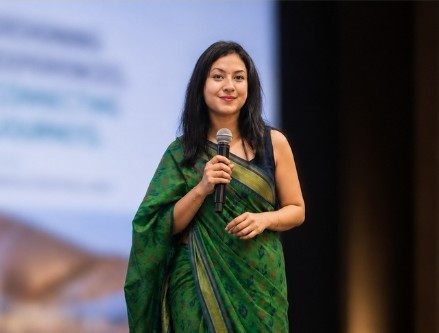
Architect Aradhna Rawat has been woven into the story of Noida International Airport from its earliest days. She designed the YIAPL office, developed the physical model that first brought the airport’s vision to the world, and went on to lead the terminal design from concept through construction and towards operations. The model was prepared for the stone-laying ceremony attended by Hon’ble Prime Minister Narendra Modi; today, the journey comes full circle as the airport moves towards its inauguration. Through the many complexities and challenges along the way, Aradhna’s association with the project has remained a steady one.
Aradhna brings to her practice a rare combination of technical precision and passenger empathy. In this conversation with SSMB, she reflects on designing for millions of people who may never consciously notice the architecture, the role of steel at scale, and what it really means to lead on a construction site.
Airport architecture is one of the most technically demanding and publicly visible specialisations in the field. What drew you to it, and was it a deliberate choice or did the work choose you?
If someone had asked me at the beginning of my career whether I would become an airport architect, I probably wouldn’t have imagined it. I often say that airport architecture found me before I consciously chose it. I started my journey on Delhi Airport’s Phase 3A project, where I was introduced to the incredible complexity and scale of aviation infrastructure. What began as a professional opportunity gradually became something much more meaningful. Then came Noida International Airport, where I had the privilege of serving as the Terminal Lead Architect.
That’s where I truly fell in love with airport architecture. There’s something incredibly rewarding about designing spaces that millions of people will pass through. Every decision has to balance technical precision with the human experience making journeys smoother, more intuitive, and more memorable. That’s what keeps me inspired. Today, I can’t imagine practising architecture any other way. I would say the work chose me first. But somewhere along the way, I chose it back.
Being in aviation architecture, how much of your architectural sensibility is shaped by the experience of being a traveller and a passenger, not just a designer?
I believe being a traveller is just as important as being a designer. Whenever I travel, I experience the airport as a passenger first and an architect second. I notice how easily I can find my way, how a space makes me feel, and the small details that can either ease or complicate a journey. Those experiences constantly remind me that every design decision ultimately impacts a real person. Our goal isn’t just to design an efficient terminal, it’s to create a journey that feels intuitive, comfortable, and memorable for every passenger. Every trip I take quietly becomes research. Every airport teaches me something new, and those lessons inevitably find their way into my work.
“Every trip I take quietly becomes research. Every airport teaches me something new, and those lessons inevitably find their way into my work.”
Airports are among the few building typologies where architecture, engineering, operations, and passenger psychology must all work simultaneously. How do you hold all of those layers in your head during the design process?
It can feel like solving a giant puzzle where every piece affects another. You can’t think only like an architect, you have to think like a passenger, an operations team, a security officer, an airline, and sometimes even a cleaner, all at the same time. The key is to never lose sight of who you’re designing for. If a space works seamlessly for passengers while meeting operational and technical requirements, you’ve done your job well. Airport design is really about finding that balance, and that’s what makes it so challenging and so addictive.
What does good airport design feel like to a person passing through it, and how do you design for an experience that most people will never consciously notice?
For me, good airport design is when passengers don’t have to stop and ask themselves, “Where do I go now?” or “Whom should I ask?” If the journey feels intuitive, they’re calm, and they can move through the terminal without constantly looking for help, then the design is doing its job. The fewer questions that pop into a passenger’s mind, the better the designed space. We’re not just creating a building; we’re quietly guiding millions of people through an unfamiliar environment without them even noticing it. And honestly, if passengers never think about the architecture because everything simply works, that’s one of the biggest compliments an airport architect can receive.
You are working on Noida International Airport, a greenfield project that will redefine air travel in the NCR region. What has been the most complex design challenge on a project of that scale and ambition?
Noida International Airport was a true greenfield project, so the challenges went far beyond architecture. In the early days, even reaching the site was an adventure. We were also building a new organisation. The team was just setting up in Noida, so while designing the terminal, we were also designing our own office. We had a small team, consultants spread across the world, different time zones, and then COVID arrived in the middle of it all. Coordinating everyone often felt like conducting an orchestra across continents. Looking back, those challenges made the project what it is today. They taught us resilience, teamwork, and that great airports aren’t built by drawings alone, they’re built by people working together with a shared vision.
At what point in a project do you feel the architecture is truly resolved, is it on paper, during construction, or only when people are actually using the space?
For me, architecture is never truly resolved on paper. Drawings give it form, construction gives it life, but it is only when people start using the space that you know whether it really works.
Airport terminals involve massive structural spans, complex facades, and highly serviced interiors, all of which involve steel in significant ways. How has working with steel at this scale shaped your understanding of the material?
Before aviation, I appreciated steel primarily as a structural material. But working on large airport projects like Delhi Airport Phase 3A and Noida International Airport completely changed that perspective. At this scale, steel isn’t just about strength, it’s what makes the large, column-free spaces, complex facades, and architectural vision possible. It has taught me that the best structural solutions are often the ones passengers never notice but experience every moment they walk through the terminal.
Infrastructure and airport architecture have historically been male-dominated in India at the senior level. What has your experience been, and where do you still feel the gap most acutely?
The industry has certainly evolved, and I feel fortunate to be part of an organisation that genuinely believes in empowering women. At Yamuna International Airport Private Limited (YIAPL), a 100% subsidiary of Zurich Airport International AG, many key leadership positions, including our COO, CFO, and Head of HR are led by remarkable women who are doing an exceptional job.
That sends a very strong message to everyone in the organisation. Personally, being entrusted with the responsibility of leading the Terminal Design for Noida International Airport has been both an honour and a responsibility. I am grateful to the management for placing their trust in me and giving me the opportunity to contribute at this scale. There is still room for greater representation across the industry, especially in senior technical and decision-making roles, but I’m encouraged to see that the change has already begun.
Large construction sites, especially active airport sites, can be environments where women architects face friction that has nothing to do with their competence. How have you navigated that, and what has it cost you?
I won’t say the journey has always been effortless. Construction sites have traditionally been male-dominated, and at times I’ve had to work a little harder to earn people’s confidence. But I have always believed that competence speaks louder than stereotypes. What has helped me most is the support of my organisation and leadership, who have always trusted me with responsibility based on my capabilities, not my gender. Over time, I found that once people see your commitment, preparation, and consistency, they stop seeing you as a woman architect, they simply see you as the architect leading the project. If there’s one thing this journey has taught me, it’s that confidence is earned through your work, and respect follows.
“Once people see your commitment, preparation, and consistency, they stop seeing you as a woman architect, they simply see you as the architect leading the project.”
You are still early in what is clearly going to be a long career. What do you wish someone had told you at the start about what this profession actually demands of you?
I wish someone had warned me that architecture would happily steal my sleep. There have been countless late nights, endless revisions, and moments when a design problem follows you home and refuses to leave your mind. It really does demand a little piece of your heart and soul. When I was choosing a career, I wasn’t entirely sure what I wanted to do, but I knew what I didn’t want to do. Somehow, architecture found me, and today I genuinely feel there isn’t another profession that would do justice to my personality, creativity, and way of thinking. It’s demanding, it’s unpredictable, and it’s definitely not a 9-to-5 job, but I wouldn’t have it any other way. I absolutely love what I do.
If a young woman in architecture came to you and said she wanted to specialise in airports and infrastructure, a path very few take, what would be the first thing you would tell her?
I would simply say, “Go for it, girl. The sky isn’t the limit, you will be designing where it begins!” Stay curious, keep learning, and don’t ever underestimate yourself. Airport architecture will challenge you every single day, but that’s also what makes it so rewarding. If you put your heart into it, you’ll never stop learning and you’ll never stop being amazed by what you can create.
WHY IT MATTERS
Architect Aradhna Rawat represents a generation of women architects who are not just entering spaces previously closed to them, but leading the most complex projects within those spaces. Her work on Noida International Airport, a greenfield project built through a pandemic, across continents, with a team assembled from scratch, is proof that technical ambition and human-centred design are not competing values. In an industry where women at senior levels remain the exception, her voice is both a milestone and a signal of where the profession is headed.