

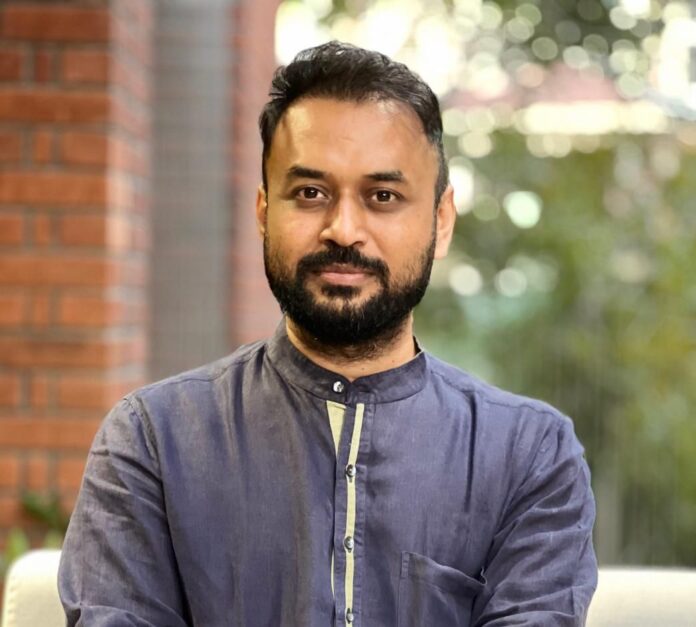
Introduction: TARUN PATEL, Principal Architect and Urban Planner at MISA Architects, has spent over two decades designing buildings that refuse to apologise for their structure. With a practice rooted in physical and urban planning, he brings a systems thinker’s rigour to every material decision. In this conversation with SSMB, he reflects on steel’s honest character, its lifecycle advantages, and why the real potential of this material in India is still largely untapped.
What role does steel play in achieving architectural versatility in your projects?
Steel has a distinct character, and we strongly believe in the honesty of materials. Its high strength-to-weight ratio makes it especially valuable in designing long-span buildings where the intent is to minimise large columns. Compared to conventional concrete systems, steel offers significantly greater design flexibility and creative freedom, which is something I particularly appreciate about the material. Steel is also honest in its expression. It enables innovative forms and detailing while enhancing both creative possibilities and structural flexibility in design as well as execution.
How do you balance aesthetics and functionality when designing with steel?
We recently designed an Ornate Transformer Factory, and that project perhaps best answers this question. The structural requirements did not initially align with our aesthetic vision. The proposed column and beam sizes were larger than what we had visually envisioned, as they were essential to ensure resilience and structural stability. Rather than resisting these constraints, we chose to work with them. We developed a service-bay typology that allowed these larger structural elements to be meaningfully integrated into the overall design.
The oversized columns, for instance, were treated not as visual obstructions but as opportunities. They were carefully detailed and planned to also function as service spaces within the facility. This is how we balance aesthetic intent with structural necessity. We always begin by incorporating the inputs of structural designers and then explore how those technical requirements can be transformed into design strengths rather than limitations.
How does designing with steel support your approach to sustainability and long-term environmental goals?
A typical steel structure has a life expectancy of 50 to 60 years, yet there are several notable examples that far exceed this. The Golden Bridge in Gujarat, for instance, has stood for over 150 years with minimal major maintenance, something that would have been significantly more demanding with concrete. Steel offers genuine flexibility in lifecycle planning, allowing structures to be modified, adapted, and extended for new purposes rather than demolished and rebuilt.
Unlike concrete, which often requires destruction and recasting, steel can be directly reused or melted and reformed into new products. With advancements in fire-rated coatings and protective systems, projects today are increasingly moving towards long-life, releasable structures, where components can be dismantled, reassembled, and repurposed over time. This adaptability and recyclability are what make steel an inherently sustainable material.
“When you consider reuse, repurposing, and reduced construction time, steel often proves to be a more sensible option than a typical concrete building.”
What misconceptions about steel do you frequently encounter in the design and construction space?
The most common misconception is that steel construction is significantly more expensive. However, in the buildings we have designed, once factors such as circularity and the ability to reuse and repurpose steel are considered, it does not necessarily prove to be costlier. Even when compared purely on construction cost, steel and concrete systems are often fairly comparable.
What gives steel a distinct advantage is the speed and ease of construction. Steel buildings can generally be erected much faster, and once the value of time is factored into the equation, steel becomes a far more practical and beneficial solution. So, while many perceive steel as an expensive option, when aspects such as reuse, repurposing, and reduced construction timelines are considered, it often emerges as the more sensible choice.
How do you approach collaborations with engineers and fabricators when working on steel-intensive projects?
Whatever form or design experience we aim to create, we involve structural engineers right from the initial stage. There are aspects that we, as architects, may sometimes overlook, whereas structural engineers bring deeper technical expertise and insights that are genuinely valuable to the process. The same applies to fabricators. They understand the practicalities of execution, the challenges involved in fabrication and erection, and the on-site realities that architects may not always fully anticipate.
By involving both structural engineers and fabricators from the very beginning, their practical knowledge helps refine the design, minimise wastage, and optimise resources throughout the construction process.
“Brick and steel can complement each other effectively, that balance is something we are yet to fully explore in futuristic buildings.”
Are there any advancements in steel technology or fabrication that you are particularly excited about?
We are currently working on a factory project namely Govind Bronze in Gujarat, where we have adopted a far more precise and technology-driven approach. Instead of using a typical built-up or aisle section, we developed a system in which a structural net is digitally designed and then cut using CNC technology.
With the support of an AI engineer, the model was developed computationally, and the designed net is being cut from steel plates using a CNC waterjet machine before being reassembled on site. The level of precision achieved through this process is incomparable to manual fabrication. It represents a new way of thinking about industrial buildings, moving beyond conventional methods towards more accurate, efficient, and technologically advanced fabrication systems.
What role do you think steel will play in redefining India’s urban infrastructure and built environment in the future?
At present, we are largely exploring steel as a material for fast construction. However, its potential extends far beyond speed alone. Steel has the ability to create powerful sensorial experiences and can even assume sculptural forms, as seen in some of our newer airports. There is still immense scope for exploration. For instance, why should residential buildings continue to rely almost entirely on RCC construction when steel can offer equally compelling possibilities.
At the same time, steel should not be viewed in isolation. In hot and dry climates, materials such as brick may prove to be more contextually appropriate when used thoughtfully and in balance. The key lies in using each material wisely. Steel undoubtedly has the potential to play a far greater role in shaping India’s evolving urban landscape.
SSMB POV:
“From honest expression and adaptive reuse to digital fabrication and collaborative execution, the interview reinforces steel as not just a construction material, but a future-ready design system capable of redefining India’s built environment.”