

As the Amrit Bharat Station Scheme transforms railway infrastructure across the country, tubular steel sections are emerging as the preferred structural solution for the new generation of Foot Over Bridges. Amrit Bharat FOBs offer a compelling glimpse into how hollow sections are redefining speed, safety and architectural expression.
Indian Railways is undergoing one of the largest station modernisation programmes in its history. While passengers immediately notice upgraded façades, improved concourses and enhanced amenities, another transformation is quietly taking shape above the platforms.
The Foot Over Bridge (FOB) has evolved from being a simple pedestrian crossing into a defining architectural and functional element of modern railway stations. Under the Amrit Bharat Station Scheme, railway stations are increasingly adopting wider, barrier-free, aesthetically superior and structurally efficient foot over bridges that improve passenger circulation while complementing contemporary station architecture. Research Designs and Standards Organisation guidelines have promoted 12-metre-wide central FOBs at many redeveloped stations, supported by standardised designs to accelerate implementation.
At the heart of this evolution lies an engineering material that is changing the way these bridges are designed and built: structural hollow sections.
The latest FOBs being developed under the Railway Land Development Authority demonstrate how tubular steel, particularly Tata Structura hollow sections, is enabling lighter structures, cleaner aesthetics, faster construction and lower lifecycle maintenance. More importantly, these bridges signal the direction in which railway infrastructure across India is moving.
“The next generation of railway Foot Over Bridges is no longer defined by heavier steel, but by smarter steel.”
CASE STUDY
Amrit Bharat Foot Over Bridges: Engineering Seamless Mobility Through Steel
As part of the Amrit Bharat Station Redevelopment Programme, railway stations across India are witnessing the construction of next-generation steel foot over bridges that redefine passenger connectivity. Engineered using tubular structural sections, these concourse bridges deliver superior strength, faster construction and enhanced aesthetics while ensuring seamless, safe and efficient access to station concourses.
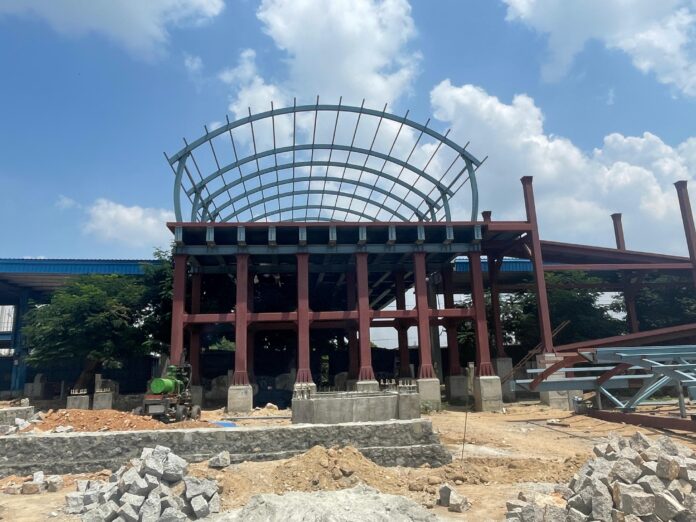
Unlike conventional truss-heavy pedestrian bridges of the past, the new generation embraces clean geometry, elegant roof forms and long, unobstructed spans. These FOBs reveal graceful curved tubular roof ribs resting over robust steel framing, creating an architectural identity while maintaining structural efficiency.
These standardised Foot Over Bridges are typically engineered for spans of 25–32 m, employing a composite I-girder system in combination with tubular steel sections. This structural configuration delivers longer clear spans, reduced self-weight, faster installation and an aesthetically refined profile, making it ideal for modern railway stations under the Amrit Bharat Station Scheme.
The bridge framework combines fabricated steel members with tubular roof arches that distribute loads efficiently while reducing overall structural weight. The resulting structure appears visually lighter without compromising strength, an increasingly important consideration in busy railway environments where rapid erection and minimal disruption are essential.
Because a significant portion of fabrication is completed off-site, installation time is substantially reduced. Components arrive ready for assembly, allowing erection activities to be completed within short traffic blocks, thereby minimising disruption to railway operations.
This modular approach aligns perfectly with the objectives of the Amrit Bharat Station Scheme, where multiple stations are being upgraded simultaneously across the country.
WHY TUBULAR SECTIONS ARE LEADING THE CHANGE
The growing adoption of structural hollow sections is not merely an architectural preference; it is driven by engineering performance.
Compared to conventional open sections, tubular members offer higher strength-to-weight ratios, superior torsional resistance and excellent load distribution characteristics. Their closed profile also provides better resistance against corrosion by eliminating exposed edges where moisture typically accumulates.
For railway infrastructure, these advantages translate directly into tangible project benefits.
- The reduced self-weight lowers foundation requirements.
- Higher structural efficiency enables longer clear spans.
- Factory fabrication ensures superior dimensional accuracy.
- Smooth surfaces improve durability and simplify maintenance.
Most importantly, tubular members present a refined architectural appearance without requiring additional cladding or cosmetic treatment.
These attributes have made products such as Tata Structura structural tubes increasingly relevant for infrastructure applications ranging from railway FOBs to airports, metro stations, industrial buildings and logistics facilities.
DESIGN MEETS EXPERIENCE
One of the defining characteristics of the RLDA Design FOBs is in their roof profile and large walkway. The sweeping curved tubular ribs not only create a striking visual identity but also allow efficient drainage, facilitate lightweight roofing systems and provide large column-free spaces for passenger movement below.
The bridges also demonstrate how structural engineering and architecture are becoming increasingly integrated. Rather than concealing the structure, the steel framework itself becomes the architectural expression. Every tubular arch contributes simultaneously to structural performance and visual identity.
This philosophy reflects a broader shift in infrastructure design where public utilities are expected to deliver both engineering excellence and civic aesthetics.
“Tubular sections combine structural efficiency, architectural elegance and construction speed, making them ideally suited for India’s railway modernisation programme.”
SUPPORTING INDIA’S INFRASTRUCTURE MISSION
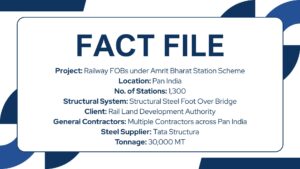
The Amrit Bharat Station Scheme represents one of Indian Railways’ most ambitious infrastructure initiatives, targeting the phased redevelopment of more than 1,300 railway stations across the country. The programme focuses on improving passenger experience through upgraded station buildings, multimodal integration, enhanced accessibility and improved circulation systems, including modern foot over bridges.
Every redeveloped station requires infrastructure that can be delivered quickly, perform reliably over decades and minimise maintenance costs. Tubular steel answers all three requirements.
Its compatibility with prefabrication, modular construction and standardised design enables railway authorities to accelerate execution while maintaining consistent quality across projects. As more stations adopt similar engineering principles, hollow structural sections are expected to play an increasingly significant role in India’s railway modernisation programme.
CONCLUSION
The Amrit Bharat Foot Over Bridges are more than individual infrastructure projects. They represent the evolution of railway engineering itself. What was once viewed as a functional pedestrian connector has become a sophisticated piece of public infrastructure that is lighter, faster to construct, aesthetically refined and engineered for long-term performance.
As India’s railway stations continue their transformation under the Amrit Bharat Station Scheme, tubular steel is quietly becoming one of the key enablers behind this new generation of infrastructure.
For the steel construction industry, the message is equally significant. The future of railway mobility will not simply be built with steel. It will increasingly be shaped by the versatility, efficiency and architectural possibilities of structural hollow sections.
SIDEBAR
Why Tubular Steel Works for Railway FOBs
- Higher strength-to-weight ratio
- Better torsional performance
- Reduced structural weight
- Faster prefabrication and installation
- Cleaner architectural appearance
- Lower maintenance due to closed profiles
- Ideal for long-span pedestrian bridges
- Compatible with modular construction techniques