

Building the Backbone of Air India’s Aviation Renaissance
Intro: At Kempegowda International Airport, Bengaluru, a new Maintenance, Repair and Overhaul facility is under execution, conceived not as a construction project but as a long-term aviation asset, one aligned with global standards, operational resilience, and India’s growing role in the international aerospace ecosystem. Delivered through the Tata Group’s integrated capabilities, the Bengaluru MRO reflects a shift in how aviation infrastructure is being planned and executed in India, where engineering depth, execution certainty, and lifecycle thinking converge.
BUILDING MORE THAN INFRASTRUCTURE
Spread across nearly 40.38 acres within the airport’s south-eastern airside precinct, the MRO masterplan has been structured as a phased development programme capable of supporting both narrow-body and wide-body aircraft maintenance operations.
While the facility will undoubtedly add significant maintenance capacity, its larger significance lies in strengthening India’s aviation self-reliance. By enabling heavy maintenance activities within the country, the project aims to reduce overseas dependence, improve fleet availability, and create a stronger domestic aerospace support ecosystem.
For Tata Projects, the distinction between constructing a facility and creating a capability defines the entire programme. The objective has never been limited to delivering a building. Instead, the focus has been on developing an aviation asset capable of supporting decades of operational performance. Every design decision, construction methodology, and engineering intervention has therefore been evaluated through the lens of long-term functionality, maintainability, and resilience.
A HANGAR WITHOUT COMPROMISE
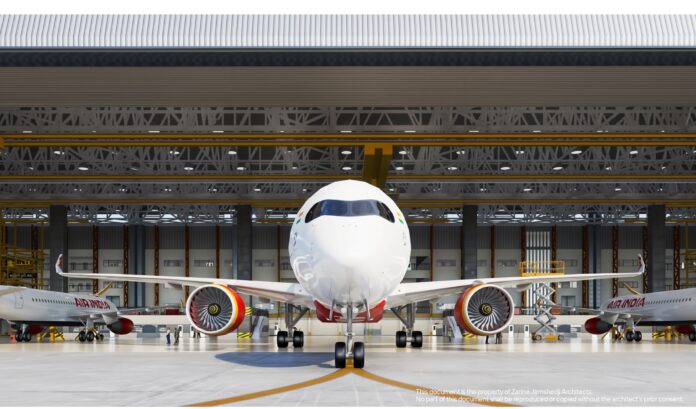
At the heart of Phase 1 stands Hangar-1, one of the largest free-span aircraft maintenance hangars currently under construction in India. With an impressive clear span of 239.35 m, a clear internal height of 24 m, and an overall structural height approaching 35 m, the facility has been designed to simultaneously accommodate three wide-body and two narrow-body aircraft.
Such operational flexibility demands an entirely column-free environment. Within a maintenance hangar, unobstructed aircraft movement, docking operations, servicing access, and equipment circulation are not conveniences, they are operational necessities.
Delivering this requirement called for a highly sophisticated long-span structural system capable of balancing strength, stability, serviceability, and constructability. Deflection control, structural behaviour under extreme loading scenarios, erection sequencing, and integration of aviation-specific systems all had to function as parts of a single coordinated engineering solution.
Given the project’s scale and criticality, independent proof-checking by IIT Madras was incorporated to validate structural assumptions and assess performance under critical load combinations, reinforcing the project’s commitment to engineering rigour and institutional accountability.
A CONSORTIUM DESIGNED FOR COMPLEXITY
Projects of this magnitude rarely succeed through isolated expertise. Recognising the multidisciplinary nature of the challenge, Air India adopted a consortium-led EPC delivery model. Tata Projects serves as consortium leader, while Aircraft Support Industries contributes specialist expertise in aviation hangar systems and structural steel engineering. Supporting the programme are STUP Consultants, Zarine Jamshedji Architects, AECOM, and IIT Madras, each bringing specialised capabilities across structural engineering, architecture, project management, and independent verification.
In aviation infrastructure, precision and accountability must coexist. Complex projects often struggle to balance these objectives wherein specialised expertise can fragment ownership, while centralised control can dilute technical depth. The consortium structure addresses this challenge by creating clearly defined responsibilities while maintaining a unified project vision. Each partner contributes domain excellence; the outcome remains collective.
“The consortium structure ensures depth of expertise while maintaining clarity of responsibility.”
BUILDING INSIDE A LIVING AIRPORT
Few construction environments are as demanding as an active airfield. Unlike conventional industrial projects, every construction activity within an operational airport must coexist with live aviation operations. Height restrictions, BCAS security protocols, controlled lifting procedures, aerodrome safety regulations, and airside movement constraints influence virtually every decision taken on site.
In such an environment, predictability becomes as important as performance. The project team has therefore adopted an execution philosophy focused on eliminating risk through planning rather than mitigating it after the fact. Extensive off-site fabrication of major steel assemblies forms a cornerstone of this strategy.
Manufacturing structural components in controlled factory environments ensures tighter dimensional accuracy, improved quality assurance, better application of fire-protection systems, and reduced on-site activity within the highly regulated airside zone.
“In airside construction, predictability is as critical as performance.”
WHERE DIGITAL ENGINEERING MEETS INDUSTRIALISED CONSTRUCTION
One of the project’s most significant engineering innovations is the adoption of strand-jacking technology for roof erection. Rather than assembling major roof components at height, large structural sections are first assembled at ground level and then lifted using synchronised hydraulic strand jacks. For the Bengaluru MRO, roof sections weighing nearly 6,000 tonnes will be elevated with exceptional precision, reducing work-at-height exposure, enhancing safety, and ensuring accurate positioning of these massive structural assemblies.
For a hangar of this scale operating within airport constraints, the construction methodology is not simply a means of execution, it becomes an integral part of the engineering solution itself. Complementing this physical strategy is a comprehensive 5D BIM environment that governs the project’s digital execution framework.
Far beyond clash detection and design coordination, the BIM platform integrates construction sequencing, multidisciplinary collaboration, progress monitoring, cost management, and lifecycle asset data. Importantly, the digital model has been developed with the intention of supporting facility operations long after construction is complete, extending its value well beyond project delivery.
Approximately 18,000 tonne of E350 structural steel form the backbone of this vision. Large-span roof trusses, built-up girders, primary columns, and secondary framing systems have been engineered for strength, durability, and efficient erection sequencing, creating a structural framework capable of supporting decades of intensive aviation operations.
“The model is designed to outlive construction and support long-term asset management.”
CREATING AN INTEGRATED MRO ECOSYSTEM
The Bengaluru MRO extends far beyond the iconic hangar structure. Phase 1 encompasses aircraft aprons, maintenance pavements, specialised workshops, component repair facilities, warehousing infrastructure, engineering offices, utility systems, logistics zones, and advanced docking equipment. Together, these elements create a fully integrated maintenance ecosystem rather than a collection of standalone facilities.
Sustainability considerations have also been embedded into the development strategy, with the project aligned to LEED Platinum benchmarks. Energy efficiency, material longevity, operational resilience, and resource optimisation have been incorporated from the earliest stages of design, ensuring that performance and sustainability advance together.
Beyond its operational role, the Bengaluru MRO reflects India’s growing aviation aspirations. As the country strengthens its aerospace ecosystem and expands domestic maintenance capabilities, facilities such as this will play a pivotal role in shaping the next chapter of India’s aviation renaissance.