

How intelligent material handling is becoming the first operation in every successful industrial project
Introduction: Before a factory makes anything, it has to move something. Steel plates have to reach fabrication bays. Heavy components have to be transferred between workstations. Pressure vessels have to be positioned. Machine tools have to be installed. Finished assemblies have to move through the plant. In a modern industrial facility, thousands of such movements take place every day, often without attracting the attention given to the manufacturing process itself. Yet every movement carries a time implication, a productivity consequence and, often, a safety consideration.
A 25-tonne steel plate has to be moved without unnecessary swing. A pressure vessel may need to be rotated with precision. A machine worth crore may have to be positioned within tight tolerances. A bridge girder may have to travel across an entire bay without disrupting surrounding operations.
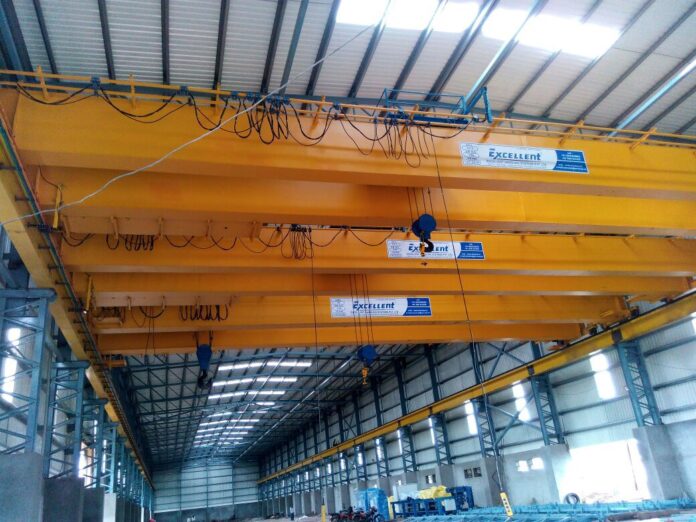
What appears to be a simple lift is actually an engineered operation. The crane has to match the load, duty cycle, span, lifting height, environment and production requirement. Its controls have to deliver the necessary precision, its safety systems have to protect people and assets, and its reliability has to support production continuity.
In modern industry, movement is production. Yogesh Gore, Director, Excellent Handling Systems, points to the broader shift in India’s material-handling landscape, from conventional crane systems towards automated, energy-efficient and digitally monitored solutions. At the same time, the industry’s focus is moving beyond capacity and price towards safety, productivity, reliability and lifecycle cost. The crane, in other words, is beginning to move from the periphery of the factory towards its production architecture.
INDIA’S FACTORIES ARE GROWING, SO ARE LIFTING REQUIREMENTS
India’s industrial expansion is changing the scale and complexity of material movement. EV and battery manufacturing, steel processing, precast, automotive, infrastructure, heavy engineering, defence, renewable-energy manufacturing, logistics and warehousing are creating very different lifting requirements. Loads are becoming heavier, production cycles tighter and facilities increasingly automated and digitally connected.
A crane serving a heavy fabrication shop may face very different demands from one operating within an automotive or logistics facility. One application may prioritise capacity and reach; another may require high positioning accuracy, frequent cycles or integration with automated systems. This diversity is driving demand for application-specific lifting solutions.
Gore identifies steel, precast, infrastructure, automotive, heavy engineering and logistics among the sectors driving strong demand, particularly as they seek automation, precision, higher productivity and reduced downtime. The implication is important: the crane is no longer simply equipment placed inside a factory. Increasingly, it is part of how the factory is designed to work.
EVERY MANUFACTURING REVOLUTION BEGINS WITH MOVEMENT
Industry 4.0 has brought automation, robotics, AI and digitalisation to the centre of manufacturing conversations. But beneath all that sophistication is a physical reality: material still has to move. A component cannot be assembled until it reaches the workstation. A machine cannot produce until it is positioned. A finished assembly cannot move to the next stage until it is transferred.
The more sophisticated the manufacturing system becomes, the more important this movement becomes. A highly automated production line can still lose efficiency because material arrives late. A digitally connected plant can still suffer production losses when a critical crane is unavailable. A precision process can still be compromised by uncontrolled handling.
The relationship is therefore direct: Material flow dictates production flow. Production flow dictates productivity.
Pramod Divate, Director, Excellent Handling Systems, sees increasing control and technology as central to making this movement more predictable. Precision lifting, automated controls and monitoring are becoming integral to how cranes support modern production rather than simply additional features attached to them.
The manufacturing revolution may be digital. But it still has to move physically through the factory.
THE LIFT NEEDS TO BE DESIGNED INTO THE BUILD
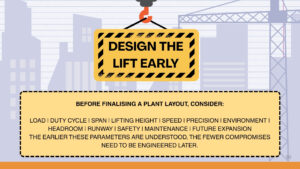
One of the most expensive mistakes an industrial project can make is to treat the crane as something to be specified after the building has already been designed. By then, structural arrangements, bay dimensions, headroom and runway provisions may already be fixed. Hook approaches may be restricted, maintenance access may be difficult and future expansion may become more complicated.
Early crane planning changes that equation. Divate points out that when lifting requirements are considered during plant planning, the building structure, bay dimensions, headroom and material flow can be designed together. This can reduce costly modifications while improving productivity, safety and crane accessibility. The question therefore needs to change from: “Which crane will fit this building?” to: “What lifting system does this process require, and how should the building support it?” That is no longer merely a procurement question. It is a plant-design question.
BEYOND CAPACITY: ENGINEERING THE RIGHT CRANE
The most familiar crane-selection question is: How many tonnes does it need to lift? Capacity is fundamental. But it describes only one part of the job. A crane lifting a particular load occasionally has different requirements from one performing hundreds of cycles every day. Span, lifting height, operating speed, duty class, load characteristics and working environment all influence the design. So do headroom, runway limitations, power supply, controls, safety requirements and future expansion.
Gore notes that industries often still give disproportionate importance to initial cost and lifting capacity, even though the wider operating parameters are equally important. This is why customised crane engineering begins with the application.
As Gore explains, the process starts by understanding material flow, load characteristics, duty cycle and operating environment before configuring the mechanical, electrical and control systems around the specific requirement. Whether the eventual solution is a single-girder, double-girder, semi-goliath, goliath, jib or special-purpose crane, the equipment should be the outcome of the engineering exercise.
PRECISION IS PRODUCTIVITY
Heavy lifting is no longer only about strength. Modern manufacturing increasingly demands controlled, repeatable movement. A heavy load may need to accelerate smoothly, travel across a bay, decelerate without excessive swing and settle accurately at its destination. Every unnecessary correction consumes time. Every uncontrolled movement introduces risk.
Divate highlights the role of precision control in this equation. Smooth acceleration and deceleration and accurate positioning can reduce load swing and accidental impact while improving handling accuracy, product protection and workplace safety. The productive lift, therefore, is not necessarily the fastest lift. It is the movement that gets the load where it needs to go with the least unnecessary intervention.
That distinction becomes increasingly important as factories seek higher throughput and greater automation.
WHEN THE CRANE STOPS, PRODUCTION MAY STOP
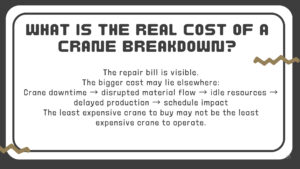
A crane does not directly manufacture a product. But a critical crane breakdown can leave production waiting. Material may remain stranded. Operators may become idle. Downstream processes may be delayed. Production schedules may need to be rearranged. Maintenance teams may have to respond to an unplanned failure. This makes crane availability a production issue.
Gore points to the role of correctly selected drives, motors, brakes and control systems in improving energy efficiency and reliability. Condition monitoring and predictive maintenance can further reduce unexpected breakdowns and associated production losses. The economics of a lifting system therefore need to extend beyond purchase price. Energy consumption, reliability, maintenance, availability and downtime all contribute to lifecycle cost.
THE CRANE GETS SMART
The transformation of lifting is increasingly following the transformation of manufacturing itself. For Divate, the significance lies in the collective impact of these technologies. Anti-sway can improve control. Load monitoring provides greater visibility. VFDs enable more controlled movement. Anti-collision systems add another layer of protection. Remote monitoring brings equipment information beyond the physical crane.
Automation takes the idea further by allowing repeatable movements to become part of programmed material-flow sequences. The crane is no longer simply executing commands. It is increasingly capable of sensing, controlling and communicating.
FROM REACTIVE MAINTENANCE TO INTELLIGENT MAINTENANCE
Traditional maintenance waits for failure. Connected equipment makes another model possible. Condition monitoring allows teams to understand equipment behaviour while it is operating. Predictive approaches seek to identify developing problems early enough for intervention to be planned rather than forced by an unexpected breakdown.
Divate describes this as a shift from reactive breakdown maintenance towards condition-based and predictive maintenance, with real-time data and automation supporting equipment availability, safety, productivity and maintenance planning. For the plant, the benefit is not simply a healthier crane. It is a more predictable production environment. That distinction is critical.
DESIGNING FOR TOMORROW
Factories do not remain static. Products change. Production volumes change. Layouts evolve. Automation increases. New machinery is introduced. Material flows are reorganised. A lifting system designed only around today’s requirement can eventually become a constraint on tomorrow’s plant.
Future expansion therefore needs to enter the engineering conversation early. Runway arrangements, headroom, structural provisions and potential changes in load profiles can influence how adaptable a facility remains. The same principle applies to technology.
Gore believes the next generation of industrial lifting will be defined by smart monitoring, automation, energy efficiency and advanced safety systems, with intelligent cranes increasingly capable of monitoring their own health, optimising operation and integrating with plant systems. The future-ready crane is therefore not simply one that lasts for decades. It is one that can remain relevant as the factory around it changes.
THE LIFT BEFORE THE BUILD
Industrial progress is usually measured by what is visible. The new factory. The automated line. The robotic cell. The machine tool. The bridge. The turbine. The finished steel structure. But before any of these achievements become visible, there is movement.
Steel has to reach fabrication. Components have to reach assembly. Machines have to be positioned. Heavy structures have to be transferred. Finished products have to move to their next destination. That movement is easy to overlook when it works well.
Yet as India’s industrial facilities become larger, more automated and more connected, material handling can no longer remain an afterthought. The crane is becoming part of the plant’s production architecture. Its capacity matters, but so do its duty cycle, precision, reliability, safety, energy consumption, maintainability and digital readiness. Its purchase price matters, but so does the cost of every hour it is unavailable.
“The least expensive crane to buy may not be the least expensive crane to operate.”
“The crane is no longer simply executing commands. It is increasingly capable of sensing, controlling and communicating.”
“The future-ready crane is not simply one that lasts for decades. It is one that can remain relevant as the factory around it changes.”