

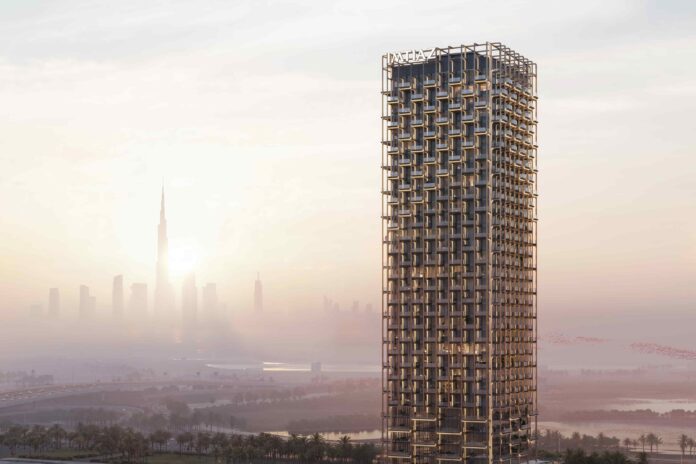
In Dubai’s rapidly evolving skyline, The Symphony is set to make its mark not through height alone, but through a steel exoskeleton that appears to weave itself around the tower. Inspired by the intricate geometry of Al Sadu weaving and Talli embroidery, the 42-storey structure turns steel into a three-dimensional architectural language, one that changes in depth and tone as daylight moves across its façades.
Designed by Zaha Hadid Architects for Imtiaz Developments, The Symphony is located in Dubai’s new Horizon district, between Meydan Racecourse and the waters of Ras Al Khor. Its defining exoskeleton is more than a visual statement. The interwoven structure establishes the rhythm of the façades while shaping a series of outdoor spaces for the apartments, with the depth of the terraces responding to the geometry of the structural grid.
This is where the steel application becomes particularly compelling. The precision-engineered exoskeleton has been conceived to serve both structural and environmental purposes. By shading the façades, it helps reduce solar gain, while the projecting terraces provide greater protection for outdoor living areas in Dubai’s intense climate. Rather than adding a decorative layer to the building, the steel framework becomes an active part of its environmental response.
The material strategy extends beyond structural performance. Modular construction methods and the use of recycled steel are proposed as part of the project’s approach to reducing embodied carbon, alongside low-carbon concrete and responsibly sourced finishes.
The relationship between steel and the building’s identity becomes even more visible after sunset. Photovoltaics charge batteries during the day, with the stored energy used to illuminate the three-dimensional lattice. Its soft amber glow recalls the metallic threads of Talli embroidery, allowing the same structural language to shift from a response to sunlight by day to a luminous architectural feature at night.
The Symphony presents a distinctive way of thinking about steel in high-rise architecture. Here, the exoskeleton is not simply a structural solution or a façade treatment. It is the element that connects structure, climate, material efficiency and cultural expression, turning steel into the defining thread of the building’s identity.