


Why Fire Engineering Must Sit at the Structural Design Table From Day One
WHY WE CONTINUE TO DESIGN FIRE BACKWARDS
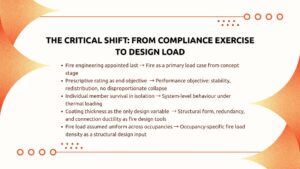
The sequencing of a typical project explains much of the problem. Architecture progresses, the structural system is established, members are sized, connections and services are coordinated, and only then does fire engineering frequently enter the picture. By this stage, the framing arrangement, load paths and member sizes may already be substantially fixed. The fire engineer is left to protect an existing structural solution rather than influence how that structure responds to fire.
Prof. L.S. Jayagopal, Managing Director, Mithran Structures Pvt. Ltd., sees the current renewed interest in fire safety design in the context of a much broader evolution. Changes in building codes, lessons from major fire disasters and advances in engineering analysis have collectively pushed the industry towards performance-based thinking. Instead of prescribing a single route to compliance, performance-based codes focus on defined safety objectives and allow engineers to develop solutions around the actual behaviour expected from the building.
This freedom, Prof. Jayagopal stresses, demands deeper engineering. Fire scenarios, thermal response and structural behaviour have to be understood rather than assumed. The objective is no longer merely certification; it is demonstrable structural performance.
Nitesh Agrawal, COO, Skeleton Consultants Pvt. Ltd., sees the consequences of late fire-engineering involvement at the project level. When fire engineering is brought in after structural design, he notes, its options are largely confined to passive solutions. If the fire strategy requires changes to load paths, member sizes, connections or the primary structural system, it has already become a structural issue. Early integration is therefore essential not only for safety, but also for constructability and cost efficiency.
The issue, then, is not simply whether a fire consultant is appointed. It is whether fire engineering enters early enough to influence the structure.
FIRE AS A STRUCTURAL LOAD
Treating fire as a design load changes the engineering question fundamentally. Steel certainly loses stiffness and strength as temperatures rise, but material degradation is only part of the response. Thermal expansion in restrained structures can generate substantial forces well before temperature-induced strength loss becomes critical.
A heated steel member attempts to expand, but beams, columns, floors and connections surrounding it may prevent that movement. The restraint converts thermal expansion into axial compression, potentially causing yielding, buckling and connection distress. Agrawal points out that these forces can become severe enough to trigger structural problems before the steel itself has reached a critically reduced strength. Movement joints, slip connections and controlled release points can therefore become genuine fire-design tools rather than secondary detailing measures.
Prof. Jayagopal highlights an equally important aspect: the behaviour does not end with heating. During cooling, members contract while restraint remains, producing tensile forces in connections that may already have been weakened. The threat can therefore continue after the fire has been extinguished. This transition from compression during heating to tension during cooling is particularly significant for connections and demonstrates why structural fire analysis must consider the complete thermal cycle.
Connections designed primarily for gravity-load conditions may suddenly be required to accommodate axial thrust, rotation and bending generated by thermal movement. Their behaviour can determine whether local distress remains contained or begins propagating through the structure. This is where fire ceases to be simply a question of material temperature and becomes a question of structural interaction.
DESIGNING THE SYSTEM, NOT JUST THE MEMBER
A building does not respond to fire as a collection of isolated beams and columns. As individual components lose capacity, forces redistribute, adjacent members participate and alternate load paths emerge. Understanding this system behaviour is central to performance-based structural fire engineering.
Composite steel-concrete floors demonstrate the principle particularly well. As steel beams lose flexural capacity, the concrete slab can redistribute loads through tensile membrane action, developing a broader load-carrying mechanism across the floor plate. Large-scale fire tests have demonstrated that such system behaviour can sustain loads beyond what isolated-member calculations might suggest.
This does not eliminate the need for passive fire protection. It changes how intelligently that protection can be specified. If the engineer understands redundancy, continuity, membrane action and alternate load paths, protection can be considered as one part of a larger structural fire strategy rather than as the sole measure of resilience.
Structural form itself can contribute significantly. Agrawal points to composite steel-concrete systems, where concrete provides thermal mass and delays temperature rise in the steel while continuity and redundancy help preserve stiffness and facilitate load redistribution. Concrete-filled steel tubes similarly benefit from interaction between the steel shell and concrete core, while tubular and box sections can offer favourable exposed surface-to-mass ratios. Composite slabs, ductile connections and continuous framing further strengthen the ability of a structure to respond as a system.
The implication for steel construction is important: fire resilience does not always have to be applied to a structure after it has been designed. It can, to a significant extent, be designed into it.
FROM FIRE RATING TO FIRE PERFORMANCE
The distinction between prescriptive and performance-based design is ultimately one of objectives. Prescriptive design asks whether a member or assembly achieves the required rating under standard fire exposure. Performance-based design asks whether the structure remains stable for the required duration and whether local failure can be prevented from developing into disproportionate collapse.
Prof. Jayagopal places this distinction at the heart of modern structural fire engineering. When fire is treated as an accidental design load from the outset, he explains, it can influence structural form, material selection and overall building configuration. Performance-based design therefore shifts the engineer’s attention from satisfying a prescribed number of hours towards demonstrating that the building achieves the intended safety objective.
This also makes occupancy-specific fire load an important design input. A residential floor may carry approximately 780–950 MJ/m² of fire load density, while an office may range around 420–700 MJ/m². Libraries and archives can exceed 1,500 MJ/m², while warehouse storage can move beyond 2,000 MJ/m². The structural system may be similar, but the severity and duration of the fire it could experience are very different.
Agrawal emphasises this particularly for warehouses, industrial factories and storage facilities, where fire loads can be considerably higher than in conventional offices or residential buildings. Duration matters as much as peak temperature: a prolonged fire allows heat to penetrate further into the cross-section, progressively degrading strength and increasing the risk of instability. Fire load density therefore needs to become an early structural design consideration rather than a parameter addressed after the framing system has been established.
THE CODE IS BEGINNING TO MOVE
India’s evolving structural design framework is beginning to recognise this shift. The IS 800:2025 draft revision treats fire as an accidental design situation with defined load combinations involving dead load, imposed load and the effects of fire. Partial safety factors are taken at unity for this extreme condition, while imposed loads are reduced to 50 per cent for non-storage occupancies during fire. Provisions relating to fire-resistant steel under IS 15103 are also incorporated.
The significance goes beyond calculation methodology. Once fire is formally recognised as an accidental structural action, treating fire engineering purely as a post-design compliance activity becomes increasingly inconsistent with the design philosophy itself.
As Prof. Jayagopal’s broader argument suggests, performance-based provisions create the possibility of innovative and economical solutions, but they also require detailed engineering analysis. Codes can provide the framework; they cannot substitute for understanding structural behaviour. The industry’s project sequencing must therefore evolve alongside its design standards.
MODELLING FIRE AND ITS UNCERTAINTIES
The analytical capability to make this transition is already available. Finite-element platforms such as ANSYS, ABAQUS, SAFIR and VULCAN can simulate thermal gradients, material degradation, connection behaviour, large deformations, catenary and membrane mechanisms, and contraction forces during cooling. Engineers can therefore examine not simply whether a member survives, but how failure might propagate through the structural system.
Progressive-collapse modelling can investigate which component becomes critical first, where its load is redistributed, whether alternate load paths can carry the demand and whether connections possess sufficient ductility to accommodate the resulting deformation. This system-level understanding is essential because the structural defence against progressive collapse lies largely in redundancy, continuity, tying and deformation capacity.
Yet modelling must not create a false sense of certainty. Agrawal cautions that real fires involve uneven heating, changing restraint conditions and complex interactions that idealised models cannot reproduce perfectly. Progressive collapse under fire can therefore be dynamic and unpredictable. The purpose of advanced analysis is not to claim absolute prediction, but to expose vulnerabilities and establish whether the structure possesses sufficient robustness to tolerate uncertainty.
Here again, the principles are fundamentally structural: multiple load paths, horizontal and vertical tying, ductile members and connections, continuity and adequate restraint. Fire does not invent these requirements; it makes their importance impossible to overlook.
WHEN FIRE SIMULATION BECOMES STANDARD PRACTICE
Structural fire analysis is steadily moving from specialist territory towards mainstream engineering practice. Computational tools have become more accessible, codes are creating space for performance-based approaches and full-scale testing has demonstrated that complete structural systems can possess considerably greater fire resistance than isolated-member assessments suggest.
For steel construction, this creates an important opportunity. Better fire engineering does not necessarily mean more passive protection; it can mean more rational protection. If structural behaviour can be demonstrated, connections are designed for thermal movement, redundancy is deliberately developed and load-redistribution mechanisms are understood, fire protection can be directed according to actual structural need.
This is where the perspectives of Prof. Jayagopal and Agrawal ultimately converge. Prof. Jayagopal’s emphasis is on the larger engineering transition: fire must be recognised as an accidental design load capable of influencing structural form, material selection and configuration, with performance-based engineering focused on stability rather than mere rating. Agrawal reinforces what that means in practice: fire needs to influence member sizing, connections, load paths and robustness while those decisions can still be changed.
The tools and engineering understanding already exist. The real challenge is bringing them into the project early enough.
FIRE BELONGS AT THE STRUCTURAL DESIGN TABLE
When a complex steel building is conceived, engineers routinely consider gravity, wind and seismic actions while determining its structural system. Fire deserves the same early attention. Every steel member will expand when heated, every connection will experience the consequences of that movement, every floor system will either possess or lack adequate redistribution capacity, and every occupancy will impose a different potential fire severity.
These behaviours are inherent in the building regardless of when a fire consultant is appointed. Early structural fire engineering simply gives the design team the opportunity to influence them before the structure is fixed.
That may ultimately be the most important shift for steel construction. The future of fire-resistant buildings cannot be defined solely by how many hours an individual steel member survives under standard test conditions. It must also be defined by how intelligently the complete structure responds when fire changes its material properties, forces and load paths.
Fire engineering, therefore, belongs where wind and seismic engineering already sit: at the structural design table from day one.
EDITOR’S NOTE
Fire engineering cannot remain a downstream compliance exercise. The analytical tools are available, the engineering understanding has advanced and the code framework is beginning to recognise fire as a structural design situation. Fire needs to enter the project while structural form, member sizes, connections, redundancy and load paths can still be influenced. The shift from fire rating to fire performance is ultimately not about adding another design requirement. It is about recognising fire for what it has always been: a load the structure must be designed to face.
“Fire must be treated as an accidental design load from the outset, influencing structural form, material selection and configuration. The objective is not merely to achieve a prescribed rating, but to ensure stability and prevent disproportionate collapse.” – Prof. L.S. Jayagopal, Managing Director, Mithran Structures Pvt. Ltd.
“Fire engineering must enter before the structural system is frozen. When fire affects load paths, member sizes or connections, it is no longer a passive protection issue, but becomes an integral part of structural design.” – Nitesh Agrawal, COO, Skeleton Consultants Pvt. Ltd.