

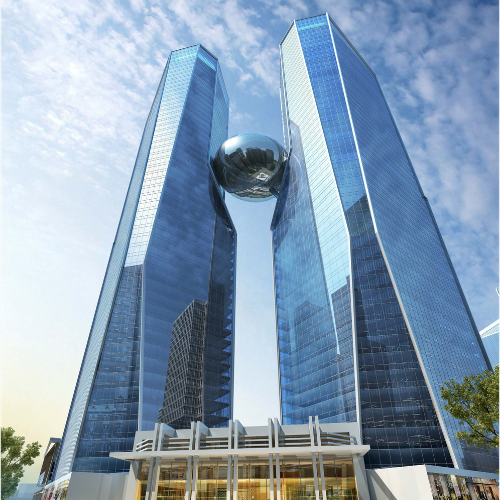
India has mastered steel where complexity demands it but hesitates when height requires it. While steel powers airports, stadiums, and industrial structures, high-rise buildings continue to lean heavily on reinforced concrete. If steel is viable, efficient, and future-ready, why does it still struggle to shape the skyline? This cover story explores whether the barrier is truly technical or simply a threshold the industry has yet to cross.
The Contradiction in the skyline
India’s relationship with steel is, in many ways, a story of confidence. Over the past two decades, the country has demonstrated an extraordinary command over steel construction in some of its most complex and demanding projects. Airports that stretch across vast spans with minimal structural interruption, stadiums that carry immense loads with structural elegance, industrial facilities that rise with speed and precision, steel has proven itself not just as a material, but as a system of efficiency, scalability, and engineering clarity.
In these environments, steel is not questioned. It is assumed.
And yet, when the same material enters the conversation of vertical urban development, a subtle hesitation begins to emerge. The skyline, perhaps more than any other typology, reveals this contradiction with striking clarity. As buildings rise beyond a certain threshold, typically around 80 to 100 m, steel begins to recede from the structural narrative, giving way to reinforced concrete, a material the industry is deeply familiar with and operationally geared towards.
This transition is rarely discussed explicitly. It is not mandated by code, nor enforced by regulation. It is simply observed, repeated across projects, across cities, and across typologies.
The question, then, is not whether India can build with steel at height. It clearly can.
The more pertinent question is:
Why does it choose not to beyond a point?
Is the hesitation rooted in structural limitations? Do engineering systems begin to fail or become inefficient beyond certain heights? Or does the answer lie elsewhere in cost structures, execution ecosystems, regulatory frameworks, and long-standing industry habits that shape decision-making far more than technical capability?
What makes this inquiry particularly compelling is that every stakeholder in the construction ecosystem appears to hold a piece of the answer.
What emerges from the intersecting perspectives is not a single barrier, but a layered condition.
Steel is not absent from India’s skyline because it cannot rise higher. It is absent because every stage of the building process from design to delivery introduces a set of considerations that collectively shape the decision.
The hesitation is not technical in isolation. It is systemic.
It lies at the intersection of:
- Engineering complexity
- Execution capability
- Commercial viability
- Regulatory comfort
- And industry familiarity
And perhaps most importantly, it lies in the transition between what the industry knows how to do and what it is willing to evolve toward.
This story is not an argument for steel over concrete. It is an inquiry into why one material dominates where another has already proven its worth elsewhere. Because if India can build complexity in steel, the question is not whether it can build height.
The question is:
What is holding it back from doing so consistently?
THE INVISIBLE CEILING: WHERE HEIGHT BEGINS TO CHANGE THE RULES
If the contradiction in India’s skyline raises the question, the next step is to locate where that question begins to take form in practice. Across cities, project typologies, and development scales, a pattern quietly repeats itself. Steel structures are widely adopted up to a certain height, particularly in commercial buildings, institutional projects, and hybrid systems, but beyond that threshold, they begin to cede ground to reinforced concrete. This transition is rarely formalised in design briefs or explicitly stated in project discussions, yet it is deeply embedded in decision-making.
The “100-m barrier” is not a rule. It is a behavioural pattern. And like most patterns in construction, it is shaped not by a single constraint, but by an accumulation of factors that begin to intensify as buildings grow taller.
From a structural standpoint, the shift begins with forces. As Satyajit Mhatre, Associate Technical Director (Structures), WSP explains, the moment a building starts rising vertically beyond mid-rise levels, the dominance of gravity loads begins to recede to lateral forces, primarily wind, and in certain regions, seismic activity. The building no longer behaves as a simple vertical load-bearing system; it begins to act like a cantilever resisting overturning forces.
This transformation is fundamental. At lower heights, structural design is largely governed by vertical loads like dead loads and live loads that are relatively predictable and uniformly distributed. Steel performs exceptionally well in this regime, offering speed, efficiency, and flexibility. But as height increases, lateral stability becomes the governing criterion. Drift, displacement, and vibration begin to dictate design decisions, and the structural system must evolve to accommodate these new demands.
What worked at 20 storeys becomes inadequate at 50. What is efficient at mid-rise becomes complex at high-rise. This is where the nature of the structure and the material begins to matter differently.
Steel, by virtue of its strength-to-weight ratio, offers clear advantages. It is lighter, which reduces overall dead load and foundation demand. It is ductile, which allows it to dissipate energy effectively under seismic conditions. And it can be fabricated with precision, enabling efficient structural systems. Yet, these very advantages introduce new sensitivities.
A lighter structure, while beneficial in reducing load, also becomes more responsive to dynamic forces. Wind-induced motion becomes more perceptible. Vibrations, even when within safe limits, can affect occupant comfort. Controlling these responses requires additional systems like greater stiffness, damping mechanisms, or more complex structural configurations, all of which introduce cost and coordination challenges.
At the same time, lateral systems must become more sophisticated. Outrigger systems, belt trusses, composite cores, and hybrid configurations begin to replace simpler structural approaches. These systems are not inherently problematic, but they demand a higher level of integration between design, fabrication, and execution. They also require early-stage coordination across disciplines, something that is not always embedded in conventional project workflows.
As Suhas Eklahare, Executive Vice President, NCC Limited points out, different structural systems come with distinct trade-offs. Braced frames, while economical and efficient at lower heights, begin to impose architectural constraints and material inefficiencies as buildings grow taller. Outrigger systems provide better control over drift and overturning forces but introduce complexities in construction sequencing and coordination. Diagrid systems offer structural and aesthetic efficiency yet demand a level of precision in fabrication and execution that the ecosystem is still developing.
In practice, therefore, the choice of system becomes a balancing act, not just between performance parameters, but between what is theoretically optimal and what is practically achievable.
This is where the “invisible ceiling” begins to take shape.
It is not that steel cannot perform beyond a certain height. It is that the conditions required for it to perform efficiently begin to multiply. Each additional layer of complexity, whether structural, logistical, or coordination-driven adds to the overall risk profile of the project. And as these layers accumulate, the decision-making process begins to shift. What starts as a question of structural capability gradually becomes a question of delivery certainty.
Dr. Abhishek Jain, Senior Associate, Vintech Consultants highlights that even at the design stage, cost sensitivity plays a significant role in shaping structural choices. Systems that require higher steel tonnage or more complex detailing can quickly become less attractive in a market where cost per square foot remains a critical parameter. When these costs are compounded by execution uncertainties, the perceived advantage of steel begins to narrow.
At the same time, the regulatory environment introduces its own set of considerations. Seismic design requirements, connection detailing standards, and fire safety provisions all add layers of complexity that must be addressed with precision. These are not insurmountable challenges, but they require a level of planning and coordination that is not always aligned with conventional construction timelines.
What emerges, therefore, is a convergence of factors:
- Increasing structural complexity
- Heightened sensitivity to execution quality
- Rising cost implications
- And a growing dependence on coordinated workflows
Individually, none of these factors are sufficient to limit steel’s application in high-rise buildings. Together, they begin to influence decision-making in subtle but significant ways.
The “100-m barrier” is not a structural limit. It is the point at which complexity begins to outweigh comfort. It marks the threshold where the industry transitions from familiar territory into a zone that demands greater precision, deeper collaboration, and a higher tolerance for uncertainty. And in that transition, reinforced concrete often re-emerges as the material of choice, not because it is always more efficient, but because it is more forgiving within the existing ecosystem.
“Height is not where steel stops performing, it is where complexity begins to demand a different level of alignment.”
DESIGNING HEIGHT: WHEN STRUCTURE STOPS LIMITING AND STARTS LEADING
If the previous section establishes where hesitation begins, this is where the narrative must deliberately shift away from constraint, and toward consequence. Because the question is not only why steel struggles to rise higher. It is also what is lost when it doesn’t.
From an architectural standpoint, steel does not simply replace concrete. It fundamentally alters the relationship between structure, space, and time. As Jayesh Hariyani, Chairman & Managing Director, INI Design Studio explains, the difference lies not just in how buildings are constructed, but in how they are conceived at the very beginning of the design process.
With reinforced concrete, architecture often begins by negotiating with structure. Column grids, beam depths, and core configurations establish a framework within which space must be organised. The structure, in many ways, defines the limits of design.
Steel reverses that relationship. Longer spans, slimmer members, and reduced structural depth allow architects to prioritise spatial continuity over structural accommodation. Instead of working around columns, designers can begin to think in terms of uninterrupted volumes, flexible floor plates, and adaptable layouts.
This shift becomes particularly significant in high-rise buildings. Unlike low-rise or mid-rise structures, tall buildings are long-term assets. Their value is not defined only by how they perform at the time of completion, but by how effectively they can adapt to changing needs over decades. Tenancy patterns evolve, workplace formats transform, and programmatic requirements shift. Buildings that cannot accommodate this change gradually lose relevance.
Steel introduces a level of adaptability that directly responds to this reality. Floor plates can be reconfigured without major structural intervention. Large column-free spans allow spaces to be reorganised with minimal disruption. Structural systems can support evolving uses without requiring extensive retrofitting. In this sense, steel is not merely a material, it is a strategy for future-proofing. And yet, this advantage rarely drives decision-making at scale.
One reason lies in the sequencing of decisions within the construction ecosystem. As Jayesh Hariyani observes, material choices are often made before the architect is fully engaged in the process. Developers, contractors, and approval frameworks tend to default to systems that are familiar, widely understood, and operationally predictable. Reinforced concrete fits comfortably within this ecosystem. Steel, by contrast, introduces variables that require deeper engagement and coordination.
In such a context, architecture is not always positioned to challenge the default. It inherits it. This dynamic has a direct impact on how high-rise buildings are conceived. Instead of asking what structural system would best support the building’s long-term performance, the process often begins with what is easiest to execute within existing constraints. Design ambition is then shaped around that decision, rather than the other way around.
The result is not a lack of innovation, but a narrowing of possibility. Steel, when used intentionally, has the ability to dissolve the conventional boundaries between structure and envelope. It enables façades to become more integrated with structural systems, allowing the building skin to perform multiple roles including controlling light, managing heat, and contributing to structural behaviour.
This integration is difficult to achieve in traditional RCC systems, where structure and façade often operate as separate layers. Projects that have explored steel more deeply begin to reveal this potential. Systems such as diagrids and exoskeletons, often associated with global skyscrapers, are not merely aesthetic expressions. They are performance-driven solutions that redistribute loads efficiently while enabling large, open interiors and responsive building envelopes.
Jayesh Hariyani points out that such systems are already being explored within the Indian context, demonstrating that the limitation is not conceptual feasibility, but ecosystem readiness. The backend required to support these systems that include precision fabrication, advanced connection detailing, and coordinated execution is still evolving.
This brings the narrative back to a recurring theme. The hesitation is not rooted in design capability. It is rooted in the conditions required to realise that design.
Even so, there are clear signs of transition.
A new generation of architects and developers is beginning to shift the conversation from familiarity to performance. Instead of asking which material is standard, they are asking which system is most appropriate for the building’s intended function, lifespan, and context.
In these conversations, steel begins to re-enter the equation not as an alternative, but as a logical choice. The implications of this shift are significant.
When structure is no longer treated as a constraint, it becomes a generator of space. When material choice is driven by performance rather than habit, buildings begin to respond more intelligently to their context. And when adaptability is prioritised over immediate convenience, architecture begins to align more closely with the realities of how cities evolve.
The question, then, is not whether architects are capable of designing steel high-rises. It is whether the ecosystem allows them to fully explore that capability.
“In high-rise buildings, flexibility is not a luxury, it is a long-term necessity. Steel simply makes it possible.”
STRUCTURAL SYSTEMS & ENGINEERING LOGIC: WHERE POSSIBILITY MEETS PRECISION
If architecture reveals what steel can enable, structural engineering defines the conditions under which that possibility can be realised. Tall buildings are not simply scaled-up versions of smaller structures. As height increases, the governing forces shift, and with them, the logic of structural design. Gravity loads give way to lateral forces like primarily wind, and in certain regions, seismic activity. The building begins to behave less like a vertical stack of floors and more like a slender cantilever resisting overturning.
In this regime, structural systems are no longer interchangeable. They become strategic.
Across global high-rise construction, a range of systems has evolved to address these challenges that include braced frames, outrigger systems, diagrids, and composite configurations. Each of these systems responds to the same fundamental problem: how to control lateral movement while maintaining structural efficiency.
In the Indian context, however, the choice of system is shaped not only by performance, but by practicality. Suhas Eklahare notes that braced frame systems, while effective and economical for mid-rise buildings, begin to lose efficiency as height increases. As buildings grow taller, the demand for global stiffness intensifies. Bracing members must become larger, connections more complex, and multiple bays must be engaged to resist lateral forces. This not only increases steel tonnage and cost but also begins to interfere with architectural planning like obstructing views, limiting façade flexibility, and reducing usable space.
What is structurally viable at 30 storeys becomes intrusive at 60. Outrigger systems, by contrast, offer a more robust response to height. As Satyajit Mhatre explains, these systems connect the central core to perimeter columns through horizontal elements, effectively redistributing overturning moments and enhancing overall stiffness. By mobilising the entire structural width of the building, outriggers reduce drift and improve lateral performance, making them particularly suitable for tall buildings in the 40 to 80 storey range.
Yet, this efficiency comes with its own demands. Outrigger systems require precise coordination between structural and architectural elements. Their placement must align with functional layouts, mechanical floors, and façade systems. Construction sequencing becomes more complex, and the integration of multiple systems demands a level of planning that extends beyond conventional workflows.
Diagrid systems represent another evolution in structural thinking, one that merges efficiency with expression. By eliminating vertical columns and distributing loads through a network of diagonal members, diagrids achieve both structural performance and architectural identity. However, as both Suhas Eklahare and Satyajit Mhatre highlight, these systems demand exceptional precision in fabrication and execution.
Node connections, where multiple members intersect at varying angles, become critical points of complexity. Their design, fabrication, transportation, and installation require a level of coordination that is still developing within the Indian ecosystem.
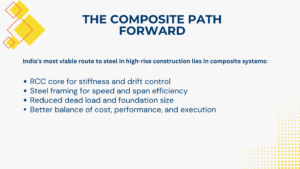
In this landscape of options, one approach consistently emerges as the most practical. Composite systems. Both structural consultants converge strongly on this point. A hybrid configuration combining a reinforced concrete core with steel framing offers a balanced response to the challenges of height. The concrete core provides the stiffness required to control drift and resist lateral forces, while the steel framing enables longer spans, reduced dead loads, and faster construction.
This is not a compromise. It is an adaptation. Dr. Abhishek Jain further refines this approach by highlighting the role of integrated systems, such as shear walls working in conjunction with steel beams, and innovations like sacrificial columns to manage interface challenges. These strategies demonstrate that the industry is not merely adopting global systems, it is modifying them to suit local conditions.
Even within these systems, however, complexity does not disappear. It shifts.
Connection design becomes a critical factor. Steel structures rely heavily on the integrity of their connections, where forces are transferred between members. In high-rise buildings, these connections must accommodate not only static loads but dynamic forces resulting from wind and seismic activity.
As Dr Abhishek Jain points out, seismic design requirements can significantly increase connection demands, with strength requirements exceeding member capacities and leading to more complex detailing. This has direct implications for cost, fabrication, and execution.
Vibration and occupant comfort introduce another dimension of engineering complexity. Steel’s lower mass, while advantageous in reducing loads, can result in higher accelerations under wind forces. Even when structures are safe, perceptible movement can affect user comfort, requiring additional systems such as dampers or increased stiffness, both of which add to design and construction complexity.
What becomes evident through these layers of analysis is that steel, as a material, performs exceptionally well under the right conditions. But those conditions are exacting.
They demand:
- Precise system selection
- Integrated design approaches
- High-quality fabrication
- And disciplined execution
In other words, steel does not tolerate approximation. This is where the contrast with reinforced concrete becomes particularly instructive. Concrete, by its very nature, accommodates a degree of variability. Minor deviations in execution can often be absorbed without significant impact on structural performance. Steel, by contrast, requires precision at every stage from design to fabrication to erection.
This distinction does not make steel inferior. It makes it demanding.
And in an ecosystem where consistency of execution varies across projects, this demand begins to influence decision-making. The question, therefore, is not whether structural systems for tall steel buildings exist.
They do and they are well understood.
The question is whether the ecosystem can consistently deliver the level of precision those systems require.
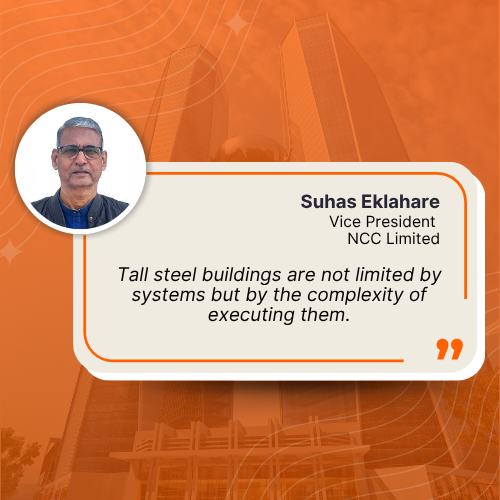
“Tall steel buildings are not limited by systems, they are defined by the precision required to execute them.”
EXECUTION REALITY: WHERE STEEL MEETS THE CONSTRUCTION ECOSYSTEM
If design defines intent and engineering defines possibility, execution determines whether either can be realised at all. And it is here — on site, in fabrication yards, in sequencing plans, and in the coordination between trades that the story of steel in high-rise buildings begins to change character.
Across stakeholder perspectives, a consistent truth emerges: the limitations of steel are not rooted in its performance as a material, but in the demands it places on the ecosystem that must deliver it.
Steel, unlike many conventional systems, does not operate in isolation. It is part of a tightly coupled chain of design, fabrication, transportation, erection, and connection, all of which must align with a high degree of precision. Any break in this chain does not merely slow down the process; it compromises the very advantages that steel is meant to offer.
This is where the industry begins to feel the weight of complexity.
From a contractor’s perspective, the challenge is immediate and tangible. Suhas Eklahare highlights that the execution of tall steel structures involves multiple layers of coordination that extend far beyond structural design. Fabrication must be carried out with tight tolerances in controlled environments. Members must be transported, often through congested urban conditions, to site without damage or delay. Erection at height requires specialised equipment, skilled labour, and carefully planned sequencing to ensure safety and accuracy.
Each of these steps introduces its own set of dependencies. Unlike reinforced concrete, where much of the construction activity is contained within the site and follows a relatively linear process, steel construction is inherently distributed. It begins off-site, moves through multiple stages of processing, and culminates in assembly rather than creation. This distributed nature makes it faster under ideal conditions, but also more vulnerable to disruption.
Dr. Abhishek Jain points to a critical structural weakness in the current ecosystem: fragmentation. Steel and concrete works are often executed by separate contractors, each operating within their own timelines, methodologies, and capabilities. The interface between these systems, particularly in composite structures becomes a point of friction.
Steel framing may be ready for erection, but concrete cores may lag.
Or concrete works may advance, while steel fabrication is delayed. In such scenarios, the advantage of speed is quickly eroded.
The issue is not capability, it is coordination.
This lack of integration extends into planning and procurement. Steel construction requires early-stage decisions that lock in design, material specifications, and fabrication schedules well in advance. Any delay in procurement, whether due to supply chain constraints, financial approvals, or design changes can have cascading effects on the project timeline.
Dr. Abhishek Jain emphasises that inadequate planning and cash flow management often disrupt steel projects, not because the systems fail, but because the processes around them are not aligned. This introduces a subtle but critical shift in perception. Steel is not seen as risky because it is unreliable.
It is seen as risky because it is unforgiving.
Where concrete can absorb delays, adjustments, and minor inconsistencies, steel demands precision at every stage. Fabrication errors cannot be easily corrected on site. Connection misalignments require rework. Welding quality directly impacts performance. Inspection systems must be robust, and quality control must be maintained consistently. In high-rise construction, where these challenges are amplified by height, scale, and complexity, the margin for error becomes even smaller.
Satyajit Mhatre highlights that the execution of connections, particularly in seismic conditions is a critical factor. Steel structures rely heavily on ductile detailing, precise welding, and proper bolt pre-tensioning. Any compromise in these areas can affect structural behaviour, especially under dynamic loads.
At the same time, the physical act of building becomes more demanding.
Erecting large steel members at heights exceeding 200 or 300 m requires specialised lifting equipment, careful sequencing, and a highly skilled workforce. The availability of such resources is not uniform across projects. Skilled erection teams, experienced supervisors, and safety systems capable of operating at such scales are still evolving within the industry.
This introduces another dimension to the hesitation. It is not only about whether the system can be designed. It is about whether it can be delivered consistently, across different contexts, with predictable outcomes.
The perspective of Mukesh Jaitley, Director Engineering, Dosti Reality reinforces this reality from a developer’s standpoint. Site constraints in dense urban environments including limited working space, restricted hours, noise regulations, and logistical challenges can significantly affect the execution of steel structures. Handling large, prefabricated elements in tight sites, coordinating deliveries, and maintaining productivity under such conditions requires a level of operational discipline that is not always feasible.
In such environments, the theoretical speed advantage of steel can be offset by practical limitations. The ecosystem, in essence, is not yet uniformly configured to support steel at scale in high-rise construction. And yet, it is important to recognise that these challenges are not permanent barriers. They are transitional.
Brajesh Nahar, COO and Director, APL Apollo Building Products Limited points out that the steel industry itself has evolved significantly, with advancements in fabrication technologies, prefabrication systems, and supply chain integration. The capability to produce high-quality, precision-engineered components already exists. The opportunity now lies in aligning this capability with design practices and construction workflows.
What is required is not a reinvention of systems, but a reconfiguration of processes.
Steel demands:
- Early collaboration between stakeholders
- Integrated project delivery models
- Stronger alignment between design and fabrication
- And a workforce trained to operate at higher levels of precision
In other words, steel demands an ecosystem that behaves as a system. Until that alignment is achieved, the hesitation will persist, not because steel cannot perform, but because the environment required for it to perform efficiently is still being built.
“Steel does not fail in execution, it exposes where execution is not yet aligned.”
THE DEVELOPER’S EQUATION: COST, SPEED, AND THE PRICE OF CERTAINTY
At the level of design studios and engineering offices, steel presents itself as a material of opportunity that is efficient, adaptable, and capable of transforming how buildings are conceived and constructed. But on the developer’s desk, the conversation changes character.
Here, decisions are not made in terms of structural elegance or system optimisation. They are made through a lens that is far more immediate and uncompromising: cost, time, risk, and return.
Every material choice must ultimately answer a simple question: Will this improve the project’s overall viability?
From this standpoint, steel enters the equation with both promise and caution.
Mukesh Jaitley articulates this balance with clarity. When planning a high-rise building, the evaluation begins not with material preference, but with a set of interdependent considerations: building height, site conditions, handling logistics, and the implications of structural systems on usable space.
In dense urban environments, where land value is high and margins are tightly calculated, spatial efficiency becomes critical. Structural elements are not neutral, they directly influence the economics of the project. Thick columns can reduce carpet area. Deeper beams can impact floor-to-floor heights, particularly in projects constrained by regulatory limits.
In such scenarios, even small structural inefficiencies can translate into significant financial implications when multiplied across floors.
Steel, while offering advantages in strength and span, must therefore justify itself within this spatial economy. Its strongest argument lies in speed. Faster construction translates into earlier completion, which in turn enables earlier monetisation. In commercial real estate, this advantage is particularly significant. Buildings can be leased or sold closer to completion, allowing developers to recover investments more quickly and improve overall project cash flow.
This is where steel presents a compelling case. But speed, in isolation, is not enough. It must be weighed against upfront cost. Steel structures typically involve higher initial expenditure compared to reinforced concrete. This is influenced by material cost, fabrication requirements, and the need for specialised systems such as fireproofing and precision connections. Dr. Abhishek Jain notes that even at the design stage, cost sensitivity plays a decisive role in shaping structural choices, particularly in a market where cost per square foot remains a primary metric.
This creates a tension that sits at the heart of the developer’s decision-making process:
- Steel offers speed, but at a cost
- Concrete offers economy, but at a slower pace
The choice, therefore, is not straightforward. It depends on how developers value time relative to cost.
In high-value urban markets, where land costs are significant and delays can erode profitability, speed becomes a strategic advantage. In such cases, steel or more often, composite systems begins to make sense. But in projects where cost control outweighs time sensitivity, reinforced concrete continues to dominate.
Beyond cost and speed, risk emerges as a critical factor. Steel construction introduces dependencies that must be carefully managed. Fabrication timelines, transportation logistics, availability of specific grades or sections, and coordination between trades all influence project outcomes. Any disruption in this chain can impact schedules and costs.
Mukesh Jaitley points out that supply chain uncertainties, particularly in sourcing specialised steel sections can pose challenges, especially in the context of global market fluctuations and geopolitical conditions. At the same time, site conditions in urban environments add another layer of complexity. Limited working space, restricted operating hours, noise regulations, and the handling of large prefabricated elements all affect productivity. In such conditions, the theoretical advantages of steel must be reconciled with practical constraints.
This is where the concept of certainty becomes central.
Developers are not inherently resistant to innovation. But they operate within a framework where predictability is highly valued. Construction timelines must be reliable. Costs must be controlled. Risks must be minimised.
Reinforced concrete, despite its limitations, offers a level of predictability that aligns with this framework. It is widely understood, supported by an established ecosystem, and capable of accommodating variations in execution without significant disruption.
Steel, by contrast, demands a higher degree of discipline across the entire project lifecycle.
It requires:
- Early decision-making
- Coordinated planning
- Reliable supply chains
- And consistent execution
In environments where these conditions are not guaranteed, steel begins to appear less certain, not because it is inherently risky, but because it is less forgiving of systemic gaps.
This distinction is subtle, but it is decisive. The hesitation, therefore, is not a rejection of steel. It is a preference for certainty. And until steel can be delivered with the same level of predictability that developers associate with conventional systems, its adoption in high-rise buildings will continue to be selective rather than widespread.
At the same time, there are clear indicators that this equation is beginning to evolve. As urban densities increase and construction timelines become more critical, the value of speed is rising. As sustainability considerations gain importance, the environmental advantages of steel like recyclability, reduced site impact, and lower waste are becoming more relevant. And as the ecosystem gradually strengthens, the perceived risks associated with steel are beginning to reduce.
In this shifting landscape, the developer’s equation is no longer static. It is being recalibrated. The question is no longer whether steel is viable. It is whether the balance between cost, speed, and certainty is beginning to tilt in its favour.
“For developers, the decision is rarely structural, it is transactional, shaped by cost, time, and the need for certainty.”
MATERIAL READINESS & INDUSTRY CAPABILITY: IF STEEL IS READY, WHY ISN’T THE SKYLINE?
By this point in the story, the hesitation has been examined from multiple angles including design ambition, structural logic, execution complexity, and commercial decision-making. Each layer has revealed its own set of constraints, yet none of them, in isolation, is sufficient to explain why steel remains underrepresented in India’s high-rise skyline.
Which brings the narrative to a crucial question:
If steel can perform,
If systems exist,
If design capability is available,
then what exactly is holding back its adoption at height?
From the perspective of the steel industry, the answer is both clear and revealing. The limitation is not material capability. It is the pace at which the ecosystem is evolving to utilise it.
As Brajesh Nahar emphasises, India today is among the world’s leading steel producers, with a manufacturing ecosystem that is fully capable of supporting steel-intensive high-rise construction. Over the years, the industry has invested heavily in advanced production processes, precision manufacturing, and product innovation. Structural steel is no longer a basic commodity, it is a highly engineered solution, tailored to meet the demands of modern construction.
High-strength steel grades, ranging from 250 MPa to 550 MPa, are readily available in the domestic market. These materials enable higher load-bearing capacity with reduced sectional dimensions, allowing structures to achieve strength through optimisation rather than mass. This distinction is fundamental. While reinforced concrete relies on volume to achieve strength, steel achieves it through engineering efficiency.
The implications of this are significant. Lighter structures reduce foundation loads. Optimised sections reduce material consumption. Higher precision improves overall performance.
In the context of high-rise buildings, these advantages directly translate into structural efficiency and design flexibility.
The evolution is not limited to material strength alone. Advancements in fabrication technologies have further expanded the possibilities of steel construction. Precision-engineered components, manufactured under controlled conditions, ensure consistency in quality and performance. Technologies such as Direct Forming enable the production of hollow sections with high dimensional accuracy and uniform mechanical properties, critical factors in tall buildings where tolerances are tight and performance demands are high.
These hollow sections be it square, rectangular, and circular, offer enhanced torsional rigidity, improved buckling resistance, and efficient load distribution. Their application in columns, lateral load-resisting systems, and composite structures allows for more refined and efficient structural configurations. At the same time, the rise of prefabrication and pre-engineered building systems is redefining construction workflows. Off-site manufacturing, followed by rapid on-site assembly, has the potential to significantly reduce construction timelines while improving quality control and reducing dependency on manual labour.
From a sustainability standpoint, steel presents an even stronger case.
It is inherently recyclable.
It reduces construction waste.
It minimises on-site disruption.
In dense urban environments, where construction activities increasingly come under scrutiny for their environmental impact, these advantages are becoming more relevant than ever. As cities grapple with issues such as pollution, congestion, and resource efficiency, the need for cleaner, faster, and more controlled construction methods is intensifying.
Steel aligns naturally with these emerging priorities. And yet, despite this readiness of material, technological, and environmental, its adoption in high-rise buildings remains limited. This disconnect reveals a deeper issue. There exists a gap between what the industry can produce and what projects are designed to utilise.
Brajesh Nahar points to a critical missing link: collaboration. Architects, structural designers, fabricators, and manufacturers often operate within their own domains, with limited integration during the early stages of a project. As a result, the full potential of modern steel solutions remains underexplored.
Designs are developed based on conventional assumptions. Material capabilities are introduced later, often too late to influence core decisions. In such workflows, steel is not fully leveraged, it is merely accommodated.
This is not a limitation of knowledge, but of process. Steel, by its very nature, demands early engagement. It requires material understanding to inform structural strategy, and structural strategy to inform design intent. Without this alignment, the advantages of steel including efficiency, speed, adaptability remain partially realised.
There is also a broader institutional dimension to this gap. Building codes, approval systems, and industry standards are still evolving to accommodate the nuances of steel-based high-rise construction. Fire safety norms, design specifications, and construction practices require continuous updating to reflect advancements in material technology and global best practices.
At the same time, technical education and training must evolve to equip professionals with the skills required to design, fabricate, and execute steel systems at scale.
These are not barriers in the traditional sense. They are indicators of a system in transition. What becomes evident is that India’s steel industry is, in many ways, ahead of its adoption curve.
The capability exists.
The technology exists.
The material exists.
What is still evolving is the ecosystem that connects these elements into a cohesive, reliable, and scalable construction system.
“India is not constrained by steel capability, it is constrained by the pace at which the ecosystem is learning to use it.”
THE REAL BARRIER: TECHNICAL LIMIT OR A PSYCHOLOGICAL THRESHOLD?
By now, the contours of the story are clear. Steel is not absent from India’s skyline because it cannot rise. It is absent because the conditions required for it to rise are still aligning. Across every layer of the ecosystem, the signals are consistent.
Architects are ready to design with steel, not as an alternative, but as a driver of spatial innovation and long-term adaptability. They see in it the ability to create buildings that are lighter, more flexible, and more responsive to the way cities evolve.
Engineers are ready to deliver it. Structural systems whether outrigger-based, composite, or hybrid are well understood, globally validated, and technically viable within the Indian context. The design capability exists, the tools are available, and the knowledge base is strong.
Manufacturers are ready to supply it. The steel industry has evolved significantly, offering high-strength materials, precision-engineered sections, and advanced fabrication technologies that can support the demands of high-rise construction.
And yet, despite this readiness, the skyline hesitates. Because readiness, in isolation, is not enough.
What the story reveals is that steel does not operate within isolated domains. It does not succeed through individual excellence. It demands alignment across design, engineering, manufacturing, and execution. And it is precisely this alignment that is still emerging.
From the contractor’s perspective, steel introduces a level of execution complexity that cannot be absorbed through approximation. Precision is not optional, it is fundamental. Fabrication tolerances, connection detailing, erection sequencing, and quality control must all operate within tighter margins than conventional systems typically demand.
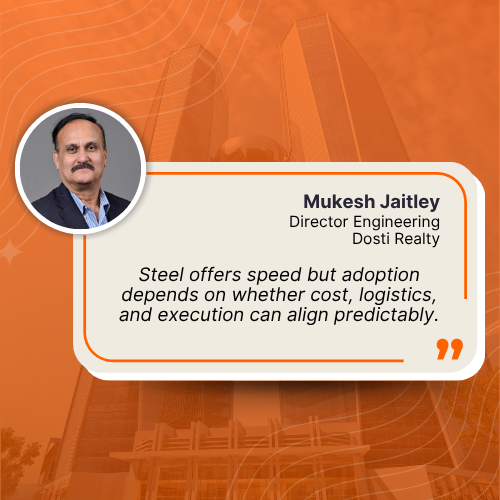
From the developer’s standpoint, the equation remains finely balanced. Steel offers speed, but speed must translate into predictable outcomes. Cost advantages must be measurable, risks must be manageable, and timelines must be reliable. In a market where uncertainty carries tangible financial consequences, predictability often outweighs potential.
From a systemic perspective, fragmentation remains a defining challenge. The separation between design and execution, between steel and concrete trades, between material capability and project application, these gaps collectively shape decision-making.
This is where the nature of the barrier becomes evident.
It is not a wall. It is a threshold. A threshold defined not by what the industry cannot do, but by what it is not yet consistently doing together.
Steel, in many ways, exposes the system.
It reveals where coordination is incomplete.
Where planning is delayed.
Where integration is missing.
It does not fail under these conditions but highlights them.
Reinforced concrete, by contrast, operates comfortably within this environment. It accommodates variation, absorbs delays, and aligns with existing workflows. It is not necessarily more efficient in every scenario, but it is more forgiving within the current ecosystem.
And that distinction between performance and predictability is where the hesitation resides.
The “100-m barrier” is not a structural limit. It is a comfort boundary. It marks the point at which the industry transitions from what it knows it can deliver to what it is still learning to deliver consistently. But thresholds, by their nature, are not permanent. They shift. And there are clear signs that this one is beginning to move.
As urban densities increase, the cost of time is rising. As sustainability becomes central to construction, the environmental advantages of steel are gaining importance. As fabrication technologies advance and supply chains strengthen, the execution gap is beginning to narrow.
Most importantly, as conversations within the industry begin to shift from familiarity to performance, from convention to optimisation, the basis of decision-making is evolving. Composite systems are already acting as a bridge, allowing the industry to transition gradually rather than abruptly. Early collaboration between stakeholders is becoming more common. Integrated project delivery models are beginning to take shape.
These are not isolated developments.
They are indicators of change.
The skyline, therefore, is not static.
It is transitional.
The hesitation that defines it today is not a reflection of limitation, it is a reflection of timing. The question is no longer whether steel can define India’s vertical future. It is whether the ecosystem can align quickly enough to allow it to.
“The barrier is not what steel cannot do—it is what the ecosystem is not yet fully prepared to do together.”
SSMB POV: THE SKYLINE WILL NOT WAIT FOR COMFORT
For decades, the Indian construction industry has operated within a framework that rewards familiarity. Systems that are well understood, widely practiced, and operationally predictable have naturally become the default. Reinforced concrete fits this framework seamlessly. Steel does not. It demands more… more precision, more coordination, more planning, more integration. It requires decisions to be made earlier, collaborations to be stronger, and execution to be tighter.
What this story makes clear is that the hesitation around steel is not a question of capability. It is a question of alignment. India has the design talent. It has the engineering knowledge. It has the manufacturing strength. What it is still building is the connective tissue that brings these capabilities together into a cohesive system.
The skyline will not wait for the ecosystem to feel ready. It will respond to the pressures that shape it. And when that shift accelerates, as it inevitably will, the transition to steel will not be gradual or hesitant. It will be decisive. Because the future of high-rise construction in India will not be defined by the materials the industry is comfortable with. It will be defined by the systems it is willing to evolve toward. And when that evolution reaches critical mass, steel will not need to justify its place in the skyline. It will simply become part of it. – Mahesh Mudaliar
Why the 100-Metre Barrier Exists
- Increasing lateral forces (wind and seismic)
- Need for advanced structural systems
- Higher cost of steel-intensive solutions
- Execution sensitivity (connections, fabrication, erection)
- Fireproofing and regulatory challenges
- Fragmented construction ecosystem
The Emerging Consensus
- Steel is structurally viable
- Composite systems are most practical
- Design capability exists
- Execution ecosystem is uneven
- Adoption depends on integration
The Integrated Approach
The future of steel high-rises in India will depend on:
- Early collaboration between stakeholders
- Integrated steel-concrete delivery systems
- Improved fabrication and erection capabilities
- Alignment between design intent and execution
- Recognition of lifecycle value over initial cost