

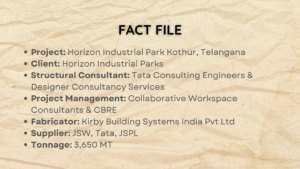
A new paradigm is steadily emerging, one that reimagines industrial infrastructure through sustainability, material intelligence, and integrated systems thinking. At the centre of this shift is Mahendra Waghule, Head – Projects & Development at Horizon Industrial Parks, whose work on the Kothur Campus in Hyderabad exemplifies this evolving approach.
“Growth and green are not opposing goals, they are interdependent outcomes.” – Mahendra Waghule
BUILDING INDUSTRIAL ECOSYSTEMS, NOT JUST INFRASTRUCTURE
India’s industrial landscape is undergoing a decisive shift. What was once driven primarily by speed, cost, and scale is now being redefined by a more complex and necessary metric called sustainability. Yet, in many cases, sustainability continues to be treated as an overlay, an addition that follows design rather than shaping it.
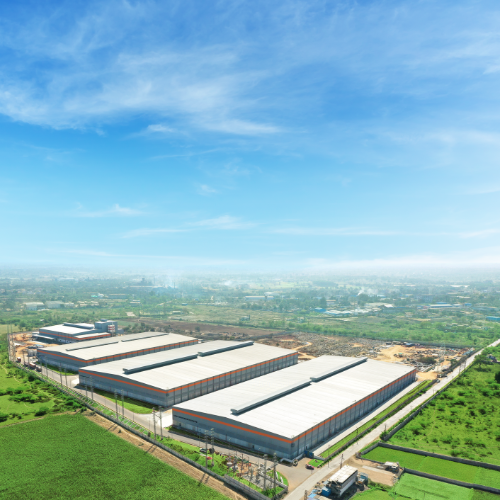
At Horizon Industrial Parks’ Kothur campus in Hyderabad, this hierarchy is reversed. Here, sustainability is not appended to the project. it is embedded within its DNA. The development emerges as a deliberate attempt to demonstrate that Grade-A industrial infrastructure in India can meet global benchmarks not only in performance and efficiency, but also in environmental responsibility. The ambition is both clear and measured: to reduce lifecycle costs for occupiers, create tangible ESG impact, and prove that speed, scale, and sustainability can operate in alignment rather than conflict.
Each greenfield development, in this context, becomes an opportunity to challenge industry norms. Kothur positions itself as a working model, an industrial ecosystem where responsible growth is not aspirational rhetoric, but a built reality.
STEEL AS THE FRAMEWORK OF FUTURE-READY INFRASTRUCTURE
At the structural core of Kothur lies steel, strategically deployed not just for its engineering efficiency, but for its long-term sustainability value. The use of pre-engineered buildings (PEBs) has enabled the creation of large-span industrial spaces with significantly reduced construction timelines. In a market where speed-to-market is critical for occupiers, this advantage becomes both operationally and economically decisive.
Simultaneously, TMT reinforcement provides the necessary structural resilience to accommodate heavy operational loads, while also allowing for future adaptability. Industrial parks are rarely static environments; they evolve with changing tenant requirements, technologies, and operational scales. Steel, with its inherent flexibility, allows this evolution to occur with minimal structural disruption.
Beyond immediate performance, steel introduces a compelling lifecycle advantage. Its recyclability, reusability, and residual scrap value contribute to a significantly lower environmental footprint over time. Unlike many conventional materials, steel does not conclude its utility at the end of a building’s lifecycle, it continues to participate in future construction cycles.
In this sense, steel operates as both a present-day enabler and a future safeguard, aligning structural performance with environmental responsibility.
“Steel delivers efficiency in the present while securing sustainability for the future.”
ENERGY EFFICIENCY AS A LAYERED SYSTEM
The sustainability framework at Kothur is not defined by isolated interventions, but by the integration of multiple systems working in cohesion. Energy efficiency is approached through both active and passive strategies, ensuring that consumption is reduced at its source rather than compensated for later.
The integration of LED lighting, insulated roofs and wall systems, rooftop solar provisions, and skylights creates a multi-layered energy strategy. Among these, skylights and natural ventilation systems emerge as particularly impactful. By maximising daylight penetration and enabling passive airflow, the project significantly reduces reliance on artificial lighting and mechanical cooling systems.
This approach leads to a measurable reduction in energy intensity across the facility. For occupiers, this translates directly into lower operational costs. For the environment, it results in reduced carbon emissions and a more efficient energy footprint.
The emphasis here is not on adding renewable energy alone, but on first reducing demand, an approach that reflects a deeper understanding of sustainable design.
LANDSCAPE AS ECOLOGICAL INFRASTRUCTURE
One of the defining aspects of Kothur’s sustainability approach is the integration of landscape as a functional system rather than a visual afterthought. Native plantations, fruit gardens, green buffers, and biodiversity pockets collectively transform the industrial environment into a living ecosystem.
These interventions contribute to multiple outcomes simultaneously. They regulate microclimates, reduce ambient temperatures, and improve air quality. At the same time, they enhance the experiential quality of the space for its users.
Industrial environments are often perceived as purely functional, with little consideration for human comfort. By introducing shaded zones, green corridors, and interactive outdoor spaces, Kothur repositions the industrial park as a space that supports both productivity and well-being.
The presence of biodiversity further reinforces ecological balance, ensuring that the development contributes positively to its surrounding environment rather than merely occupying it.
HUMAN-CENTRIC SUSTAINABILITY
Sustainability, in its most complete form, must extend beyond environmental metrics to include the people who inhabit and operate within these spaces. At Kothur, this principle is reflected in the integration of facilities that prioritise workforce well-being.
Recreational spaces, canteens, accessible design for differently-abled individuals, and wellness initiatives collectively contribute to a more inclusive and supportive environment. Regular health check-ups, safety training programmes, and community engagement initiatives further strengthen this human-centric approach.
Such interventions are not merely social additions, they have measurable impacts on productivity, retention, and overall workplace satisfaction. By addressing the needs of its users, the project ensures that sustainability is experienced at a human level, not just measured through technical parameters.
“A truly sustainable industrial park must support both performance and people.”
RESILIENCE AS A DESIGN IMPERATIVE
In addition to sustainability, resilience forms a critical pillar of Kothur’s design philosophy. Industrial infrastructure must not only perform efficiently under normal conditions but also withstand operational and environmental uncertainties.
The project incorporates dedicated hazardous material zones, advanced firefighting systems, and compliance with national and international safety standards, including FM Global benchmarks. Structural systems are designed to accommodate seismic considerations and evolving climate risks.
Regular safety drills, training programmes, and compliance protocols ensure that resilience is not limited to infrastructure alone, but extends to operational readiness. This layered approach to resilience ensures that the project remains reliable and adaptable over time, reinforcing its long-term viability.
MIND-BOGGLING ASPECT:
Redefining Industrial Sustainability
- Industrial infrastructure designed as an integrated ecosystem
- Steel enabling speed, flexibility, and lifecycle sustainability
- Passive and active systems reducing energy dependence
- Closed-loop water management ensuring long-term resource security
- Landscapes functioning as ecological and experiential assets
- Human-centric design enhancing productivity and well-being
- Built-in resilience addressing both operational and climate risks
A BENCHMARK BEYOND CERTIFICATION
The Kothur campus has achieved IGBC Platinum pre-certification, positioning it among India’s leading green industrial developments. However, the significance of the project extends beyond certification. Its true value lies in its operational outcomes like lower energy consumption, efficient resource utilisation, reduced environmental impact, and enhanced user experience. For occupiers, these translate into tangible benefits, including cost savings, reliability, and alignment with global ESG commitments. Rather than being defined by one-time metrics, the project demonstrates sustained performance over time.