


A building’s carbon footprint is often decided long before the façade is detailed or the first solar panel is installed. It lies hidden in structural grids, spans, material quantities, and the quiet mathematics of how a building stands. As the global construction sector confronts the urgency of climate change, architects are beginning to look beyond operational efficiency toward the embodied carbon locked within the structure itself. In this cover story, SSMB explores how early design decisions, structural intelligence, and material responsibility are reshaping the way architects think about sustainability and why the real green revolution in architecture may begin with the invisible carbon within a building’s bones.
Where Carbon Actually Lives
For decades, the sustainability conversation in architecture has been dominated by operational performance. Buildings were judged by how efficiently they consumed energy, how well they cooled, heated, and lit their interiors over decades of use. Solar panels, efficient HVAC systems, and high-performance façades became the visible symbols of green architecture.
Yet the carbon story of a building begins much earlier. Before a building switches on its first light or cools its first room, a significant portion of its environmental impact has already occurred. The extraction of raw materials, their processing into steel or cement, their transportation to site, and their assembly into structure release vast quantities of carbon long before the building becomes operational.
This is embodied carbon. The invisible environmental cost embedded within the physical fabric of construction.
Across the global construction sector, embodied carbon is emerging as one of the most critical environmental challenges. Studies increasingly suggest that embodied emissions can represent nearly 40 to 50 per cent of a building’s lifecycle carbon footprint, and in high-performance buildings with reduced operational energy, the share can climb even higher.
And much of this carbon is concentrated in the structure. Structural systems, including steel frames, reinforced concrete slabs, columns, and foundations, carry the majority of material mass in most buildings. As C.S. Raghuram, Partner, Trilogue Studio LLP, points out, this material mass translates directly into carbon impact. In many commercial projects, structural systems alone account for 45 to 75 per cent of total embodied carbon, often exceeding the combined footprint of façade systems, services, and interior finishes.
The numbers reveal an important contradiction within architectural practice. Designers often spend enormous attention on finishes and materials that are visually prominent, while the true carbon burden remains embedded within structural systems that are rarely discussed in environmental terms.
Interior finishes, Raghuram notes, typically contribute only 10 to 20 per cent of embodied carbon. Even materials that are carbon-intensive per kilogram, such as anodised aluminium trims or kiln-fired tiles, remain relatively minor contributors simply because their overall mass in the building is small.
Against the thousands of tonnes of concrete and steel that form a structural frame, finishes operate on a very different order of magnitude. Yet the structure alone does not complete the picture. Between the structural skeleton and the visible layers of interior design lies the building envelope, which includes the façade systems, insulation layers, and glazing assemblies that mediate between interior and exterior environments.
Carbon Behaves In A More Complex Way
Envelope systems carry their own embodied emissions during manufacturing and installation, but they also determine how much energy the building will consume for decades. A poorly insulated façade can lock a building into high operational energy demand, while a well-designed envelope can dramatically reduce heating and cooling loads.
This delicate balance between embodied and operational carbon is increasingly shaping architectural decision-making. For Vibhor Mukul Singh, Founder & Principal Architect, Designers’ Alcove for Arts & Architecture, understanding this relationship requires a more comprehensive environmental perspective. A building’s carbon footprint, he explains, cannot be evaluated through isolated components alone. It emerges from an entire network of material flows like manufacturing processes, transportation distances, construction methods, maintenance cycles, and eventual end-of-life disposal.
To understand these interconnected impacts, Singh advocates the use of life-cycle assessment (LCA), a methodology that evaluates environmental impacts across the entire lifespan of a building. Through LCA, architects can trace how energy, water, materials, and waste move through the building system, revealing environmental consequences that remain invisible in conventional design processes.
Without such analysis, many carbon-intensive decisions remain hidden within the complexity of construction. The implications of this invisibility are becoming more significant as global energy systems evolve. For much of the past century, operational energy consumption dominated the environmental footprint of buildings. Heating, cooling, lighting, and equipment loads generated emissions continuously over decades, making operational carbon the primary focus of sustainability policies.
Equation Beginning To Change
As electricity grids shift steadily toward renewable energy sources, operational emissions are expected to decline. Buildings powered by clean energy will carry dramatically lower operational footprints than their predecessors. When that happens, the balance of responsibility will shift toward embodied carbon.
In a future powered largely by renewable electricity, the emissions embedded in materials may become the dominant climate impact of buildings. Structural decisions, once treated purely as engineering necessities, will increasingly become environmental decisions.
This realisation is gradually reshaping the way architects think about design. Material quantity, structural efficiency, and construction logic are emerging as critical sustainability parameters. The environmental impact of architecture is no longer determined solely by how buildings perform during their lifetime, but also by how intelligently they are constructed in the first place.
And as this awareness grows, a quiet but important shift is taking place within design studios. Sustainability is beginning to move away from the visible technologies of green architecture toward the hidden intelligence of structure. Because if carbon truly lives anywhere in a building, it lives first within the materials that hold it up.
Design Locks Destiny
If embodied carbon lives largely within structure, then its origins lie even earlier, perhaps in the geometry of design itself. Before structural drawings are prepared, before quantities are calculated, and before contractors enter the conversation, architects quietly establish the spatial logic that will determine the material demands of the entire building. Grids are drawn, spans are imagined, massing takes shape, and structural systems begin to reveal themselves.
These early design moves may appear purely architectural. In reality, they act as powerful carbon decisions. For Krishna Kishore, Founding Partner, K Square Architects, the earliest geometry of a building is often the most decisive predictor of its environmental footprint. Once a structural grid is established, the mathematics of the building quickly begins to unfold.
A modest adjustment in column spacing can ripple across the entire structure. Increasing a grid from nine metres to twelve metres, for instance, does not simply extend the beam length. It alters beam depth, column sizes, and structural reinforcement across every level of the building. In many cases, such changes can increase steel intensity by 20 to 30 per cent.
What appears on the drawing board as a spatial gesture quietly multiplies material quantities across the structure. And once the structure is built, that material and its carbon remain embedded for the lifetime of the building.
Piyush Kapadia, Principal Architect, Pooja & Piyush Associates, describes embodied carbon in similarly direct terms. At its core, he argues, the issue is fundamentally about material quantity. Structural grids, spans, and massing strategies determine beam depths, slab thicknesses, reinforcement levels, and foundation volumes. Even small reductions in span can significantly reduce structural volume when multiplied across floors.
In practice, these decisions are rarely visible in the finished building. They do not reveal themselves in architectural photographs or sustainability brochures. Yet they define the environmental footprint of the project. In Kapadia’s view, the concept stage of design is therefore where the real sustainability battle is fought. “The most sustainable material,” he often reminds clients, “is the one we never use.”
Across many projects in his practice, structural logic becomes a tool for reducing unnecessary material consumption. Systems such as filler slabs remove concrete from zones that do not contribute structurally, lowering dead loads and consequently reducing beam sizes and foundation demand. These decisions rarely attract visual attention, yet they quietly reshape the material efficiency of the entire building.
Massing strategies introduce another dimension to this conversation. Architectural ambition often encourages dramatic spatial gestures like large cantilevers, complex offsets, or expressive projections that appear visually light but require heavy structural intervention behind the scenes. For Krishna Kishore, such gestures frequently carry hidden structural consequences.
Large cantilevers and irregular massing often require transfer beams or heavily reinforced structural zones to redirect loads back into the structural grid. These elements can add significant quantities of steel or concrete without creating additional usable floor area. They carry structural responsibility but deliver no spatial benefit. In carbon terms, these elements become what Kishore describes as “hidden structural debt.” The environmental cost of such decisions remains largely invisible to occupants, yet it is permanently embedded within the building’s structural system.
Invisible Carbon Emerges In Subtler Ways
Architects sometimes introduce long structural spans to maximise spatial flexibility or visual openness, even when such flexibility may never be required. Façades may become highly articulated, requiring secondary steel frameworks and anchoring systems to support decorative cladding layers. What begins as aesthetic expression gradually multiplies into material demand.
Kapadia observes that invisible carbon often hides behind such layers of decorative ambition. Articulated façades, suspended ceilings, layered wall systems, and decorative cladding assemblies can introduce multiple structural and material layers that add weight without necessarily improving building performance. In response, several of his projects have explored a different approach, one rooted in material honesty.
Restraint Becomes Form Of Design Intelligence
The deeper lesson emerging from these practices is that sustainability rarely begins with technology. It begins with design discipline. For Vibhor Mukul Singh, carbon awareness must therefore enter the architectural process long before sustainability technologies are introduced. Orientation, daylighting strategies, controlled fenestration, and the use of locally available materials often shape the environmental performance of buildings more profoundly than mechanical systems added later.
Design decisions that respond to climate and context can reduce both operational and embodied carbon simultaneously. Singh argues that architecture which works against the forces of nature inevitably carries environmental consequences. Just because a structural gesture is technically possible, he observes, does not necessarily mean it should be pursued.
This philosophy reframes sustainability as a matter of architectural judgement rather than technological correction. In practice, the most effective carbon reduction strategies rarely involve dramatic interventions. They emerge from careful adjustments to geometry, structure, and material logic during the earliest stages of design. Because once those early decisions are fixed, the structure begins to follow a predictable path. And by the time the façade is designed, or sustainability checklists begin, the building’s carbon destiny may already have been written.
Engineering Efficiency
If design decisions quietly lock in the carbon trajectory of a building, engineering determines how intelligently that trajectory unfolds. Once grids are established and spans defined, the structural system begins translating architectural intent into material reality. Beams deepen, columns thicken, foundations expand, and the skeletal logic of the building takes shape. Yet within this process lies a crucial opportunity: structural optimisation.
The difference between a conservative structural system and a carefully optimised one can represent a substantial difference in material consumption, and therefore carbon emissions. According to C.S. Raghuram, structural optimisation is often the single most effective lever available to architects and engineers seeking to reduce embodied carbon. Efficient column grids, appropriately sized members, and rational load paths can reduce material volumes by 15 to 30 per cent before any material substitutions are even considered.
The principle is simple but powerful: reduce material first, then improve the material itself. Too often, sustainability discussions jump directly to alternative materials or low-carbon substitutions. Yet the most effective carbon reduction strategy is often to use less material altogether. This approach shifts the focus from material selection alone to the deeper logic of structural systems.
In practice, structural efficiency often emerges through the careful calibration of loads and structural behaviour. Engineers frequently work with conservative assumptions to account for uncertainty, like generous safety factors, strict deflection limits, and precautionary load estimates. While these practices are essential for safety, they can also lead to structural members that are heavier than necessary.
Raghuram notes that generic environmental product declarations used as default benchmarks often overestimate carbon values by 20 to 40 per cent compared to manufacturer-specific data. Similarly, conservative assumptions regarding transport distances, construction waste, and fabrication processes can inflate perceived carbon footprints.
More precise data and project-specific analysis often reveal opportunities to reduce both structural mass and associated carbon emissions without compromising performance. Yet efficiency does not arise from engineering calculations alone. It increasingly emerges from the integration of digital tools into the design process.
Architect Krishna Kishore believes that one of the most significant transformations in contemporary practice lies in the shift from designing first and calculating later, toward a more integrated approach where carbon performance informs design itself. Parametric modelling tools now allow architects to explore the structural and environmental consequences of design decisions almost instantly. Adjusting a column spacing, altering a roof geometry, or modifying structural systems can immediately reveal the carbon implications of those choices.
Rather than waiting for structural calculations to follow architectural design, architects can now test multiple structural configurations in real time. This shift introduces a new design philosophy — what Kishore describes as “calculate to design.”
Through digital modelling platforms such as Grasshopper, combined with structural analysis engines like Karamba, architects can evaluate how geometry influences both structural behaviour and carbon intensity simultaneously. Lifecycle assessment tools, including One Click LCA, EC3, and Tally, translate material specifications directly into carbon quantities, allowing design teams to compare alternatives quickly and transparently.
In some cases, artificial intelligence-driven optimisation tools are capable of evaluating thousands of structural configurations, identifying solutions that minimise both material consumption and embodied carbon. What once required weeks of analysis can now occur within the early design stages, where the greatest influence over carbon outcomes exists. For many architects, this integration of carbon modelling into design workflows marks an important cultural shift.
Carbon accounting is gradually moving away from late-stage sustainability reporting toward becoming an active design parameter, evolving alongside cost, performance, and spatial quality. Yet engineering efficiency does not imply architectural restraint or the abandonment of expression. On the contrary, many architects argue that structural efficiency can itself become a source of architectural character.
In several of his projects, Piyush Kapadia has explored ways in which structure itself becomes the architectural language of the building. Exposed deck slabs arranged in rhythmic patterns can evoke the visual logic of traditional timber rafters while eliminating suspended ceilings and unnecessary finishing layers. In such cases, the structural system performs more than one function. It carries loads, defines spatial rhythm, and shapes the architectural experience simultaneously. This alignment between structure and architecture creates a powerful form of efficiency.
Material Performs Double Duty
Natural stone floors used directly without excessive underlayers, exposed structural ceilings that eliminate additional finishes, and masonry walls left unplastered all contribute to reducing material layering while strengthening the architectural identity of the building. For Kapadia, such strategies reinforce an essential principle: architectural expression does not need to rely on additional materials. Instead, it can emerge directly from the logic of structure itself.
Krishna Kishore similarly describes this shift as part of a broader movement toward a new minimalism in architecture. Rather than concealing structural systems beneath decorative layers, contemporary design increasingly celebrates the elegance of efficient structural connections, rational grids, and exposed load-bearing elements. In this emerging architectural language, the beauty of a building lies not in ornamental complexity but in the clarity of its construction.
A precisely engineered steel connection, carefully resolved within the structural system, can possess a sophistication equal to or greater than a façade composed of high-carbon composite materials.
Efficiency Becomes Aesthetic
At the same time, advances in materials themselves are opening new possibilities for carbon reduction. Steel production, long associated with high embodied carbon, is undergoing a significant transformation as recycling technologies improve. Steel produced through electric arc furnaces using recycled scrap can carry dramatically lower carbon intensity than steel manufactured through traditional blast furnace processes.
Because steel is inherently recyclable, it also retains value at the end of a building’s life cycle, allowing structural components to be reintroduced into future construction rather than becoming waste. This circular material potential further strengthens the case for intelligent structural systems. Engineering efficiency, therefore, operates across multiple dimensions like structural optimisation, digital modelling, material innovation, and architectural integration. But all these strategies share a common principle.
The greenest building systems are not necessarily those that add the most technology. They are those that achieve the greatest structural performance with the least material. Because when material efficiency aligns with architectural clarity, sustainability ceases to be a technical requirement. It becomes a natural outcome of intelligent design.
Steel Under Scrutiny
If structure determines the bulk of a building’s embodied carbon, then the materials that form that structure inevitably come under scrutiny. Among them, steel occupies a particularly complex position in the sustainability conversation. Steel has long been associated with high embodied energy. Its production, especially through traditional blast furnace processes, requires significant amounts of energy and raw material extraction. In purely numerical terms, structural steel carries a substantial carbon footprint per tonne compared to many conventional construction materials. Yet the story of steel is far more nuanced.
For Piyush Kapadia, the environmental evaluation of materials must move beyond simplistic comparisons between individual materials. Steel production may be energy-intensive, he notes, but steel also possesses qualities that fundamentally alter its lifecycle impact. Unlike many construction materials that become waste at the end of a building’s life, steel can be dismantled, reused, and recycled repeatedly without significant degradation in performance. Structural components can re-enter the material cycle, reducing the need for virgin raw material extraction in future construction.
In this sense, steel behaves less like a disposable material and more like a permanent industrial resource. This circular potential becomes increasingly important as the construction industry begins to think beyond single-building lifecycles toward broader material ecosystems. The origin of steel also matters greatly in determining its environmental footprint.
As C.S. Raghuram explains, the carbon intensity of steel varies significantly depending on how it is produced. Virgin structural steel manufactured through blast furnace processes carries considerably higher embodied carbon than steel produced using recycled scrap in electric arc furnaces. Recycled steel can carry up to 70–75 per cent lower carbon emissions compared to primary steel production. This distinction highlights an important shift in how materials are specified in contemporary architecture. It is no longer sufficient to specify steel as a material; architects and engineers increasingly need to understand how that steel is produced, where it is sourced, and how much recycled content it contains.
Environmental Product Declarations (EPDs) have therefore become critical tools in the emerging carbon-aware design process. By providing transparent data about the environmental impacts of specific materials and manufacturing processes, EPDs allow architects to make more informed material selections.
Material Alone Cannot Resolve Carbon Challenge
Steel performs best when it is used intelligently, when structural systems are designed to exploit its strength-to-weight efficiency rather than merely substituting it for heavier materials without reconsidering the overall structural logic. For Krishna Kishore, the true environmental value of steel lies precisely in this efficiency. Steel structures can often reduce the dead load of buildings compared to conventional reinforced concrete systems, leading to smaller foundations, lighter structural frames, and reduced construction waste.
In many building typologies, particularly industrial buildings, long-span structures, and hybrid systems, steel can therefore emerge as a carbon-efficient structural strategy when evaluated across its entire lifecycle. This perspective challenges the simplistic narrative that one material is inherently more sustainable than another. Instead, sustainability emerges from the relationship between material properties, structural systems, and lifecycle thinking.
Enabling Structural Adaptability
Buildings rarely remain static throughout their lifespan. Functional requirements evolve, new technologies emerge, and spatial demands shift over time. Materials that allow buildings to adapt without requiring complete reconstruction can significantly reduce lifecycle carbon emissions. Because steel structures can often be modified, extended, or dismantled with relative ease, they support a more flexible architectural future.
For architects concerned with circular construction and long-term material reuse, this adaptability becomes a critical advantage. At the same time, the architectural expression of steel is undergoing its own transformation.
In many contemporary projects, steel is no longer concealed behind finishes or cladding systems. Instead, it becomes a visible part of the architectural language with exposed frames, trusses, and structural members expressing the logic of the building itself. This approach aligns with what Krishna Kishore describes as a growing movement toward structural minimalism, where architectural identity emerges directly from efficient structural systems rather than applied layers of decoration.
When structure becomes architecture, materials begin to perform multiple roles simultaneously. They carry loads, define space, shape visual identity, and reduce the need for additional finishing layers. In doing so, they reduce both material consumption and embodied carbon. Steel, therefore, occupies a unique position in the evolving sustainability discourse of architecture.
It is both scrutinised and valued. Questioned for its carbon intensity, yet recognised for its recyclability, strength, and adaptability. The challenge is not to abandon steel, but to use it more intelligently, more selectively, and more transparently. In an era where buildings must perform not only structurally but environmentally, steel is gradually shifting from a commodity material toward a climate-conscious construction system. Its true sustainability will depend not merely on how much steel we use, but on how thoughtfully we choose to use it.
From Invisible To Intentional
For much of modern architecture, carbon has remained an invisible parameter. Design discussions traditionally revolved around space, structure, cost, and aesthetics. Environmental performance often entered the conversation much later, typically through mechanical systems, façade technologies, or sustainability certifications applied after the core design decisions had already been made.
But as awareness around embodied carbon deepens, this sequence is beginning to reverse. Carbon is gradually moving from the margins of architectural practice toward its centre. Instead of being measured after a design is completed, it is increasingly being evaluated while the design is still taking shape. This shift marks a quiet but significant transformation in how buildings are conceived.
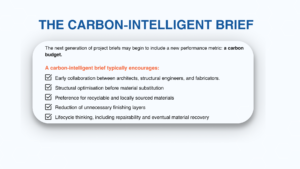
For Krishna Kishore, the most effective way to address embodied carbon is to treat it as a design parameter from the very beginning of a project. A carbon-intelligent brief, he argues, should begin not only with square footage targets and budget limits but also with a clearly defined carbon budget. By establishing measurable carbon targets early in the design process, architects and engineers can evaluate structural systems, materials, and geometries against environmental performance benchmarks.
Without such targets, carbon rarely becomes an active design consideration. When carbon budgets are introduced alongside cost and schedule constraints, structural and material decisions begin to evolve in response. This shift is already visible in several international design practices where embodied carbon is measured in kilograms of CO₂ equivalent per square metre and tracked alongside traditional project metrics such as cost and built area.
Carbon becomes something that is designed, optimised, and negotiated.
Not merely reported.
For C.S. Raghuram, this transformation also requires a stronger analytical framework within the design process. Whole-life carbon assessments, once considered specialised sustainability exercises, are increasingly becoming standard tools during concept development. Digital platforms such as lifecycle assessment software and carbon modelling tools now allow architects to evaluate structural alternatives during the earliest stages of design.
Different structural grids, material systems, and envelope strategies can be compared quickly, revealing how seemingly minor adjustments influence the overall carbon footprint of the building. When these tools are integrated with BIM workflows, carbon becomes a live design parameter, evolving alongside geometry and cost as the building develops. The result is a more transparent and informed design process. Yet technology alone cannot create carbon-aware architecture.
For Vibhor Mukul Singh, the deeper transformation must occur at the conceptual level of architectural thinking. Carbon awareness should not begin with complex simulations or mechanical technologies but with the fundamentals of architectural planning. Orientation, climate-responsive massing, passive daylighting strategies, and the use of locally available materials often shape environmental performance more profoundly than technological systems added later.
Designs that respond to climate and context naturally reduce energy demand and material excess. In this sense, sustainability becomes an extension of architectural wisdom rather than a technical correction. Singh emphasises that architects must begin to consider the entire lifecycle of buildings, from construction to operation, maintenance, and eventual dismantling.
A building’s carbon footprint is not confined to its construction phase. It unfolds across decades of use and adaptation. Designing for longevity, repairability, and maintenance, therefore, becomes a critical aspect of carbon-conscious architecture. Simple strategies such as accessible service systems, durable materials, and adaptable structural frameworks can significantly extend the lifespan of buildings while reducing the need for resource-intensive renovations.
In parallel, architects are beginning to rethink how buildings might eventually return materials to the construction cycle. Kishore suggests that future project briefs may increasingly ask an unusual question during the earliest stages of design: how will this building be taken apart in fifty years?
Such thinking introduces the concept of design for deconstruction, where materials and structural systems are selected not only for performance during the building’s life but also for their ability to be recovered and reused afterwards. Materials such as structural steel, which can be dismantled and recycled almost indefinitely, become particularly valuable within this circular construction model.
Collaboration Is Important
Embodied carbon often increases when design and engineering processes occur in isolation. Architects sketch forms, structural engineers later adapt them into structural systems, and fabricators finally translate them into construction components. Each stage introduces adjustments that may increase material consumption. Carbon-aware design, therefore, demands earlier collaboration between architects, structural engineers, and fabricators.
Kapadia notes that when structural thinking enters the architectural process early, many material inefficiencies can be eliminated before they are embedded in the project. Structural systems can align more naturally with architectural intent, reducing the need for heavy transfer structures, oversized members, or secondary support systems. In such integrated design environments, efficiency becomes a shared objective rather than a corrective exercise.
Gradually, these shifts are transforming how architecture understands responsibility. Sustainability is no longer limited to energy-efficient operations or technological upgrades. It is becoming embedded in the geometry of buildings, the logic of their structures, and the lifecycle of their materials. The invisible carbon that once remained hidden within construction is slowly becoming visible within design decisions.
And as it becomes visible, it becomes possible to reduce it. Architecture, in this evolving landscape, is learning to move from reacting to carbon toward designing with carbon in mind. From invisible impact to intentional design.
The New Green Literacy
Architecture has always been a discipline of imagination. For generations, architects have imagined how cities might grow, how structures might rise, and how spaces might inspire those who inhabit them. The tools of the profession evolved accordingly. Sketches, models, structural calculations, and material innovations that translated ideas into built form. Today, however, architecture is entering a different kind of imagination. It is learning to imagine carbon. Not as an abstract environmental statistic, but as a measurable consequence of design. A consequence embedded in the thickness of slabs, the spacing of columns, the weight of steel frames, and the geometry of structural systems.
The climate conversation has gradually revealed an uncomfortable truth: many of the environmental decisions that shape a building are made long before sustainability technologies appear in the design process. By the time solar panels are installed or energy systems optimised, much of the building’s carbon footprint has already been determined.
It was decided when the grid was drawn. When the span was extended. When the material was specified. When the structure was imagined. For architects like Piyush Kapadia, this realisation places the responsibility of sustainability squarely at the earliest stage of design. Carbon, in many ways, becomes a question of restraint, of knowing when not to add material, when to simplify structure, and when to allow architectural expression to emerge from the logic of construction itself.
Similarly, Krishna Kishore believes the next generation of architecture will be defined not by visual spectacle but by the intelligence embedded in its systems. The elegance of an optimised structural connection, he suggests, may ultimately become more meaningful than buildings wrapped in layers of carbon-heavy finishes.
This emerging sensibility does not diminish creativity. If anything, it refines it. For Vibhor Mukul Singh, architecture that respects climate, context, and material logic often produces spaces that feel more grounded and enduring. Buildings that work with natural forces rather than against them tend to age gracefully, require fewer interventions, and sustain their relevance over time.
And for C.S. Raghuram, the future of architectural practice will increasingly be shaped by measurable performance. Embodied carbon is beginning to sit alongside cost, area, and schedule as a fundamental design metric. When carbon becomes visible within the design process, it begins to influence decisions in ways that were previously unimaginable. Together, these perspectives suggest that architecture is entering a new phase of maturity.
A phase where sustainability is no longer treated as a technological overlay but as a design intelligence embedded in the structure of buildings. This shift requires a new kind of literacy within the profession.
Architects must learn to read buildings not only through form and space but also through material flows and carbon consequences. Structural engineers must engage earlier in the design process, translating architectural ambition into efficient structural systems. Material producers must provide transparent environmental data that allows designers to make informed decisions.
Clients, too, will play a crucial role. A truly carbon-conscious built environment cannot emerge unless project briefs begin to recognise environmental performance as a primary objective rather than an optional aspiration.
The transition will not be instantaneous. Construction practices evolve slowly, and the scale of the global building industry makes transformation complex. But the direction is becoming clear.
The next era of architecture will likely be defined not by the spectacle of green technologies but by the quiet intelligence of material efficiency. Buildings will increasingly be judged not only by how they look or how they perform, but by how responsibly they were constructed. By how much material they required. By how intelligently their structures were conceived. And by how gracefully their materials might return to the cycle of construction once their useful life has ended.
In this evolving landscape, the role of the architect remains profoundly important. Because long before carbon accounting software runs its calculations, before engineers optimise structural members, and before materials arrive on site, a single line is drawn on paper. That line determines the grid. The grid determines the structure. And the structure quietly determines the carbon. The future of sustainable architecture, it seems, may not lie in what we add to buildings. It may lie in how thoughtfully we design what holds them up.
SSMB POV: Seeing Carbon Where It Truly Lies
For decades, the construction industry pursued sustainability through visible interventions like solar panels, intelligent façades, energy-efficient systems. These measures remain important, but they address only part of the environmental equation.
What this story reveals is a more fundamental truth: the real climate impact of buildings is decided much earlier and much deeper. It lies in structure. The grids that organise space, the spans that define openness, the beams and columns that carry loads. These elements quietly determine the majority of a building’s embodied carbon. Yet they often remain absent from mainstream sustainability conversations.
What emerges from the insights of leading architects in this story is a new design literacy. Carbon is no longer merely an environmental metric to be reported after construction; it is becoming a design intelligence to be considered from the first line drawn on paper.
For architects, engineers, and builders alike, the message is clear: the future of sustainable construction will not be defined only by how buildings perform once they are complete. It will be defined by how intelligently they are structured before they are built.
In the coming years, the most sophisticated buildings may not be the ones with the most technology, but the ones that achieve the greatest architectural clarity with the least material. Because in the new grammar of sustainability, efficiency is no longer merely an engineering virtue. It is becoming architecture itself.
Carbon Reality Check: Where a Building’s Carbon Actually Lives
While sustainability conversations often revolve around façades, finishes, and building systems, the bulk of a building’s carbon footprint is embedded much deeper within its structure.
Typical whole-life carbon distribution in a commercial building:
- Structure (steel, concrete, foundations): 30–45%
- Operational energy (HVAC, lighting, equipment): 20–40%
- Envelope/façade systems: 10–20%
- Mechanical & electrical systems: 10–15%
- Interior finishes & fit-out: 5–15%
- Construction & transport processes: 3–8%
Design Decisions That Lock Carbon Early
Long before sustainability technologies enter the picture, architects make a series of choices that quietly determine a building’s material demand.
Five early design moves that shape embodied carbon:
- Structural Grid Spacing: Wider spans require deeper beams, larger columns, and heavier foundations, multiplying structural tonnage.
- Building Massing & Cantilevers: Complex offsets or large projections often require heavy transfer beams that add carbon without increasing usable space.
- Floor Systems: Choices between conventional slabs, composite decks, or optimised structural systems can significantly influence concrete and steel volumes.
- Façade Complexity: Highly articulated façades often require secondary support structures that add hidden structural material.
- Material Layering: False ceilings, cladding systems, and redundant finishes introduce additional material layers that increase embodied carbon.