

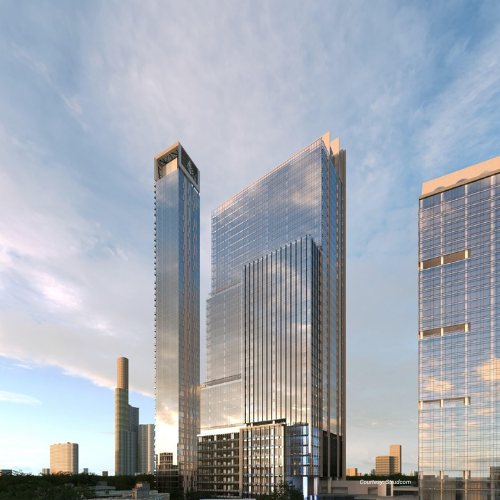
Introduction: There was a time when commercial real estate was defined by scale, how tall a building rose, how much it cost, how prominently it stood on the skyline. Today, a quieter metric is shaping every decision: time. How early a building can be occupied, how smoothly it moves from construction to commerce, how little uncertainty it carries along the way. In this edition, SSMB reflects on this shift and explores how steel-led construction is changing the rhythm of commercial development in India. Through voices from across the value chain, the story traces how speed is no longer about building faster on site, but about thinking earlier, coordinating better, and delivering certainty in a market where every month matters.
By 2026, India’s commercial real estate market is no longer defined merely by square footage delivered or capital deployed, it is increasingly judged by how fast value can be unlocked. Across Grade A office developments, tech parks, mixed-use commercial hubs, and emerging urban business districts, time-to-market has become the sharpest competitive differentiator.
Recent market trends make this shift unmistakable. Commercial development cycles that once comfortably stretched over four to five years are now being compressed aggressively. Global Capability Centres (GCCs), technology firms, BFSI occupiers, and flexible workspace operators are demanding earlier possession, phased handovers, and near-immediate operational readiness. Leasing decisions are being taken faster, but patience for delayed delivery has all but disappeared.
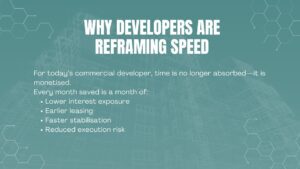
For developers, the implication is direct and unforgiving. Every month lost between structural completion and tenant occupancy translates into:
- Deferred rental income
- Higher interest and finance costs
- Prolonged capital lock-in
- Missed market windows in competitive micro-markets
In an environment where commercial assets are expected to stabilise faster and deliver returns sooner, time itself has become a measurable financial metric that is as critical as cost, yield, or location.
FROM COST OPTIMISATION TO TIMELINE CERTAINTY
Traditionally, commercial construction conversations revolved around cost per square foot, material optimisation, and design efficiency. Today, those discussions have evolved. Developers are increasingly asking harder, sharper questions:
- How soon can the structure be completed?
- When can façade installation realistically begin?
- How early can interior fit-outs start, floor by floor?
- At what point does the building become usable—not just complete?
The shift is subtle but significant. Success is no longer defined at project completion; it is defined at first occupancy.
This recalibration has forced the industry to re-examine its structural choices. Conventional construction systems that are highly dependent on site conditions, sequential workflows, curing cycles, and labour availability are finding it harder to deliver certainty under compressed timelines. Delays at the structural stage now ripple across every downstream activity, from façade anchoring to MEP integration and tenant handover.
It is within this context that steel has re-emerged not as an alternative, but as a strategic accelerator.
STEEL AND THE ECONOMICS OF SPEED
What distinguishes steel construction in today’s commercial landscape is not just faster erection, it is the ability to front-load certainty. Steel allows fabrication to begin while foundations are still underway, collapsing what were once sequential phases into parallel workstreams. It shifts quality control from unpredictable sites to controlled factory environments. It replaces waiting time with assembly logic.
More importantly, steel enables something the modern commercial developer values deeply: predictability.
Predictable schedules allow developers to:
- Align statutory approvals, interior works, and tenant onboarding with confidence
- Plan phased occupancies instead of all-or-nothing handovers
- Reduce exposure to labour volatility and weather disruptions
- Protect project cash flows in increasingly tight financial environments
In fast-moving commercial markets, speed is no longer about rushing construction, it is about eliminating uncertainty.
“In steel construction, predictability is the real luxury.”
WHY THIS MOMENT MATTERS
India is entering a phase where commercial growth is no longer confined to Tier 1 CBDs. Tier 2 cities and emerging business districts are witnessing a steady rise in office demand, driven by decentralisation, cost optimisation, and regional talent pools. In these markets especially, projects are often owner-driven, capital discipline is paramount, and prolonged construction cycles are simply untenable.
At the same time, architectural expectations are rising. Modern workplaces demand long spans, flexible floorplates, rapid reconfiguration, and façade systems that can be installed early and efficiently. Structural systems are now expected to serve not just strength and safety, but speed, adaptability, and future readiness.
Steel sits at the intersection of all these demands.
WHERE TIME IS GAINED, NOT JUST COST SAVED
The real advantage of steel in commercial construction is rarely found in a single activity or milestone. It emerges from a fundamental shift in how time is structured across a project. Steel does not merely make construction faster at site, it moves certainty forward, replacing sequential dependency with parallel progress and eliminating the waiting that quietly consumes months in conventional construction.
One of the earliest points where steel begins to alter the timeline is long before work intensifies on site. Himadri Sen, Senior General Manager at Shapoorji Pallonji and Company, points out that offsite fabrication is the single biggest schedule lever in steel construction. Unlike traditional systems, steel members can be fabricated while foundations are still underway. This overlap collapses the early critical path, allowing the project to “start” structurally much earlier than the site would otherwise permit. Fabrication in controlled shop environments also reduces weather dependency, improves quality control, and significantly lowers the risk of rework during erection.
However, this advantage only materialises when design decisions are taken early and repeated framing logic is adopted. Steel rewards clarity. Once drawings are finalised, production can move decisively, converting time that would otherwise be lost to curing and sequencing into measurable progress.
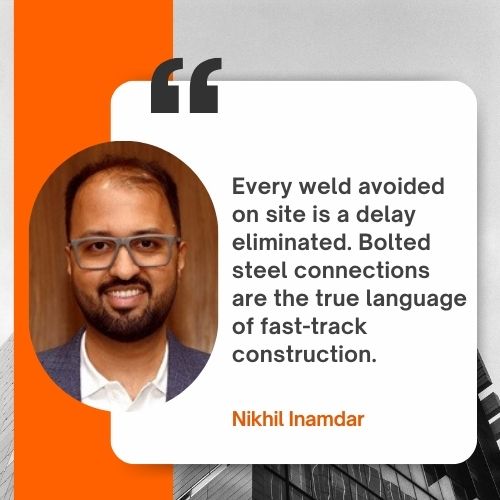
As steel transitions from factory to site, its time advantage becomes visible in erection. Bolted steel connections transform construction into an assembly-led process rather than a labour-intensive craft. Nikhil Inamdar, Director at Strudcom Consultants, explains that his firm’s detailing philosophy deliberately minimises on-site welding, relying almost entirely on bolted connections to accelerate erection and reduce dependency on highly skilled site labour. Every weld avoided on site removes uncertainty, from inspection delays to safety risks, allowing structures to rise in a predictable, repeatable rhythm.
“Steel does not save time by working faster, it saves time by starting earlier.”
The structural systems chosen also play a decisive role in how quickly a commercial building comes together. Dr. Vinod Jain, Managing Director of Vintech Consultants, notes that steel frames with steel-to-steel connections offer a clear time advantage over shear wall–dominated systems, which remain constrained by formwork and curing cycles. Where bracing is architecturally feasible, steel systems provide agility without compromising performance. Even when concrete elements are unavoidable, their extent can be strategically reduced, preserving the overall speed advantage of steel-led construction.
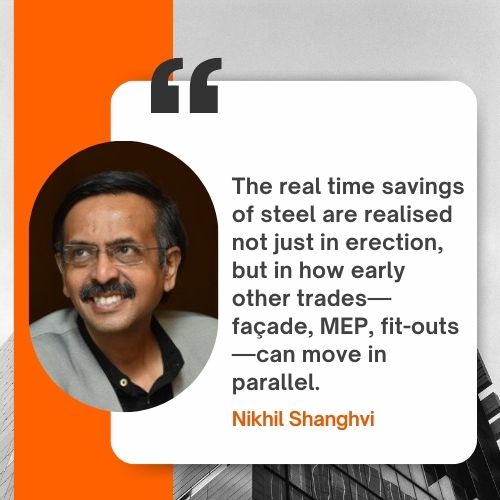
Speed, however, is not only about how fast a structure is erected, it is about what becomes possible immediately afterward. Nikhil Shanghvi, Managing Director of SACPL, highlights composite metal deck systems as the backbone of fast-track commercial construction. Deck slabs act as permanent formwork and, more importantly, provide an immediate and safe working platform for other trades. This allows multiple floors to be in different stages of progress simultaneously, framing above, slab topping below, and MEP or fit-outs progressing further down. Time is not saved at one level; it is multiplied across the building.
Steel’s lightweight nature quietly accelerates the project even before the superstructure rises. Reduced structural weight translates into lighter foundations, smaller excavation volumes, and faster substructure completion, an advantage that becomes especially pronounced in urban sites and redevelopment projects where access, disruption, and logistics are tightly constrained.
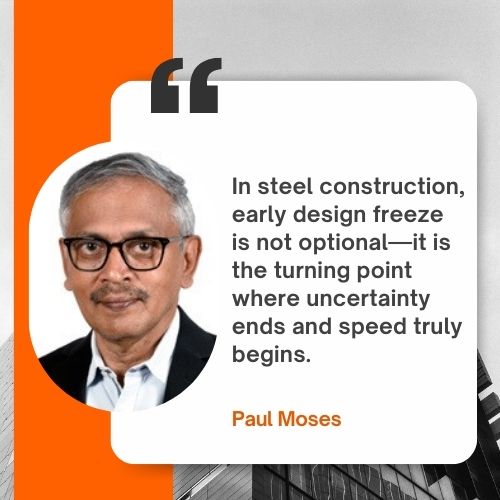
Precision is another dimension where steel gains time indirectly but decisively. Steel construction forces resolution early. Paul Moses, Director – Design & Projects at RSP Design Consultants, emphasises that steel demands accurate planning and intense coordination at the outset. Services are routed through pre-determined beam openings, coordinated with structural design before fabrication begins. Plumbing lines, electrical trays, and fire services are no longer negotiated around finished structures; they are embedded into the logic of the building from day one. This front-loaded effort eliminates downstream clashes, reduces congestion on site, and accelerates service installation once floors are released.
The same precision benefits façade integration. Moses cites projects where steel structures were deliberately designed to work in tandem with precast façade systems, allowing façade panels to be fabricated off-site and bolted directly to steel frames. This compatibility enables envelope closure to begin earlier and proceed faster, often in large zones rather than piecemeal. When buildings are enclosed sooner, interior environments can be conditioned earlier, unlocking faster progress for fit-outs and tenant works.
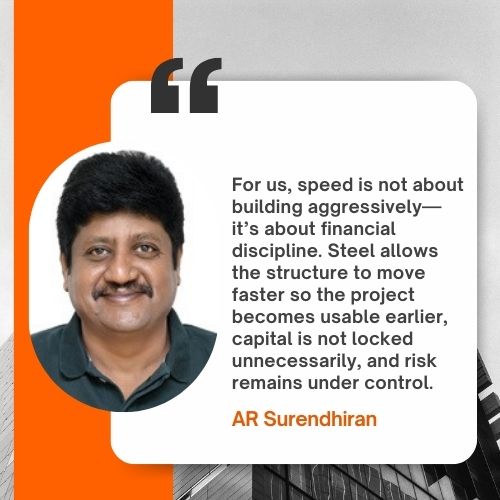
Perhaps the most understated advantage of steel lies in sequential usability. Unlike conventional systems that demand structural completion before value creation begins, steel allows buildings to become usable floor by floor. Developers can release completed levels for interior works and tenant customisation while construction continues above. AR Surendhiran, Managing Partner, Habitat Holdings, underscores the importance of this in Tier 2 South Indian markets, where projects are closely monitored by owners and capital cannot remain idle for long. Steel, he observes, allows other activities to move in parallel, making projects operational much earlier than conventional construction would permit.
Viewed together, these advantages do not present themselves as dramatic leaps in speed. Instead, they form a cascade of time gains, days saved in fabrication become weeks saved in erection, which in turn unlock earlier façade closure, faster MEP integration, and quicker tenant readiness. Steel replaces waiting with workflow, uncertainty with sequence, and reactive problem-solving with planned execution.
This is why steel’s advantage cannot be reduced to faster construction alone. Its true value lies in how it restructures the timeline of a commercial project, aligning design, engineering, fabrication, and execution into a single, overlapping system. In an industry where every month saved can mean millions gained or lost steel does not just shorten schedules. It makes them reliable.
“In commercial real estate, the building begins to succeed the day it becomes usable, not the day it is completed.”
HOW SPEED RESHAPES THE COMMERCIAL DEVELOPER’S BALANCE SHEET
In commercial development, speed is rarely discussed in isolation from money and rightly so. Construction timelines are not merely technical schedules; they are financial instruments that determine how long capital remains locked, how soon revenue begins to flow, and how much uncertainty a developer is willing to absorb. As projects become more tightly linked to leasing commitments, business openings, and market cycles, the cost of delay has become increasingly visible.
From a developer’s standpoint, the most tangible impact of speed is felt in how early a project becomes usable, not when it is declared complete. Surendhiran, speaking from the perspective of a Tier 2 South Indian developer, frames this reality with clarity. In owner-driven developments, he notes, long construction timelines are less about technical inconvenience and more about financial discipline. Capital tied up for extended periods directly affects project viability, especially when developments are closely monitored by the promoter. Steel, in this context, becomes valuable not because it chases marginal cost savings, but because it shortens the core structural phase and allows parallel activities to begin much earlier.
That early usability has a cascading financial effect. When floors are released sooner, developers can align interior works, statutory approvals, and tenant fit-outs without waiting for the entire structure to be completed. Rental income, or at the very least firm leasing commitments, can begin earlier. In large commercial assets, even a single month gained can mean avoiding significant deferred revenue. As Surendhiran points out, the primary benefit is not speed for its own sake, but the ability to start operations earlier, with tighter control over financing costs and reduced exposure to labour and material price volatility.
Finance costs are another pressure point where time exerts quiet but persistent influence. Prolonged construction schedules extend interest accruals and strain working capital. Faster delivery shortens the duration for which borrowed capital remains unproductive. In markets where developers are increasingly cost-conscious and process-driven, steel’s ability to offer predictable and compressed timelines directly supports healthier financial outcomes. According to Surendhiran, this predictability is often more valuable than headline construction savings, because it reduces overall project risk.
This emphasis on certainty is echoed further down the delivery chain. From an execution perspective, Himadri Sen explains that steel fundamentally changes how schedules are planned and protected. Offsite fabrication allows fabrication to proceed while foundations are still underway, shifting critical activities earlier in the project lifecycle. But this advantage only materialises when design decisions are taken early and repeated framing or long-span systems are used intelligently. When these conditions are met, steel enables projects to move from linear planning to parallel execution, compressing timelines without increasing chaos.
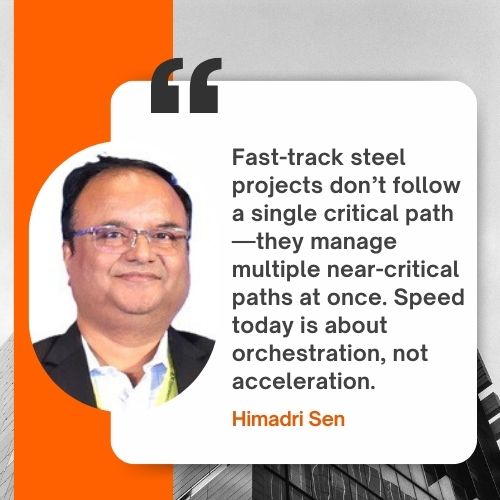
Parallel workstreams, however, demand a different mindset. Sen describes fast-track steel projects as exercises in systems integration and risk management, rather than simple acceleration. Multiple near-critical paths including foundations, fabrication, façade, and MEP must be managed simultaneously, with interface milestones treated as non-negotiable constraints. When handled well, this approach can significantly reduce delivery timelines. When mismanaged, it can introduce hidden delays that surface too late to correct. The financial implication is clear: speed must be orchestrated, not assumed.
From a structural engineering perspective, speed also translates into risk containment, which has direct business implications. Dr. Vinod Jain highlights that conventional structural systems reliant on extensive formwork and curing cycles often slow projects at precisely the stage where momentum matters most. Steel-to-steel connections, by contrast, are faster to erect, more precise, and far more predictable. This reduction in on-site ambiguity lowers the likelihood of rework, an often underestimated source of financial leakage in commercial projects.
Rework is not just a technical issue; it is a budgetary one. Site corrections consume time, introduce safety risks, and disrupt downstream trades. Well-resolved detailing, Jain explains, ensures that most decisions are made on paper rather than under pressure on site. For developers, this means fewer surprises, steadier cash flow projections, and tighter control over execution risks.
There is also a longer-term business dimension to speed that extends beyond construction. Nikhil Shanghvi frames performance-based engineering not only as a tool for structural efficiency, but as a means of protecting operational continuity. By designing for specific performance objectives such as post-seismic serviceability, developers can reduce future downtime and lifecycle costs. In commercial real estate, where business interruption can be as damaging as construction delay, this form of “speed after delivery” becomes an extension of the same value proposition.
Taken together, these perspectives underline a central truth: steel does not simply accelerate construction; it reshapes the financial profile of a commercial project. It allows revenue to begin earlier, reduces interest exposure, limits volatility, and strengthens delivery credibility. In competitive markets, whether Tier 1 business districts or emerging Tier 2 commercial zones, these advantages directly influence asset performance.
For today’s commercial developer, speed is no longer an operational aspiration. It is a strategic requirement, measured not just in days saved on site, but in financial certainty gained across the project lifecycle. Steel’s role in this equation is increasingly clear: it converts time from a liability into a controllable asset.
“In commercial real estate, the building begins to succeed the day it becomes usable, not the day it is completed.”
ARCHITECTS AT THE HEART OF THE SPEED EQUATION
If steel compresses timelines, it is architecture that determines whether that compression is achievable or merely aspirational. In fast-track commercial projects, speed does not begin on site; it begins at the moment design decisions are locked with clarity and conviction. Steel, more than any other structural system, makes this truth unavoidable.
According to Paul Moses flexibility and speed have become inseparable demands in contemporary commercial buildings. Hybrid work models, evolving tenant expectations, and rapidly changing space usage patterns have fundamentally altered how offices are planned. Large, column-free floorplates are no longer a luxury; they are a baseline requirement. Steel, Moses explains, enables these expansive spans with ease, allowing architects to design open office environments that can be zoned fluidly into collaborative areas, formal and informal meeting spaces, social hubs, and amenities without structural constraints dictating spatial logic.
What makes steel particularly relevant in this context is not just spatial freedom, but adaptability over time. Moses points out that large spans allow future modifications and reconfigurations to be carried out with minimal disruption when tenant requirements change. In a commercial environment where churn is inevitable, this ability to adapt quickly becomes an extension of speed beyond construction into the operational life of the building itself.
However, steel’s greatest architectural demand is also its greatest advantage: early design freeze. Moses is unequivocal on this point. In steel construction, early design freeze is not a procedural milestone, it is the project’s inflection point. It is the moment when the client, architect, project manager, structural engineer, and MEP consultants collectively agree that the design is final, and that changes will no longer be entertained. Once this consensus is achieved, the project shifts decisively from deliberation to execution.
This early alignment unlocks multiple accelerators simultaneously. Fabrication planning becomes efficient and uninterrupted. Costs stabilise because revisions and rework are eliminated. Architectural, structural, and MEP systems can be coordinated in full, dramatically reducing downstream risk. As Moses notes, early design freeze allows all stakeholders to focus entirely on production and erection rather than on revisions and reconciliations, a critical distinction in fast-track projects.
Design-to-build coordination becomes particularly consequential when services integration is considered. Unlike conventional construction, where MEP routing often evolves reactively on site, steel demands that these decisions be made upfront. Moses highlights that plumbing pipes, electrical trays, and firefighting systems are routed through pre-determined openings in steel beams, which are coordinated well before fabrication. These openings are not afterthoughts; they are the result of deliberate, multi-disciplinary coordination. The payoff is significant as services installation becomes faster, cleaner, and far less congested, eliminating one of the most common causes of delay in commercial projects.
Façade integration is another area where architectural leadership directly translates into speed. Moses references projects where steel structures were deliberately designed to work in tandem with precast façade systems. In such cases, vertical steel members are positioned strategically to receive precast panels that are fabricated off-site and bolted directly onto the steel frame. This approach allows façade panels, structural steel, and glazing systems to be manufactured in parallel and installed sequentially with remarkable efficiency. Envelope closure, which often dictates when interior works can begin, is dramatically accelerated.
The contrast becomes particularly evident when steel-compatible façade strategies are abandoned. Moses recalls instances where precast systems had to be replaced with conventional masonry due to external constraints, resulting in slower execution and labour challenges, especially at height. The lesson, he notes, is unambiguous: steel delivers its full time advantage only when paired with equally industrialised façade and envelope systems.
As project timelines compress, the role of the architect itself is evolving. Moses observes that in steel-led commercial projects, architects are no longer confined to spatial planning and aesthetics. They are increasingly expected to act as integrated design leaders, fluent in manufacturing logic, assembly processes, transportation constraints, and erection methodologies. Knowledge of component sizes, weights, crane capacities, and site logistics is no longer optional, it directly influences design decisions that affect speed.
This shift is reinforced by the growing reliance on BIM as a real-time coordination platform rather than a documentation tool. Moses stresses that strong BIM capability allows architects to coordinate continuously with structural engineers, MEP consultants, and steel contractors, resolving issues digitally long before they can disrupt site execution. Standardisation of steel components, repetition in façade panels, and familiarity with hybrid steel-concrete systems further reduce production time and fabrication complexity.
In this evolving landscape, architects are designing not just buildings, but processes. They are aligning geometry with manufacturing, detailing with logistics, and spatial ambition with construction reality. Steel, by its very nature, demands this integration and rewards it with speed.
What emerges is a clear pattern. Fast-track steel projects succeed not because they move faster at site, but because architects make decisive, informed choices early. By freezing designs with intent, coordinating relentlessly across disciplines, and designing with assembly in mind, architects transform steel’s potential into guaranteed delivery.
In the economy of speed, architecture is no longer merely about form or function. It is about certainty, and steel makes that responsibility unmistakably clear.
“Fast steel projects succeed because decisions are taken early—and never revisited on site.”
THE TIMEKEEPERS OF PRECISION
If architects set the pace for fast-track steel projects, structural engineers are the custodians who ensure that speed does not unravel into risk. In steel construction, time is not recovered on site; it is either protected or lost at the detailing table. This is where engineering discipline quietly determines whether ambitious timelines remain achievable or collapse under their own weight.
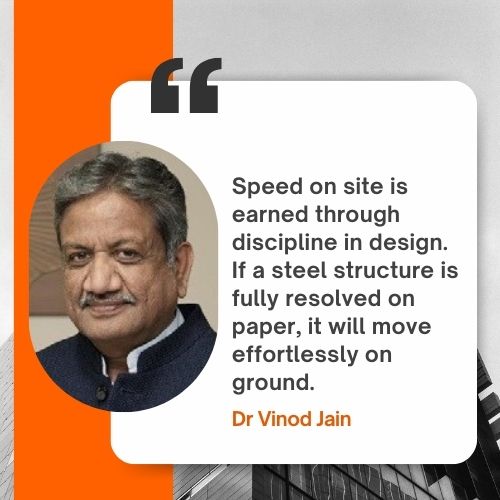
At the heart of fast commercial delivery lies one fundamental principle: structures must be designed not only for strength, but for assembly. Dr. Vinod Jain is clear that the most time-efficient steel systems are often those that remain structurally straightforward. Steel frames with steel beams, rational bracing systems, and steel-to-steel connections consistently outperform systems that rely heavily on shear walls, formwork, and curing cycles. While shear walls may be unavoidable in certain architectural conditions, Dr Jain notes that wherever bracing is feasible, steel structures gain agility both in erection speed and schedule predictability.
This emphasis on simplicity is not about cutting corners; it is about eliminating unnecessary friction. Steel-to-steel connections, Dr Jain explains, are inherently faster and more precise than steel-to-concrete interfaces. They reduce ambiguity, accelerate alignment, and allow erection crews to work with repeatable logic. In commercial projects operating under compressed timelines, this clarity becomes indispensable.
That clarity is reinforced through assembly-friendly detailing, an area where all three structural consultants converge strongly. Dr Jain stresses that steel projects must be fully resolved on paper before reaching site. When detailing fails to account for clashes or constructability constraints, problems inevitably surface during erection, forcing site modifications that delay progress and introduce safety risks. Speed, in this sense, is not achieved by working faster on site, but by eliminating the need to think on site.
Nikhil Shanghvi extends this idea further by framing detailing as a form of communication with the site. Standardised, repetitive connection details reduce setup time, speed up inspections, and allow crews to build familiarity quickly. When erection teams encounter the same shear tabs, double-angle connections, or bolted joints repeatedly, productivity rises naturally. Shanghvi also highlights the importance of designing visible, intuitive load paths, details that “make sense” to site personnel, so components seat correctly the first time, without hesitation or rework.
This site-first mindset is echoed strongly by Nikhil Inamdar. His approach prioritises bolted connections almost exclusively, deliberately minimising on-site welding. Welding, he notes, introduces variability like inspection delays, labour dependency, and safety exposure that runs counter to fast-track execution. By restricting welding to only unavoidable conditions, such as shear wall interfaces, steel erection becomes cleaner, faster, and far more predictable.
Beyond connections, the choice of structural systems plays a decisive role in determining how quickly a commercial building progresses. Inamdar points to Concrete Filled Tube (CFT) columns combined with built-up steel beams and deck slabs as particularly effective for speedy execution. These systems provide early stiffness and stability, enabling faster deck progression and reducing reliance on extensive concrete elements. Dr Jain reinforces this view by noting that such systems allow structures to perform efficiently without resorting to complex or over-engineered solutions.
Composite deck systems, as Shanghvi explains, act as accelerators beyond the structural frame itself. Deck slabs provide immediate working platforms, allowing other trades to mobilise sooner and operate concurrently across multiple levels. The real time savings, he notes, are not confined to erection, they are realised when framing, slab topping, MEP installation, and fit-outs overlap smoothly across floors.
Performance-based engineering (PBE) emerges as another critical lever, when applied with restraint. Dr Jain cautions that for most commercial steel buildings, conventional linear analysis is often sufficient if design parameters are chosen correctly. Speed, he argues, is more closely linked to selecting the right lateral force-resisting system and rational member sizes than to deploying complex analysis for its own sake. Over-engineering can slow projects as much as under-engineering.
Shanghvi, however, introduces a complementary dimension to PBE by highlighting its role in enabling lighter systems, smaller foundations, and faster approvals, particularly for unconventional or long-span designs. When used judiciously, PBE allows engineers to justify efficient solutions that may fall outside prescriptive norms, reducing tonnage while maintaining safety. Importantly, he adds, PBE also enhances resilience, allowing buildings to recover faster after extreme events, compressing not just construction timelines, but future operational downtime.
Inamdar brings this discussion back to execution by emphasising how PBE can be used strategically to design out slow elements, such as excessive shear walls. Fewer concrete walls translate directly into faster construction. When combined with modular steel systems and deck slabs, the result is a structure that advances rapidly with minimal wet works on site.
Perhaps the most underappreciated contribution structural engineers make to speed lies in erection sequencing and temporary stability planning. Dr Jain describes how his team reviews complete steel detailing models, often through Tekla, to verify load paths not just in the final structure, but at every intermediate stage of erection. Member continuity, splice locations, and temporary stability are assessed well before construction begins, ensuring that the structure remains stable as it rises.
Shanghvi expands on this by explaining how erection load cases, partial frames, and unbraced lengths must be checked early to avoid unsafe or inefficient temporary strengthening on site. Logical framing grids, clear identification of stability systems, and differentiation between temporary and permanent bracing all reduce the need for method-statement revisions during construction, saving time where it is hardest to recover.
Inamdar adds a critical execution-layer insight: crane logic and logistics must be embedded into design decisions from the very beginning. By engaging steel vendors during the concept stage, his teams anticipate lifting constraints, crane locations, and erection sequencing early. Designing crane supports and member weights with real site conditions in mind eliminates delays caused by reconfiguration, idle machinery, or late-stage redesign.
Together, these perspectives reveal a consistent truth. Speed in steel construction is not accidental, and it is not driven by site heroics. It is engineered deliberately, through disciplined system selection, empathetic detailing, early coordination, and an unwavering focus on buildability.
Structural engineers, in this sense, are the timekeepers of fast-track commercial projects. Their decisions determine whether speed remains a controlled advantage or dissolves into risk. When engineering is precise, restrained, and execution-aware, steel delivers not just faster buildings, but predictable ones.
“Parallel workflows reward clarity. They punish indecision.”
EXECUTING SPEED IN REAL TIME
If speed is designed on paper and engineered into systems, it is ultimately tested on site. This is where intent meets reality, where parallel workflows either deliver extraordinary gains or unravel under their own complexity. In fast-track steel construction, EPC contractors are not merely executors; they are real-time orchestrators of risk, interfaces, and momentum.
From a contractor’s perspective, steel fundamentally changes when and how work begins. Himadri Sen identifies offsite fabrication as the single most decisive schedule advantage in steel construction. Unlike conventional systems, steel allows fabrication to commence while foundation work is still in progress, effectively pulling the structural start date forward. This overlap is not incremental, it is transformational. It allows projects to gain time before site constraints, weather, or labour availability begin to exert pressure.
However, Sen is careful to note that offsite fabrication only delivers its full benefit when upstream decisions are resolved early. Finalised designs, repetitive framing logic, and long-span systems enable fabrication to proceed without interruption. When information is late or fragmented, the advantage of steel diminishes rapidly. Speed, in this sense, is conditional, it rewards preparedness and punishes indecision.
Once construction moves into full swing, steel shifts project planning away from linear sequencing toward parallel execution models. Sen describes this transition as a move from managing a single critical path to managing multiple near-critical paths simultaneously. Foundations, fabrication, façade engineering, MEP coordination, and fireproofing all advance in tandem, each with the potential to become the controlling activity if not carefully aligned. In fast-track steel projects, interfaces, not trades, become the true schedule drivers.
To manage this complexity, EPC teams adopt zone-based execution strategies, identifying interface milestones as hard constraints rather than flexible targets. Continuous “what-if” scenario planning becomes essential, allowing teams to anticipate conflicts before they surface on site. When executed well, this approach can compress overall project timelines dramatically. When mismanaged, it creates hidden critical paths that only reveal themselves after delays have already compounded.
Digital tools play a decisive role in preventing such outcomes, but not in the way they are often portrayed. Sen emphasises that technologies like BIM, 4D scheduling, and digital QA/QC add the most value at interfaces, handoffs, and repetition points, rather than as mere documentation aids. BIM coordination, when carried out early, resolves clashes before fabrication begins, accelerates shop drawing approvals, and drastically reduces RFIs during construction. Decision-making shifts away from the field and into the planning stage, where it is faster, safer, and far less disruptive.
Digital QA/QC further shortens feedback loops. Real-time inspections allow issues to be identified and corrected within the same day, reducing re-inspections and preventing minor deviations from escalating into schedule-impacting problems. In fast-track environments, these compressed feedback cycles are critical to maintaining momentum.
Yet, despite steel’s inherent advantages, execution is not without its challenges. Sen acknowledges that fast-track steel construction introduces its own set of risks, most of which stem from information timing and interface coordination. Steel is often released for fabrication before MEP routing is fully frozen. Late inputs such as façade anchor loads can introduce change risk after material has already been cut. Because steel interfaces with nearly every system that include foundations, façades, MEP services, and fireproofing, even small tolerance mismatches can cascade into rework if not anticipated early.
Logistics present another layer of complexity. Limited shop fabrication capacity, transportation constraints, and crane availability all influence just-in-time delivery strategies. Steel projects rely heavily on precise sequencing; when one component arrives late or out of order, it can disrupt multiple downstream activities. This reinforces the importance of early coordination between designers, fabricators, and site teams long before erection begins. Perhaps the most critical constraint Sen highlights, however, is the availability of skilled manpower.
Fast-track steel projects depend on a relatively small pool of experienced supervisors, erectors, and inspectors. Sustained acceleration often leads to excessive overtime, fatigue, and declining productivity if workforce capacity is not managed carefully. Addressing this challenge, he suggests, requires industry-wide investment in skill development, particularly through ITIs and industry-assisted training programmes focused on structural steel fabrication and erection.
What emerges from the contractor’s lens is a nuanced reality. Steel construction unquestionably enables faster delivery, but only when speed is managed deliberately. It demands early decisions, disciplined coordination, robust digital workflows, and a skilled execution ecosystem. When these elements align, steel allows EPC teams to deliver projects that are not just fast, but controlled, safe, and repeatable.
In fast-track commercial construction, speed is not achieved by pushing harder on site. It is achieved by removing friction before it appears. And it is the EPC contractor, working at the intersection of design intent and physical reality who ultimately ensures that engineered speed survives contact with the ground.
“The fastest projects are those where nothing needs to be rethought on site.”
HOW STEEL WILL REDEFINE COMMERCIAL SPEED BY 2030
If the last decade was about proving that steel can build faster, the next will be about proving that steel can build smarter, earlier, and with near-absolute certainty. By 2030, speed in commercial construction will no longer be measured simply in months saved, it will be measured in how seamlessly buildings move from concept to operation, and how little friction exists between design intent and delivery.
At the core of this future lies a fully digital, fabrication-first mindset. Structural engineers such as Nikhil Shanghvi point to AI-driven generative design and optimisation tools that are already beginning to reshape early-stage decision-making. These systems can rapidly evaluate framing layouts for constructability, weight, span efficiency, and erection logic, compressing weeks of iterative coordination into days. As these tools mature, steel buildings will increasingly be “designed for assembly” from the very first sketch.
This digital intelligence will flow directly into fabrication. Automated BIM-to-CNC workflows will shorten shop drawing cycles and eliminate translation errors between design and production. Robotic welding, drilling, and cutting lines will further reduce fabrication time while improving consistency. For developers and EPC contractors alike, this convergence means one thing: predictable schedules that begin earlier and hold firm.
Prefabrication and modularisation will accelerate this shift. Entire structural bays, service cores, and even volumetric modules, complete with MEP and finishes will increasingly be manufactured off-site and assembled on location. Nikhil Inamdar notes that modular steel systems combined with deck slabs already offer substantial timeline reductions, and the gradual elimination of concrete shear walls will only enhance this advantage. In high-rise commercial buildings, steel cores supplemented by damping systems may soon replace large volumes of wet concrete, allowing structures to rise faster with fewer site dependencies.
Performance-based engineering will play a central role in enabling this transition. As Dr. Vinod Jain has observed, the future lies not in complexity for its own sake, but in intelligent restraint, choosing systems that balance speed, safety, and efficiency. At the same time, advanced damping devices and energy dissipation systems will allow engineers to reduce structural mass while achieving superior performance. For commercial assets, this translates into faster construction and faster recovery after extreme events, compressing not just build timelines, but lifecycle disruption.
From an architectural standpoint, the future will demand even tighter integration between design and delivery. Paul Moses foresees architects evolving further into product-oriented, data-driven collaborators, fluent in manufacturing constraints, transportation limits, and erection logic. BIM will no longer be a coordination tool; it will be the single source of truth that aligns architecture, structure, services, façade, and construction sequencing in real time.
Execution, too, will change fundamentally. EPC contractors will increasingly rely on 4D and 5D planning, real-time site data, and reality capture technologies to manage multiple near-critical paths simultaneously. Drones, scanners, and digital QA/QC systems will feed live information back into planning models, allowing immediate adjustments to prefabricated components. Himadri Sen notes that such tools already deliver their greatest value at interfaces and by 2030, those interfaces will be almost entirely virtual, resolved long before materials arrive on site.
Yet perhaps the most important transformation will be cultural. Developers, especially in emerging Tier 2 markets, are becoming more process-driven and risk-aware. As AR Surendhiran observes, the focus is shifting away from chasing marginal cost savings toward achieving clarity, control, and predictable outcomes. Steel aligns naturally with this mindset. It replaces uncertainty with sequence, improvisation with planning, and delay with decisiveness.
By the end of this decade, the fastest commercial buildings will not be the ones that work harder on site, they will be the ones that think earlier, decide faster, and execute with discipline. Steel will be at the centre of this transformation, not because it is new, but because it has evolved into the most reliable system for delivering certainty at speed.
“Architecture today designs not just space, but sequence.”
THE FINAL WORD
Speed is no longer a luxury in commercial real estate. It is the currency by which projects are judged, capital is protected, and trust is earned. Steel does not merely help developers build faster, it helps them enter the market earlier, stabilise assets sooner, and deliver certainty in an increasingly unforgiving timeline economy. As India’s commercial landscape expands beyond traditional business districts and into new urban frontiers, steel will not just support growth, it will set the pace for it. In the race to deliver value, steel is no longer the alternative. It is the advantage.
As this cover story reveals, the race today is not about building taller or bigger, it is about delivering earlier, smarter, and with certainty. What stands out across every stakeholder voice in this story is a shared truth: fast-track projects do not succeed by working harder on site, they succeed by thinking earlier, deciding faster, and coordinating better. This is not a story about construction. It is a story about how time itself is being redesigned. — Mahesh Mudaliar, Senior Editor, SSMB
Speed Metrics — Where Steel Really Saves Time
- Structural work starts months earlier due to parallel fabrication
- Floor usability achieved sequentially, not at project end
- Façade and services advance concurrently, not sequentially
- Fit-outs begin while upper floors are still rising
Result: Time saved compounds across the entire project lifecycle.
Where Speed Is Won
Speed is won before site mobilisation, at the design table, the detailing model, and the fabrication plan.