

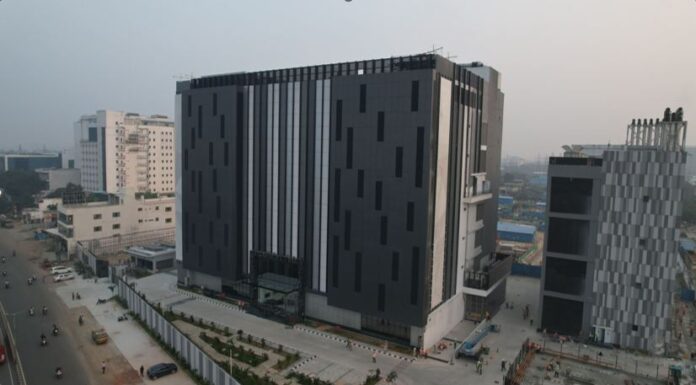
Introduction: India’s cloud story is no longer defined by software alone, it is increasingly defined by steel. As hyperscalers, cloud providers, and AI-driven enterprises accelerate their demand for compute, the physical layer that houses the cloud is evolving at unprecedented speed. A new generation of data centres that is faster to build, more precise, more resilient, and more sustainable, is emerging, powered largely by prefabricated, modular steel structures. This exclusive feature unites developer vision, consultant expertise, architectural insight, and fabrication excellence to uncover why steel has become the material of choice for India’s next wave of hyperscale and edge facilities, and what that means for engineers, owners, and policymakers shaping the country’s digital future.
From the outside, a data centre appears almost indifferent to the world around it, mute, monolithic, impenetrable. Yet inside, these structures hum with the energy of a civilisation in constant motion. Within their walls, India’s digital life unfolds: financial systems, logistics networks, EduTech platforms, hospitals, OTT services, governance frameworks, and the countless personal data trails generated every second by a billion people. They are not glamorous buildings, but they are indispensable ones, and in the coming decade they will define India’s technological destiny more than any skyline or smart city ever could.
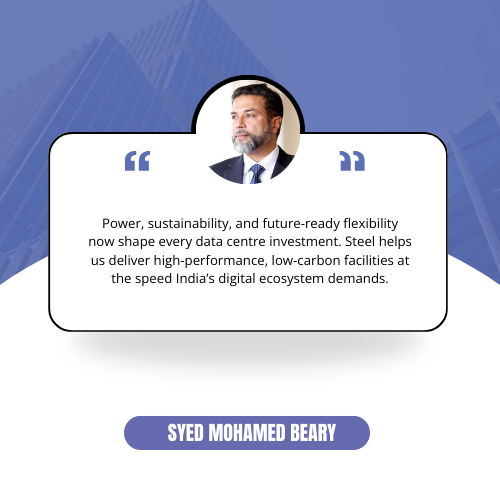
India’s transformation into a global digital hub has created an appetite for data infrastructure that is as urgent as it is immense. And no one has observed this evolution more closely than Syed Mohamed Beary, Founder & Chairman of Bearys Group, whose portfolio includes several hyperscale facilities across India’s largest digital corridors. Beary recalls the early years when data centre projects were straightforward real-estate developments, buildings built for equipment, not architectural intention. “Today, everything has changed,” he explains. “AI-driven workloads, OTT platforms, and e-commerce logistics have rewritten the logic of how we invest. We are making long-term strategic decisions, not about land, but about power access, latency performance, sustainability, and the agility of the building to evolve with technology.”
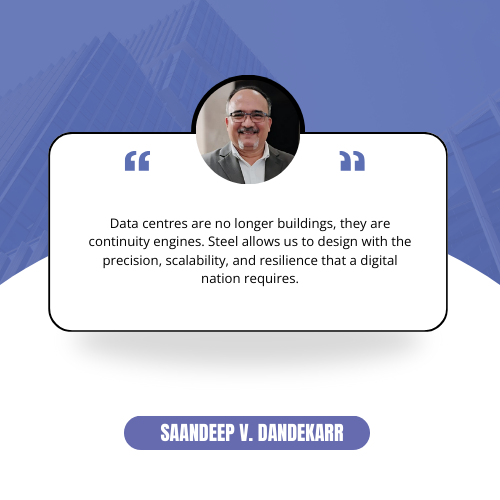
This shift is not theoretical; it is economic and structural. India is on track to add nearly 4,500 MW of new data centre capacity by 2030, backed by USD 25–28 billion in capital. These facilities are not simply accommodating more racks, they are accommodating the exponential growth of intelligence itself. As Saandeep V. Dandekarr, one of India’s most respected data-centre industry mentors, puts it, “We are no longer designing buildings; we are designing continuity. The industry is moving from the era of structural accommodation to the era of engineering optimisation.”
Continuity is the soul of these buildings. A shopping mall can afford downtime. An office tower can survive a temporary outage. A residential tower can wait for a repair. But a data centre cannot pause, not for minutes, not for seconds. It carries the responsibility of a nation’s digital heartbeat, and therefore it must behave with absolute composure under all circumstances. A data centre must remain calm in chaos, balanced in overload, predictable in uncertainty.
This expectation has fundamentally altered the way India builds. No typology in the country demands such a complex intersection of architecture, engineering, power availability, renewable integration, urban planning, and construction technology. And all of it must arrive with precision and speed, two qualities that increasingly rely on steel.
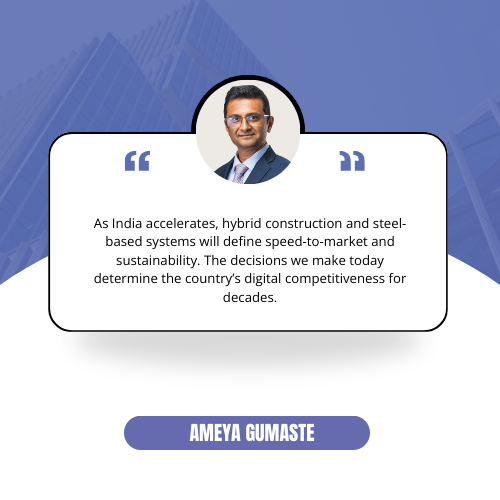
“Speed-to-market is everything,” says Ameya Gumaste, Executive Director and India Country Head at Linesight. “Every month saved is a month gained in revenue, competitiveness, and AI-readiness. Steel, especially when paired with hybrid construction, offers the speed and flexibility this industry simply cannot do without.”
Thus begins a new chapter in India’s infrastructure story, one where steel is not just a construction material, but an enabler of digital ambition. The rise of India’s steel-built data centres marks the beginning of an era in which engineering excellence and national progress are indistinguishable.
“The building cannot wait for technology to settle—because technology never does.”
DESIGNING FOR A WORLD THAT CAN’T PAUSE
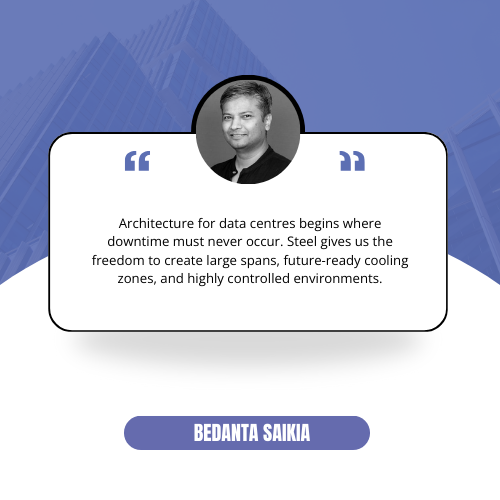
To an architect, few building types present as many constraints, contradictions, and demands as a data centre. And yet, few are as deceptively simple from the exterior, blank surfaces, windowless planes, and a silence that almost defies the fury of computation inside. But architect Bedanta Saikia, Vertical Head, Corporate Architecture, Science & Technology, Edifice Consultants knows that beneath that simplicity lies one of the most sophisticated building types in modern construction.
“What differentiates a data centre from every other typology,” Saikia explains, “is that its architecture begins with an understanding of what cannot be allowed to fail.” These buildings house machines that never sleep, operations that cannot pause, and information that must remain invulnerable. And so, instead of beginning with façade studies or spatial form, the design begins with redundancy, climate control, zoning, and the complex choreography required to maintain uptime.
Security becomes the first architectural layer, and not in the superficial sense of gates and guards. A data centre contains rings of access control, each deeper and stricter than the last. From the perimeter to the lobby, from the lobby to the meet-me rooms, and then into the heart of the data hall, every threshold is governed by client-specific protocols. “Hyper-scalers all have their own definitions of acceptable risk,” Saikia notes, “and these definitions shape the architecture more than any aesthetic decision. The building’s form follows its security logic.”
From there, the building expands vertically, not because density demands it, but because equipment does. Floor-to-floor heights of 6 to 8.5 m have become common, driven by the enormous volume of infrastructure like cable trays, ducts, liquid cooling manifolds, fire lines, and structural braces that must coexist above the white space. According to Saikia, this vertical generosity is non-negotiable: “The airflow requirements, the heat rejection systems, the raised floors, all of it demands a volume of space no conventional building can provide.”
The loads these structures must bear are equally unusual. Traditional commercial floors might support 400–500 kg/m². Data centre floors may shoulder over 2200 kg/m², and future AI racks are pushing that threshold further. Hariharan Iyer, Head‑Structures/Director, B+C, South Asia, Surbana Jurong India Private Limited explains that this is not simply a matter of scaling up the foundation. “Rack densities are rising rapidly. The equipment is heavier. Cooling hardware is heavier. Batteries and UPS systems are heavier. The structure must deliver larger spans, tighter deflections, and vibration isolation that works in harmony with IT hardware.”
But the architectural complexity does not end with weight. It extends into time. Data centres grow in phases with shell first, halls later, cooling upgrades in between, power enhancements whenever required, equipment replacements constantly. The building is expected to adapt, without protest, to the shifting needs of its tenants. This means oversized portals for future equipment movement, demountable façade sections, accessible shafts, and circulation logic that anticipates tomorrow’s machines.
Iyer emphasises one truth that every data-centre engineer must accept: “Technology inside these buildings changes every three to five years. If the structure cannot adapt to this evolution, the building becomes obsolete long before its lifespan ends.”
Thus, the architecture of a data centre is not a static creation. It is a dynamic system; an organism whose endurance depends on its ability to predict its own future.
“Cooling is no longer an engineering system; it is the architectural centre of the data centre.”
WHY MATERIAL IS NOW STRATEGY
As the demands on data centres intensify, the material that holds them up must do more than resist gravity. It must enable speed, precision, adaptation, and sustainability. Increasingly, that material is steel.
In the past, material selection was simply a structural question. Today, it is a strategic one. When hyperscale facilities require rapid deployment across multiple regions, steel becomes a catalyst. “Steel cuts construction time dramatically,” says Syed Mohamed Beary, whose developments reflect some of the fastest delivery timelines in India’s data-centre landscape. “It is lighter, stronger, more adaptable, and far more sustainable in terms of embodied carbon and recyclability.”
Speed is only the beginning. The spatial demands of data centres consisting of long spans, column-free halls, vibration control, and flexible MEP integration are all better served by steel. Saandeep Dandekarr describes steel as the “ultimate material for data-centre innovation”, reflecting its ability to support extraordinary loads without compromising space. “Everything inside a data centre depends on the geometry of space and the behaviour of structure,” he explains. “Steel enables large spans, complex secondary framing, and the integration of cooling and electrical systems that simply cannot be coordinated as efficiently with other materials.”
But as Ameya Gumaste points out, the rise of steel is also tied to economic and sustainability drivers. EAF-produced steel can reduce carbon output by up to 75 per cent, aligning with India’s new Green Steel Taxonomy and the ESG commitments of global hyperscalers. “For a sector this capital-intensive,” Gumaste says, “material decisions affect not just construction cost, but operational footprint, investor perception, and long-term compliance. Steel is not just about building fast, it is about building responsibly.”
Steel also prepares buildings for a future that is arriving faster than expected. AI-ready data centres require denser racks, heavier cooling systems, and multi-storey integration. Some hyperscale facilities today require 20,000 tonnes of steel, and AI campuses may need twice as much. The structure must not only carry these loads but anticipate even heavier ones.
Hybrid construction, concrete cores paired with steel superstructures is becoming the dominant paradigm. It brings the seismic stability of concrete together with the speed and spatial freedom of steel. Ameya Gumaste describes it as “the balanced path forward, the model that blends resilience, efficiency, and speed in a way nothing else can.”
HOW HEAT IS REWRITING THE RULES OF DESIGN
If data is the fuel of the digital economy, then heat is its most persistent adversary. The modern data centre is, at its core, a battleground between rising temperatures and the systems built to defeat them. As AI workloads intensify, pushing rack densities to unprecedented thresholds, the cooling challenge has entered an entirely new era. What once was a predictable equation involving raised floors and CRAC units has now evolved into a dynamic interplay of airflow science, thermal analytics, liquid pathways, and architectural adaptability.
“Rack densities today are breaching the limits that conventional cooling was designed for,” says Hariharan Iyer. “With AI and high-performance computing, heat loads are no longer linear. They behave in bursts, in clusters, and in cycles that demand deeper structural intelligence.” He explains how rising heat loads force architects and engineers to rethink not only MEP systems, but also the underlying geometry of floors, spans, mezzanines, and vibration control. Larger clear spans become essential, not for aesthetics, but to ensure unobstructed airflow paths and seamless integration of cooling systems that must evolve every few years.
Architect Bedanta Saikia sees this shift from close quarters. “Cooling today is a moving target. A client may begin with conventional cold-aisle setups and midway through construction decide to introduce liquid cooling elements. We cannot afford rigid architecture. The building must welcome these shifts rather than resist them.” The implications extend to ceiling heights, platform loads, shaft dimensions, and even the spatial choreography inside the data hall. In essence, the building must prepare for heat it has not yet experienced, and for cooling strategies that have not yet been invented.
The industry’s pivot toward liquid cooling is a subject of particular interest. Early adopters are experimenting with direct-to-chip and immersion cooling systems that deliver extraordinary efficiency but demand structural and architectural forethought. These systems influence equipment massing, manifold routing, service clearances, and heat-exhaust management in ways that conventional air-cooled layouts never did.
This transition is not merely technological, it is behavioural. As Saandeep Dandekarr observes, “We are entering a global era where cooling defines competitiveness. Energy ratings under 1.4 PUE are no longer a badge, they are a baseline. A building that cannot adapt its cooling cannot serve AI, and a data centre that cannot serve AI will struggle to remain relevant.”
Steel plays a subtle yet decisive role in this cooling evolution. Its predictability, strength, and adaptability make it easier to integrate heavy liquid cooling modules, chilled water loops, and secondary framing for manifold supports. The structure itself becomes an enabler of thermal strategy. It supports platforms where chillers, cooling towers, and dry coolers sit; it stabilises vibration-intensive machinery; it allows for prefabricated cooling galleries that can be installed with precision.
“Hybrid construction is not compromise—it is evolution.”
Syed Mohamed Beary highlights another dimension to the cooling challenge: sustainability. His data centres employ an array of passive and active cooling optimisation from solar ingress control to HRW-based pre-cooling and night purging. “Passive cooling alone can contribute nearly 20 per cent energy savings,” Beary explains. “When we combine design intelligence with steel’s low embodied carbon and its ability to shorten construction timelines, we achieve a holistic, future-ready cooling ecosystem.”
In the age of AI, cooling is no longer an engineering service.
It is the fulcrum of the entire building.
It is where architecture, structure, and sustainability collide.
And in India’s hyperscale future, it will determine which data centres lead and which ones simply endure.
WHEN CONCRETE AND STEEL LEARN TO THINK TOGETHER
For years, the industry debated whether steel or concrete made more sense for data centres. But the debate has quietly evolved. Today, the most forward-looking facilities rarely choose one or the other. Instead, they combine both, bringing together the thermal stability of concrete and the speed, flexibility, and precision of steel. This merging is not a compromise. It is evolution.
Ameya Gumaste has been a vocal advocate of this convergence. “Hybrid construction is the preferred model,” he states with clarity. “Concrete provides stability and cost value, while steel delivers speed and scalability. When we integrate the two, we get buildings that are faster to erect, kinder to the environment, and more responsive to technological change.”
This shift toward hybrid systems is driven by real-world constraints. Concrete offers thermal mass and cost efficiency, especially in foundations and core walls where lateral stability is crucial. Steel excels in the long spans required for data halls, in the precision demanded for MEP-heavy zones, and in the rapid timelines that hyperscalers insist upon. When combined, they form a system that is resilient, predictable, and future-ready.
Yet, hybrid construction is not merely a material strategy, it is also a response to supply-chain realities. India’s Grade-A steel fabrication capacity, though expanding, is still stretched by the demands of hyperscale construction. Ameya emphasises this point: “The industry must acknowledge capacity limitations. Large multi-storey data centres can require 20,000 tonnes of steel; AI-ready centres may need twice that. The hybrid model balances these demands without overwhelming supply chains.”
Architecturally, hybrid systems allow design teams to allocate materials based on functional logic. Concrete cores stabilise the building and anchor vertical MEP shafts. Steel frames articulate the data halls with the flexibility they require. Steel mezzanines carry secondary systems that may change frequently. Concrete switch rooms offer fire isolation. Steel platforms support rooftop mechanical equipment whose loads evolve over time.
For Bedanta Saikia, this hybrid philosophy mirrors the very nature of data centres. “These buildings must resist rigidity. A hybrid approach accepts that different components require different behaviours including thermal, structural, acoustic, and operational. It gives us freedom to design with precision rather than constraint.”
Hybrid models also align neatly with the sustainability ambitions of developers like Syed Mohamed Beary, whose IGBC Platinum certified projects demonstrate how local material sourcing, passive design, and steel’s recyclability can align to lower carbon footprints. A hybrid structure allows teams to select low-carbon concrete mixes and pair them with EAF-produced steel, creating a construction ecosystem calibrated for ESG compliance.
From an engineering standpoint, Hariharan Iyer highlights the importance of multidisciplinary coordination in making hybrid systems feasible. “A hybrid building is only successful when structural, MEP, fire, and architectural teams model the project in BIM at the highest level of detail. Without seamless integration, the very flexibility we seek becomes a liability.”
Thus, hybrid construction represents a philosophical shift.
It accepts complexity.
It leverages complementarity.
It acknowledges operational realities.
And it offers a pragmatic pathway for India to build faster, cleaner, and smarter.
The question is no longer “steel or concrete?”
It is “how can the two learn to think together?”
“Every millimetre of precision in steel fabrication saves hours in commissioning.”
THE NEW MANUFACTURING AESTHETIC OF DATA CENTRES
If steel is the strategy, fabrication is the performance. Modern data centres demand not just strength and speed, but impeccable precision. The precision that begins far from the site, in the automated shops where beams, columns, plates, braces, and platforms are cut, drilled, welded, and assembled with almost surgical discipline.
In this world of industrial choreography, companies like Apex Buildsys and Ashtech Prefab have become essential partners in India’s hyperscale expansion. Their work represents a crucial shift: data centres are elevating fabrication from a construction activity to a manufacturing philosophy.
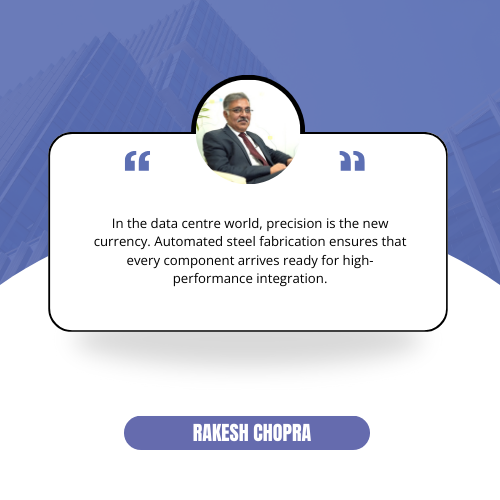
“We have redesigned our entire fabrication cycle around data-centre standards,” says Rakesh Chopra, National Sales Head at Apex Buildsys. “Automation, CNC-driven accuracy, controlled workflows, everything is engineered to ensure that what leaves our plant installs perfectly on site. There is no room for deviation when the building must work at millimetre-level tolerances.”
Chopra describes the deep sequencing that allows Apex to erect steel frames rapidly and accurately even on live hyperscale campuses. Erection fronts operate in parallel, each driven by precise survey controls and digital alignment checks. In this process, the steel frame does not merely go up; it is assembled with the precision of an engineered product.
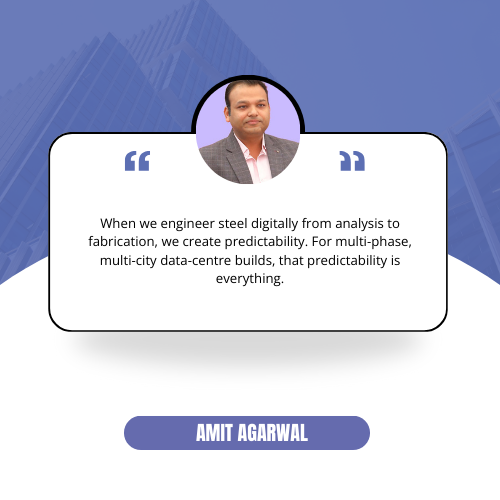
Ashtech Prefab, under the direction of Amit Agarwal, brings an equally advanced approach. Agarwal speaks passionately about the digital-first workflow that guides every project. “Our structural design is modelled in ETABS, detailed in Tekla, validated in IDEA StatiCa, and produced through CNC-based fabrication lines. Every beam, bolt, and bracket is traceable.” What emerges from this ecosystem is not raw steel, but calibrated components that are factory-finished, QA-certified, and ready to integrate with structural and MEP systems on site.
This industrialisation of fabrication is reshaping the construction culture around data centres. Precision is no longer aspirational, it is a requirement. The building must be predictable, because the equipment it houses tolerates no uncertainty. The frame must be accurate, because cable trays, ducts, busducts, and liquid-cooling manifolds depend on exact alignments. Every hole, every penetration, every embed plate must be placed with intent, not approximation.
And underlying all this is the recognition that data centres operate in a world where timelines are unforgiving. “Prefabrication cuts weeks off the schedule,” Chopra explains. “The more we finish in the factory, the less risk there is on the site and the faster the client goes live.”
Agarwal echoes this, noting that factory-controlled environments reduce waste, improve safety, and standardise quality across multi-phase deployments. “The industry is moving toward repeatable excellence,” he says. “A hyperscale rollout across cities cannot depend on variable site conditions. It depends on consistent manufacturing intelligence.”
Together, these shifts signal the rise of a new aesthetic in construction, an aesthetic not of appearance, but of performance.
“Resilience is not a feature. It is the foundation of digital infrastructure.”
THE INDIAN REALITY CHECK
The intensity with which India is building its data centres is matched only by the diversity of the environments in which they are being constructed. Few countries attempting hyperscale expansion face such a wide spectrum of natural forces, seismic activity in the North and Northeast, cyclones along the East and West coasts, flooding in cities built on historic lakes and river basins, extreme heat waves in inland regions, and monsoon-driven unpredictability everywhere. If the digital cloud is borderless, the buildings that hold it up are not; they must confront India as it exists, not as a neutral geography.
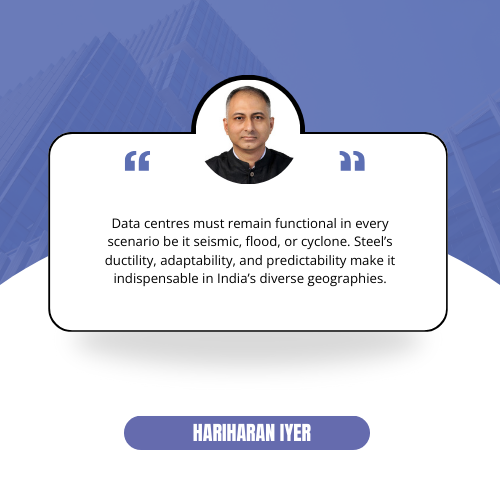
For Hariharan Iyer, this contextual complexity shapes every design decision long before the first beam is fabricated. “A data centre in Delhi cannot behave like one in Chennai, and one in Guwahati cannot be engineered like one in Hyderabad,” he explains. “The building must not only withstand the environment, but it must also remain functional and safe while housing some of the most sensitive equipment in modern infrastructure.”
India’s seismic zoning, for example, is particularly unforgiving for mission-critical structures. Delhi lies in Zone IV, Guwahati in Zone V, and several Tier-2 cities earmarked for edge data centres lie on active fault lines. In these regions, steel’s ductility becomes more than an engineering advantage, it becomes an insurance policy. Its ability to absorb energy, deform without failure, and return to service more quickly after seismic events makes it indispensable for maintaining uptime.
Along the coastlines, where cyclones have grown more intense in the last decade, wind engineering becomes a structural art. Chennai, Visakhapatnam, and Navi Mumbai have all experienced storm events that exposed the fragility of traditional industrial buildings. Modern data centres, however, are engineered to ride out these forces. Cross-braced steel frames, diaphragm action, anchorage systems, cladding behaviour, pressure equalisation strategies, every component is fine-tuned. Hariharan Iyer recalls cyclone-resilient projects in Chennai where steel framing played a decisive role in preventing damage that would have paralysed operations.
Flooding presents a different challenge, one that is both seasonal and systemic. Hyderabad’s 2023 monsoon floods exposed the vulnerability of low-lying tech corridors. In these situations, elevated steel platforms, fast-drainage understructures, and raised switchyard configurations ensure that essential systems remain above the danger line. “We have saved millions in potential downtime simply by elevating the first operational level,” Iyer says.
The varied conditions across the country have led to a new design philosophy, one where resilience is built into the building as deeply as redundancy is built into the power system. Developers like Syed Mohamed Beary, who prioritise sustainability from site selection onward, see context not as a complication but as an opportunity. “Every location has a story,” Beary notes. “Our task is to interpret it intelligently, minimise heat ingress where the sun is harsh, manage water where monsoons are unpredictable, and use materials responsibly where logistics are constrained.”
For India, designing data centres is not an exercise in universal templates. It is an act of listening. Listening to the land, listening to the wind, listening to the water, and responding with architecture that is not only efficient but empathetic.
THE ECONOMICS OF UPTIME
Data centres are expensive buildings, but only until they fail. After that, they become infinitely more expensive.
It is this brutal economic truth that shapes nearly every design call, material decision, redundancy protocol, and construction sequence across India’s hyperscale ecosystem. The building’s cost is never just the capex that appears on a balance sheet, it is the revenue it safeguards, the transactions it protects, the microseconds of latency it eliminates, and the trust it earns from users who will never see it.
To developers like Syed Mohamed Beary, uptime is not only a technical metric but a financial discipline. “Downtime is non-negotiable,” he says firmly. “We adopt a ‘Do it right the first time’ approach because even a single lapse can unravel the economic logic of an entire facility.” This philosophy drives Beary’s preference for steel-framed modular systems and off-site fabrication, methods that reduce construction risks, condense timelines, and create predictable outcomes.
In the world of hyperscale, predictability is money. This is where industry veterans like Ameya Gumaste bring a grounding realism. His work with Linesight gives him visibility into cost curves, procurement shocks, commodity fluctuations, labour volatility, and supply-chain risks across Asia. “Steel brings tremendous speed and flexibility,” Ameya says, “but it must be supported by strong procurement intelligence. We track steel and concrete pricing constantly. We study availability patterns, energy cost cycles, and delivery capacity of fabricators. A project is only as strong as the data behind its decisions.”
This perspective reveals a truth often overlooked in architectural discourse: data centres are investment assets. Their financial performance depends as much on energy efficiency, scalability, and operational durability as on their structural integrity. Decisions around grid layouts, structural spans, liquid cooling integration, and fireproofing specifications are not merely technical, they are capital strategies.
On the fabrication front, companies like Apex Buildsys and Ashtech Prefab influence uptime economics in ways that extend far beyond the factory floor.
Apex’s automated beam lines, CNC drilling stations, and digital QC systems allow them to deliver components with extraordinary accuracy. For data centres, this accuracy translates directly into MEP efficiency. Misalignment of even a few millimetre in a long-span data hall can disrupt cable routing, complicate airflow management, and delay system commissioning, all of which have financial consequences.
Similarly, Ashtech’s ETABS–Tekla–IDEA StatiCa workflow creates a digital thread that follows each component from analysis to fabrication. “Reliability,” says Amit Agarwal, “is not a slogan, it is a manufacturing outcome. When you produce at this scale, a building is only as predictable as the plant that produced its skeleton.” For multi-phase deployments, this predictability is invaluable. Developers can replicate hall modules across cities with confidence that the frame behaviour, service layouts, and erection patterns will align perfectly.
This is the quiet relationship between engineering and economics: Every degree of thermal drift, every millimetre of structural deflection, every point of vibration, every minute of outage has a cost. And in a digital nation, that cost is amplified at scale.
Thus, the economics of data centres are inseparable from the intelligence of their construction. A building that performs well financially is simply a building that performs well, every second, every day.
“Steel gives the data centre the one thing concrete never could—time.”
INDIA’S NEXT GENERATION OF STEEL-BUILT DATA CENTRES
India’s data centre boom is not a moment, it is a movement, and it is only gathering pace. The next decade will see hyperscale giants double their footprints, AI clusters multiply across tech cities, and edge data centres rise in Tier-2 and Tier-3 markets. This evolution is forcing the industry to confront a fundamental question: How do we design not just for today’s technologies, but for tomorrow’s inevitabilities?
For Saandeep Dandekarr, the answer lies in embracing adaptability as a core design intent. “Every expectation placed on a data centre today including higher rack densities, liquid cooling integration, energy accountability, redundant pathways will become more demanding tomorrow. The building must not resist these shifts; it must anticipate them.”
This anticipation is already visible in the shift toward steel-intensive frameworks. Steel allows buildings to expand vertically, reconfigure internal spans, host heavier MEP clusters, and support multi-stage cooling logic. In facilities preparing for AI workloads, this adaptability is no longer luxury but necessity.
Ameya Gumaste adds another dimension to this foresight: the rise of alternative energy ecosystems. “Green hydrogen, microgrids, and new-generation storage technologies will redefine the energy strategies of hyperscale campuses,” he observes. “Structural systems must prepare for the weight of new equipment, the geometry of new distribution pathways, and the thermal behaviour of new systems.”
Meanwhile, on the urban front, architects like Bedanta Saikia foresee a future in which data centres no longer hide at the edges of cities but merge into their industrial and mixed-use landscapes. Redevelopment of old industrial sites, integration of architectural skins, kinetic facades, sustainability-driven exteriors, buffer greens, and urban heat-mitigation strategies are making data centres participants in the urban environment rather than outliers.
Fabricators and PEB specialists such as Apex Buildsys and Ashtech Prefab will play increasingly influential roles in this evolution. As India moves toward giga-scale data parks, multi-building hyperscale campuses, and pan-India rollouts, manufacturing intelligence will become central to success. Standardised modules, digital twins, repeatable hall geometries, and harmonised fabrication workflows will allow the industry to scale without compromising quality.
And developers like Syed Mohamed Beary, whose projects already integrate renewable energy, low-carbon materials, passive-cooling logic, and IGBC Platinum standards, will push sustainability into the realm of operational identity rather than compliance.
“To build data centres is to build the future’s memory.”
STEEL MEETS THE CLOUD
In the closing arc of India’s data-centre revolution, one truth stands out: we are no longer just building infrastructure. We are building a digital civilization, one whose foundations exist not in code or cloud alone, but in steel beams, engineered spans, airtight envelopes, and the invisible choreography of cooling, power, airflow, and resilience.
As the country prepares for a decade defined by AI, quantum computing, digital governance, immersive media, and near-real-time commerce, the expectations placed on data centres will deepen. They will need to host denser racks, support hotter chips, adapt to liquid cooling, integrate microgrids, incorporate hydrogen-ready platforms, and operate within ESG boundaries that tighten each year.
Steel’s rise in this landscape is not the result of a single advantage, it is the sum of many small truths: speed, predictability, adaptability, low embodied carbon, availability, modularity, manufacturability, and its uncanny alignment with the demands of digital infrastructure.
Yet the future will not be built by material alone. It will be shaped by the people who understand how architecture, engineering, fabrication, sustainability, investment, and operations must work in unison.
People like Syed Mohamed Beary, whose philosophies on low-carbon design and future-ready geographies have reshaped development strategies across multiple tech regions.
People like Saandeep V. Dandekarr, whose industry-wide perspective links structural intelligence with operational longevity.
People like Ameya Gumaste, whose cost and procurement insights reveal the economic forces behind infrastructure decisions.
People like Hariharan Iyer, whose structural mastery ensures that India’s data centres remain calm in seismic zones, resilient in cyclone corridors, and adaptable in flood-prone districts.
People like Bedanta Saikia, who ensures that architecture responds to airflow, security, redundancy, and the perpetual evolution of technology.
And people like Rakesh Chopra and Amit Agarwal, who translate engineering intent into manufacturable precision, transforming design files into the steel spines of India’s digital ambition.
Together, they represent a generation of thinkers and builders shaping a future that is not only digital but deeply architectural.
SSMB POV
What makes this moment extraordinary is not the technology these centres house, but the transformation they represent. They signal a turning point where construction becomes manufacturing, materials become strategy, and architecture becomes the guardian of digital continuity. Steel stands at the heart of this transformation that’s fast, strong, adaptable, and aligned with the sustainability imperatives of our time.
Across every stakeholder we engaged, from developers and architects to structural experts and fabricators, the message was consistent: the future of India’s digital infrastructure will be built on intelligence, not inertia. It will rely on multidisciplinary alignment, hybrid engineering, precision fabrication, and a relentless focus on uptime.
These are the structures that will carry India’s ambition into the world. These are the sanctuaries where the cloud finds its form. These are the steel frameworks that hold the future in place. And in telling the story of how we build them, we are inevitably telling the story of India’s next chapter. — Mahesh Mudaliar, Senior Editor, SSMB