


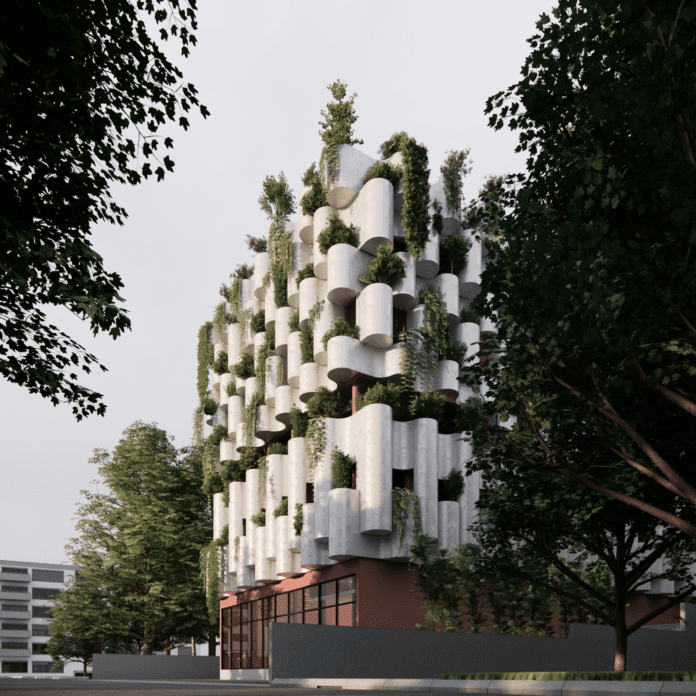
What happens when sustainability is not layered onto architecture, but becomes its very logic? The Biophilic Hotel is an answer shaped by climate, ecology, and restraint. Conceived as a restorative retreat rather than a conventional luxury destination, this hospitality project dissolves the boundary between built form and landscape, allowing nature to become the building’s most visible system, and sustainability its most powerful narrative.

“Here, architecture does not compete with nature, it learns from it. Steel becomes invisible, and greenery becomes the building.” – Nishanth Vijayputra
LISTENING TO THE LAND
The site itself set the tone. Its natural context and climatic cues urged the design team to rethink how hospitality spaces could dissolve the traditional divide between indoors and outdoors. The client’s brief was clear: create a place that feels restorative, not merely indulgent, but a retreat where guests slow down, breathe, and reconnect with nature.
“Rather than imposing a structure on the site, we allowed the landscape, light, and ventilation to dictate form.”
WHEN A FAÇADE BEGINS TO BREATHE
From the very first strokes, biophilia reshaped the building’s DNA. The façade itself became a living canvas. Sculpted concrete forms were designed not just for rhythm and shade, but as vessels for greenery. Vegetation is embedded into the building’s skin, not applied as ornament. Curved metallic sheets encase planting pockets, their ductility narrating the flows and contours of the façade. What emerges is a structure that appears to grow rather than stand.
“The façade is not a wall, but it is a living, breathing ecosystem.”
PLANNING A CAMPUS BEFORE DESIGNING BUILDINGS
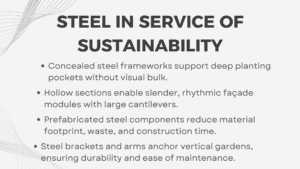
This living envelope is more than visual theatre, it is a climate tool. The green skin filters sunlight, tempers heat, and introduces evapotranspiration into the building’s microclimate. Steel plays a quiet but decisive role in making this ecological performance possible. The façade’s flowing, steel-clad modules, doubling as planters and shading devices, demanded a concealed yet robust framework. Steel offered the flexibility to cantilever elements, create deep overhangs, and integrate substantial planting pockets without compromising stability.
Hollow steel sections become both structure and expression. Their slenderness enables façade modules to project outward with rhythm and grace, supporting deep planting pockets without visual heaviness. By keeping the framework minimal and adaptable, the building retains a sense of openness where greenery, daylight, and ventilation move freely, reducing dependence on mechanical systems.
ARCHITECTURE THAT COOLS, SHADES, AND HEALS
Passive design is not an afterthought here; it is the architecture. The façade modules act as environmental devices shading interiors, reducing heat gain, and creating a cooler microclimate. Planting pockets filter sunlight and cool the air naturally, turning the building skin into a living thermal buffer.
Sustainability is tightly interwoven with the project’s construction logic. Structural steel and hollow sections, chosen for their high strength-to-weight ratio, reduce the material footprint compared to conventional RCC systems. Prefabricated steel components minimise on-site waste, shorten construction time, and significantly lower the environmental burden of formwork, water usage, and site disturbance.
Green roofs and vertical gardens are not embellishments, they define the hotel’s identity. The façade itself becomes a vertical landscape, with cascading planters forming an ever-changing green skin. Guests encounter nature not in isolated pockets but as a continuous presence, one that shifts with seasons, rainfall, and light.
ENGINEERING LIGHTNESS, CARRYING WEIGHT
One of the project’s most innovative details lies in how steel anchors ecology. Cantilevered arms and brackets support vertical gardens, allowing greenery to cascade freely while ensuring durability and ease of maintenance. The structure remains invisible; nature takes centre stage.
Balancing structural performance with biophilic lightness posed real challenges. The planter modules introduce significant loads like soil, water, and vegetation, demanding a robust system without making the façade feel heavy. The solution lay in a concealed steel framework using hollow sections, offering strength with slenderness. Prefabrication and modular detailing allowed precise load distribution, controlled tolerances, and seamless integration of irrigation systems. Careful coordination between the structural grid and green modules preserved openness for views and ventilation.
“Steel works invisibly, carrying the weight of nature so that greenery becomes the hero.”
Though still at the proposal stage, the design intent is clear: enhance guest wellbeing through constant interaction with greenery, daylight, and natural ventilation, elements proven to reduce stress, improve indoor comfort, and lower energy consumption. Operationally, the integration of passive cooling, shading, and green façades is projected to reduce energy demand and long-term maintenance loads. Early conversations with stakeholders already reaffirm the approach’s experiential and sustainable value.
In India’s hospitality sector, biophilic design is rapidly shifting from trend to necessity. Guests now seek wellness and authenticity. Clients recognise the operational and branding advantages. Increasingly, hotels are integrating passive strategies, greenery, and eco-materials from the outset, blurring boundaries between building and landscape, and positioning sustainability as both responsibility and opportunity.
For the architect, the most evocative moment lies at the façade itself, where sculpted modules cradle greenery and light filters through layered planting. It captures the project’s essence: structure and steel working invisibly so that nature becomes the true façade. The building feels alive, responsive, and in constant dialogue with its environment.
GOING GREEN
This hotel’s façade does not merely host greenery, it is greenery. Every planter, every cascade of foliage is structurally carried by steel that refuses to be seen. The building does not wear nature as an accessory; it grows it. Here, steel becomes the silent enabler of a living, climate-responsive architecture proving that the most advanced structural systems can exist not to dominate, but to disappear in service of the planet.
KEY GREEN ASPECTS
What sets The Biophilic Hotel apart is that biophilia is not confined to systems or certifications; it is embedded into the building’s anatomy. At its core, the project operates as a climate-responsive envelope. The green façade functions as a living buffer, filtering harsh sunlight, reducing heat gain, and cooling the surrounding air through evapotranspiration. This passive modulation of temperature lowers dependence on mechanical cooling, directly reducing operational energy demand.
The integration of vertical gardens and planting pockets transforms the façade into an active ecological layer. Beyond visual relief, these green systems improve air quality, trap dust, and create a healthier microclimate around guest rooms and circulation spaces. The building does not merely contain nature; it collaborates with it.
MATERIAL EFFICIENCY AS ENVIRONMENTAL STRATEGY
The use of structural steel and hollow sections, with their high strength-to-weight ratio, reduces overall material consumption compared to conventional RCC construction. Prefabricated steel components minimise on-site waste, shorten construction timelines, and significantly cut the carbon and water footprint associated with formwork and wet construction.
Water-sensitive design is inherent in the green envelope. The planting system is conceived as an integrated network, where irrigation, drainage, and maintenance are planned from inception, allowing controlled water use, efficient distribution, and long-term performance without ecological compromise.
Perhaps most importantly, the project reframes sustainability as experience. Guests inhabit spaces cooled by shade and greenery, move through corridors that breathe, and wake up to living façades that change with seasons. Environmental performance is not hidden in back-end systems, but it is felt, seen, and lived.
In this hotel, green architecture is not a statement. It is a way of being.
Editor’s Note:
In an era where biophilia often arrives as surface treatment, The Biophilic Hotel offers a deeper proposition: architecture that behaves like landscape. What makes this project truly powerful is not the abundance of green, but the environmental intelligence that makes it perform. Steel does not shout here; it supports, recedes, and allows nature to lead. It is a reminder that the future of hospitality may not lie in grander lobbies or shinier finishes, but in buildings that breathe, conserve, and quietly heal.