

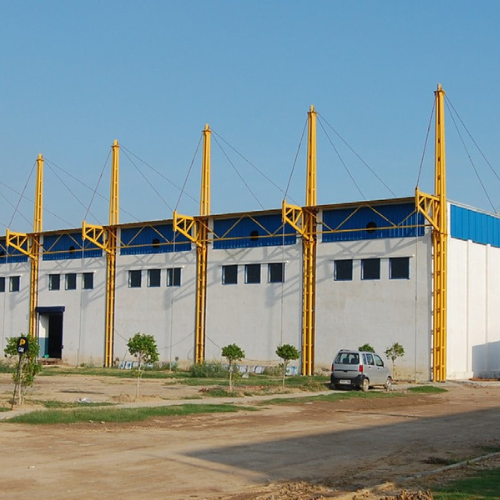
Industrial buildings rarely aim beyond function, yet the LPS Warehouse breaks away from standard PEB conventions to redefine what a warehouse can achieve. What began as a brief for a large column-free volume evolved into a cable-stayed, top-hung structure that slashed steel consumption and created an unexpected landmark on Rohtak Road. At its core, the project proves that sustainability comes not only from materials, but from structural intelligence, resource efficiency, and localised innovation based on the sustainability principle of Reduce–Reuse–Recycle.
The LPS Warehouse was born from a provocative question:
Why should industrial sheds consume so much steel when the material’s greatest strength, its ability to work in tension, is often neglected?
PEB quotations revealed excessive steel weights, reinforcing the need for a more efficient approach. The design team proposed an experimental structural system unlike anything previously attempted in India, convincing the client to embrace both innovation and uncertainty.
This decision became the turning point that set the tone for a warehouse that is lighter, greener, and conceptually far more refined than its industrial peers.
SUSPENDED INSTEAD OF SUPPORTED
The requirement for a massive uninterrupted floor plate prompted a structural rethink. Instead of relying on compression-heavy members prone to bending and buckling, the team devised a system where the entire span was supported from the top, allowing steel to perform in its most optimal state, tension.
This approach unlocked:
- A 35m-wide column-free floor
- A 196m-long uninterrupted working volume
- A roof structure that was both slimmer and lighter
- Dramatically lower material usage
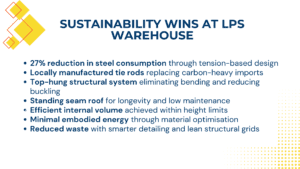
By eliminating bending forces and reducing buckling risks, the structure became inherently efficient, a proof that sustainability begins with engineering wisdom.
“A structurally informed architect can transform even a warehouse into a meaningful landmark.” – AMIT SHARMA, Principal, Axiom India
STRUCTURAL NEGOTIATION & LOCAL INNOVATION
The eventual design emerged from an intense three-month collaboration between the architect and structural consultants. The initial skepticism from engineers gradually shifted toward shared conviction as calculations aligned with the architectural intent.
A key breakthrough came from sourcing tie rods locally. With imported rods costing nearly £230 each, the team discovered Indian infrastructure capable of producing them for around ₹3,000, a monumental reduction. This not only cut costs but also significantly reduced carbon footprint by eliminating overseas manufacturing and transport.
The design process became an exercise in research-driven engineering, where referencing, prototyping, and recalibration shaped the warehouse’s leaner structural body.
STEEL OPTIMISATION AS A GREEN IMPERATIVE
The cable-stayed approach reduced steel consumption by 27 per cent, directly aligning the project with the fundamental sustainability principle of reduce–reuse–recycle.
Key environmental gains included:
- Lower embodied energy due to reduced steel use
- A lighter structural frame producing a shallower internal profile
- More usable volume within height restrictions
- Improved resource efficiency per rupee spent
Steel’s reciprocal lifecycle, recyclability, and durability further strengthened the warehouse’s long-term environmental value.
FORM EMERGING FROM STRUCTURAL TRUTH
Rather than imposing a stylistic identity, the design allowed the structure to define its own architectural language. The resulting form, a natural evolution of the cable-stayed system, asserted a distinctive presence without ornamental effort.
This authenticity transformed the warehouse into a visual marker along Rohtak Road, instantly identifiable and increasingly associated with the identity of the village of Kharawar. Here, sustainability meets aesthetic restraint: a building shaped purely by what it needs to do.
COMPLEMENTARY SUSTAINABLE MOVES
Recognising the limitations of a flatter roof profile, the team employed a standing seam roofing system, minimising leak risks and improving long-term performance. Low-maintenance materials and detailing choices reduced lifecycle impacts, contributing to a building that is not only greener at the point of construction but also across its operational lifespan.
STEEL AS STRUCTURE, IDENTITY & CULTURE
Inside the warehouse, steel became more than a structural tool, it became an agent of culture. Workers found the building’s form intriguing at first and gradually adopted it as a symbol of pride. Even the cable trays and a conference table began echoing the geometric logic of the space frame.
The architecture did not merely house activity; it shaped behaviour, inspired ownership, and embedded itself into everyday rituals.
REWRITING THE ROLE OF DESIGN IN INDUSTRIAL SHEDS
Industrial buildings are often treated as purely functional, devoid of architectural intelligence. This project challenges that assumption. By placing an architect with structural sensitivity at the centre of decision-making, the warehouse transcended the stereotype of the ‘featureless shed’.
The resulting spatial and visual impact improved the well-being of workers, elevated the contextual identity of the area, and reaffirmed the belief that even industrial projects deserve thoughtful, responsible design.
Editor’s Note:
The best green buildings don’t rely solely on add-on technologies; they begin with questioning fundamentals. The LPS Warehouse exemplifies this shift. Instead of following the well-worn path of oversized PEB sections, the design team interrogated the structural logic itself, demonstrating how rethinking forces, spans, and material behaviour can dramatically reduce environmental impact. This project is a reminder that ‘green’ is not a stylistic choice; it is a design ethic grounded in reducing material, rethinking systems, and empowering local manufacturing ecosystems. The result is an industrial structure that is lighter, smarter, and deeply expressive of its structural truth.
Why Tension Makes Steel Greener
- No bending = smaller sections
- Reduced buckling risk = lighter members
- Lower steel tonnage = lower embodied carbon