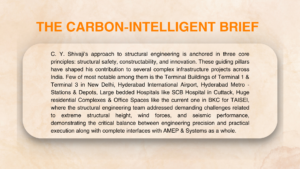



Intro: Every accomplished structural engineer carries within them a story of discovery, moments where calculations turn into structures, and theoretical concepts materialise as enduring landmarks. For C.Y. Shivaji, who currently leads Special Initiatives in EDRC, B&F IC at Larsen & Toubro Construction, Chennai, that journey spans nearly four decades of engineering evolution. With 38 years of total professional experience, Shivaji has witnessed structural engineering transform from hand calculations and simplified equations into a highly complex & digitised, technology-driven with multi-disciplinary stakeholders’ involvement & collaboration.
What inspired you to pursue structural engineering, and what motivated you to build a career in this field?
In the early days, the decision was not entirely planned. Coming from a family where my father was a mechanical engineer and my brother an electrical engineer, pursuing civil engineering felt like a natural direction.
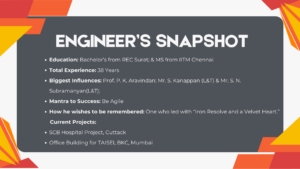
The real turning point came when I joined IIT Chennai for my master’s programme. That was where I truly began learning structural engineering in depth. The exposure there opened new horizons, not just in terms of opportunities but also challenges. During my postgraduate studies, I also worked on several projects that strengthened my confidence. They made me believe that I could eventually handle larger and more complex structures. Much of that inspiration came from my professors, particularly Prof. P. K. Aravindan, whose guidance played a major role in shaping my early thinking.
Which defining milestone shaped your journey from an engineering student to an experienced structural professional?
One of the most defining moments occurred during my master’s research at IITM Chennai. My professor assigned me a challenging structural steel project involving the design of a large portal frame for the Cochin refinery project.
At that stage I had just graduated and was still learning the nuances of structural design. I carried out the analysis using structural modelling FEM tools in SAP and completed the design. My professor later took me to the project site. Seeing the actual portal structure being erected at site was an extraordinary moment, gave me an immense satisfaction & confidence.
For a young engineer, witnessing a complete structure materialise from your own calculations feels almost surreal. That experience strengthened my conviction that structural design was the path I wanted to pursue.
What major challenges have you encountered as a structural consultant, and how do you usually navigate them?
Structural engineering has undergone remarkable transformation over the last few decades. When I started my career, design was largely dependent on manual calculations and simplified analytical approaches. Today, projects are significantly more complex, deadlines are tighter, and technology has advanced dramatically.
To stay relevant in this evolving environment, one must continuously adapt. In my view, the most important quality for an engineer is agility. Staying updated with new technologies, interacting with peers, engaging with academic institutions, Consultants, Vendors and participating in professional forums are essential.
Even today, I remain in close contact with my professors at IIT’s & other research scientists from CSIR. Conversations with experienced colleagues and exposure to industry events help keep engineers aligned with emerging developments. Ultimately, maintaining curiosity and adaptability is the key.
From your perspective, how has the role of steel evolved in structural engineering?
The evolution of steel in construction has been fascinating to observe. Earlier in my career, I was largely involved in concrete structures. Steel played a relatively smaller role in most projects.
However, the scenario has changed dramatically over the years. Today, in large infrastructure projects, particularly airports and mega structures the need & usage of steel is extensive. I have personally worked on three Mega airport projects & one mega Metro Project, and in all such structures, steel becomes integral not only to the main structural systems but also to multiple supporting secondary components.
Steel is now used extensively in façades, structural framing, MEP support systems, seismic bracing, and various support systems such as baggage handling structures. Compared to the earlier decades when its contribution was limited, steel now forms nearly 40–50 percent of the structural ecosystem in many modern projects. The scale and versatility of its use have expanded significantly.
Which emerging global trends do you believe will shape the future of steel-based structural design?
Three trends stand out clearly from a structural engineering perspective.
First is the use of Artificial Intelligence in structural design. With the availability of vast amounts of design data, AI can assist engineers in optimisation, pattern recognition, and design standardisation.
Second is the increasing role of robotics in manufacturing and fabrication. Robotics has the potential to improve accuracy, efficiency, and energy performance at production facilities.
Third, and perhaps most critical, is sustainability, particularly the growing emphasis on green steel. These three developments: AI-driven design, robotic fabrication, and sustainable materials are likely to shape the next phase of steel construction globally.
If you could introduce one transformative change in India’s construction ecosystem, what would it be?
If I had the opportunity to implement a major shift in the industry, it would be to strongly encourage modularisation and standardisation in construction.
Infrastructure projects in India often face delays due to fragmented design and execution processes. Modular design approaches, supported by AI-assisted design tools, could significantly accelerate project timelines while maintaining quality and consistency. Modularisation would be a powerful step towards improving efficiency across the construction ecosystem.
Is there an international project that inspires you for its structural innovation?
Many international projects are impressive, but I must say that we have executed several extraordinary projects ourselves at Larsen & Toubro.
The Statue of Unity stands out as a remarkable engineering achievement as an L&T’ite, for the enormous height while addressing wind and seismic challenges required exceptional coordination and structural precision.
We have also delivered notable international assignments such Qatar Football Statdium, Metro Stations in Riyadh & Biodiversity Garden project in Oman, among others. Projects like these continue to inspire me, not only for their scale but also for the engineering ingenuity involved.
Closing Reflection
For C. Y. Shivaji, structural engineering remains a discipline of constant evolution, where technology, material innovation, and human ingenuity intersect. Yet amid rapid technological change, his core philosophy remains strikingly simple: stay curious, stay connected, and remain agile.
After nearly four decades of shaping complex structures and mentoring younger engineers, Shivaji continues to embody the mindset he hopes to be remembered for Remembered as a leader whose strength was matched only by his humanity as they iron hand with velvet gloves, combining firm technical leadership with thoughtful guidance.