

India’s airports are entering a defining decade. Once viewed as transit points, they are now civic landmarks and economic catalysts that mirror the country’s rising confidence. As terminals rise across the nation at unprecedented speed, SSMB looks deeper into the forces shaping this transformation, where policy vision, design ambition, engineering depth, and industrial precision converge, and where steel plays a strategic role. The result is a new generation of airports that signals India’s take-off moment to the world.
Few building typologies capture the spirit of a rising nation as vividly as airports. They are the first and last impression of a country, the handshake between a nation and the world. In India, aviation is no longer a niche sector serving metros; it is a nationwide mobility network linking tier-2 and tier-3 cities, tourism circuits, industrial corridors, and global trade routes.
Over the past decade, India has moved from incremental airport upgrades to systemic aviation expansion. New greenfield airports, terminal modernisations, and capacity-doubling projects are unfolding simultaneously across the country. Passenger growth forecasts are not linear; they are exponential. The pressure is not only to build bigger, but to build faster, smarter, and more future-ready.
This cover story explores how India is not merely building airports, but engineering gateways for a flying civilisation.
A passenger steps into a newly built terminal in a rising Indian city. The ceiling lifts into a vast steel span that appears to float. Daylight filters through patterned skylights. Movement unfolds in a calm, legible sequence from check-in to security to boarding. Retail carries the imprint of local craft. Art narrates regional stories. Digital systems guide without intruding.
For the traveller, it feels global yet grounded.
For the nation, it signals arrival.
“India is not just building airports; it is building an aviation ecosystem.”
A NATION IN TAKE-OFF MODE
Architects like Ar. S.R. Sikka, Principal, Sikka Associates, see this moment as a fundamental shift in how terminals are conceived. Airports, he notes, are no longer treated as mere transit sheds but as civic interiors, “spaces where identity, culture, and movement coexist at scale.” In his view, “the terminal has evolved from a processing machine into a public environment,” reflecting how air travel has moved into the realm of everyday civic life.
Such scenes are no longer the privilege of Delhi, Mumbai, or Bengaluru. They are unfolding in cities that until recently existed on the periphery of India’s aviation story. Across the country, airports are being built, expanded, and reimagined at a tempo rarely witnessed in infrastructure history. What was once episodic development has become a coordinated national surge.
FROM TRANSIT POINTS TO ECONOMIC ENGINES
This transformation is not accidental. It is structural. As Nandita Bhatt, Executive Director, Airports Authority of India (AAI), explains, Indian airports have moved from passive transit points to “active instruments of national development.” Their success, she stresses, is “no longer measured purely by aircraft movements or passenger throughput.”
“Airports today stimulate tourism, unlock regional economies, influence urban growth patterns, and strengthen trade networks,” she asserts, underlining how aviation infrastructure now sits at the intersection of mobility and economic policy.
She identifies initiatives such as UDAN as a turning point in aviation’s social role. Airports, she notes, are connecting “tier-2 and tier-3 cities, coastal regions, island territories, and remote geographies to the national mainstream.” Connectivity, in this context, is increasingly viewed as economic infrastructure, “a catalyst that shortens distances not just physically but economically.”
AIRPORTS AS URBAN ANCHORS
At the metropolitan scale, the airport’s influence deepens further. Large hubs are evolving into multimodal anchors integrated with metro rail, highways, and cargo corridors. They shape logistics ecosystems, trigger real-estate development, and generate employment clusters around them.
Increasingly, as Nandita Bhatt emphasises, they are being planned as “long-life national assets” capable of supporting economic growth, disaster response, defence readiness, and global competitiveness over decades. The airport is no longer a city’s edge condition; it is becoming one of its defining centres of gravity.
“The airport terminal is no longer a building, it is a framework for growth.”
LEAPFROGGING THE AVIATION CURVE
India is compressing what took other nations half a century into a far shorter arc. This is not catch-up growth; it is leapfrog development. The outcome is a new generation of airports that are larger in scale, sharper in performance, and more adaptable in intent, yet built with the confidence of a nation that treats growth as a baseline, not a possibility.
THE INVISIBLE ENABLER
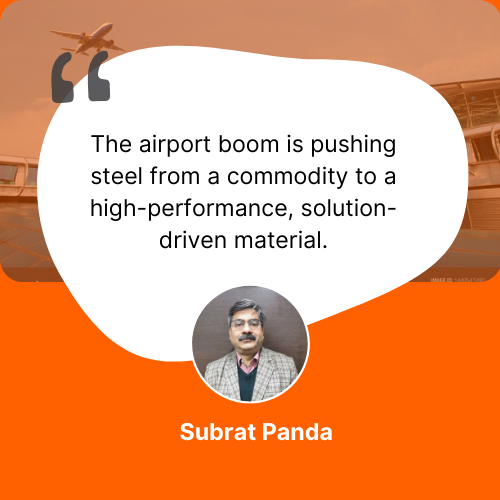
Behind this visible transformation lies an enabling layer that rarely seeks attention. As Subrat Panda, EVP & Head – Structural Steel & Construction Solutions Business, Jindal Steel, observes, the pace and scale of airport development are pushing the steel industry toward “higher precision, advanced structural systems, and stronger performance standards.”
He notes that the shift is moving steel from commodity supply toward solution-driven application, where expectations now include fire resistance, seismic resilience, and lifecycle reliability. In that sense, steel becomes more than a construction input, it becomes a facilitator of ambition. It allows spans to widen, timelines to compress, and expansions to occur without disrupting operations.
GATEWAYS AS STATEMENTS OF INTENT
What emerges, therefore, is not merely a collection of new terminals but a redefinition of how a nation builds its gateways. Airports are no longer peripheral infrastructure; they are expressions of intent. They signal how a country sees itself, and how it wishes to be seen.
India’s aviation story is not just about flying more people. It is about constructing the physical framework for a more connected, confident, and mobile civilisation. And in terminal after terminal rising across the landscape, one can read the same message: this is a nation in motion, and it is designing its gateways accordingly.
VISION AT THE SCALE OF A NATION
If the new Indian airport feels larger in scale, it is because the vision behind it has grown larger too. India’s aviation story is no longer being written project by project; it is being shaped as a national network. The goal has shifted from creating isolated showpiece terminals to weaving a cohesive aviation grid, one capable of absorbing future demand, redistributing traffic intelligently, and energising regional economies.
The airport, in this new paradigm, is not a standalone asset. It is a node in a national mobility system.
PLANNING BEYOND THE PRESENT
Airport planning in India has therefore entered a multi-horizon era. Authorities and operators are no longer designing for a static snapshot in time. They are planning simultaneously for current demand, mid-term surges, and long-term scalability. Passenger growth is not episodic; it is structural, fuelled by rising incomes, wider regional connectivity, and the steady democratisation of air travel.
As Nandita Bhatt explains, terminals today must be “right-sized for today and expandable for tomorrow,” because traffic forecasts often shift even while construction is underway. The airport, in her words, is increasingly conceived “not as a finished object but as a platform for calibrated growth.”
“Speed in airport construction is not about haste; it is about orchestration.”
FROM THROUGHPUT TO INFLUENCE
Over the past decade, Indian airports have undergone a decisive repositioning. Their value is no longer measured only by passenger numbers or aircraft movements. They are shaping how cities grow, where investments flow, and how regions connect to national and global supply chains.
Airports, in effect, have become economic magnets, quietly redrawing regional geographies. Schemes such as UDAN have widened aviation’s social footprint. By connecting tier-2 and tier-3 cities, coastal belts, island territories, and remote geographies to the national mainstream, airports are enabling access to opportunity. Connectivity is no longer a premium; it is infrastructure.
THE MULTIPLIER EFFECT
In many emerging cities, the arrival of an airport triggers a ripple effect. Hospitality sectors expand to serve new flows. Warehousing and logistics clusters follow. Real estate responds. Service industries grow. The airport becomes less a destination and more a catalyst, an initiator of economic motion.
At the metropolitan scale, this influence deepens further. Major airports are evolving into multimodal anchors linked with metro rail, highways, and cargo corridors. They organise logistics ecosystems and generate employment zones around them. Entire airport districts are taking shape as economic microcosms, often acting as gateways for foreign investment and international business.
FROM INFRASTRUCTURE TO STRATEGY
This expanded role has fundamentally altered how airports are valued. They are increasingly seen as long-life national assets, expected to support economic growth, disaster response, defence readiness, and global competitiveness over decades. In policy terms, the airport has shifted from transport infrastructure to strategic infrastructure.
Such ambition demands a new grammar of planning. Standardisation and modularity, once associated with value engineering, are now strategic tools. For a country developing dozens of airports simultaneously, repeating proven structural grids, MEP systems, apron interfaces, and passenger-processing modules is not a compromise, it is a prerequisite for scale. It brings order to speed.
MODULARITY WITH MEANING
Modular planning introduces discipline into expansion. Terminals grow in calibrated increments aligned with real demand rather than speculative forecasts. This limits overbuilding, improves capital efficiency, and simplifies lifecycle management that is vital for assets designed to serve generations.
Standardisation operates largely behind the scenes, within structural and service logic, freeing architects to focus on what passengers experience: culture, climate responsiveness, and spatial quality. Efficiency at the core enables expression at the surface.
THE INDIAN MODEL EMERGES
What is emerging is a distinctly Indian model of airport development, ambitious yet pragmatic, standardised yet expressive, fast-moving yet future-conscious. The country is compressing what took other nations decades into a far shorter timeframe. The real challenge, therefore, is not only to build quickly, but to build systems that can evolve. Airports must be ready for technologies not yet mainstream, passenger volumes not yet realised, and mobility patterns still unfolding.
India is not merely adding terminals. It is constructing an aviation framework designed for a billion journeys yet to come. And it is precisely this scale of ambition that sets the stage for the architectural and engineering innovations that follow.
ARCHITECTURE UNDER THE SKY
If airports are instruments of national strategy, architecture is where that strategy becomes human. Policy may define scale and capacity, but architecture determines how ambition is felt, navigated, and remembered. It is where infrastructure meets emotion, and efficiency meets identity.
As India builds airports at unprecedented speed, design has become the language through which national aspiration is made visible.
FROM TRANSIT INFRASTRUCTURE TO CIVIC SPACE
Over the last decade, Indian airports have undergone a quiet but decisive architectural shift. Once conceived as utilitarian transit sheds, terminals are now imagined as immersive public environments, spaces that must absorb, orient, and represent millions of people each year.
As flying becomes woven into everyday life, the airport is no longer peripheral to the city; it is one of its most visited civic interiors.
For Ar. S.R. Sikka, this reflects a broader cultural transition. Airports, he notes, are no longer merely about processing passengers. They are about hosting people. Terminals today are increasingly conceived as destinations in their own right. “The journey does not begin at the boarding gate,” he remarks, “it begins the moment a passenger enters the building.”
Post check-in zones, he explains, have evolved from residual waiting areas into cultural concourses, spaces where retail, dining, art, and spatial storytelling coexist. The Indian airport is emerging as a contemporary public square, only under a single, climate-controlled roof.
“Long spans are not architectural indulgences; they are operational strategies.”
DESIGNING FOR CLARITY AT SCALE
This evolution is driven not only by rising passenger volumes but by changing expectations. Airports are often a traveller’s first and last impression of a city, and increasingly, of the nation itself. The architecture must therefore perform a delicate balancing act: efficient yet humane, secure yet welcoming, monumental yet legible. A terminal must move thousands per hour, but it must also make each individual feel oriented and at ease.
Mega-scale terminals introduce pressures few building types encounter. Thousands of passengers move simultaneously through vast footprints, each carrying different languages, destinations, and levels of familiarity. In such environments, confusion is not a minor inconvenience; it is a systemic risk. Clear sightlines, intuitive wayfinding, and legible spatial hierarchies become operational necessities. Large, uninterrupted volumes are not indulgences; they are instruments of clarity.
STEEL AND THE FREEDOM OF SPACE
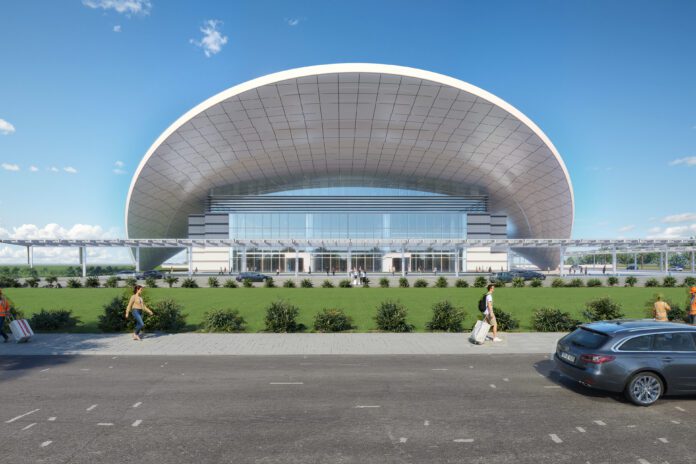
Here, steel has quietly expanded the architect’s toolkit. Long, column-free spans allow terminals to breathe, enabling visual continuity and flexible planning. Steel’s strength-to-weight efficiency makes it possible to create roofscapes that soar without visual heaviness. Scale is achieved without intimidation. Grandeur is delivered without density.
The result is space that feels expansive yet controlled, open, yet navigable.
AIRPORTS AS LIVING SYSTEMS
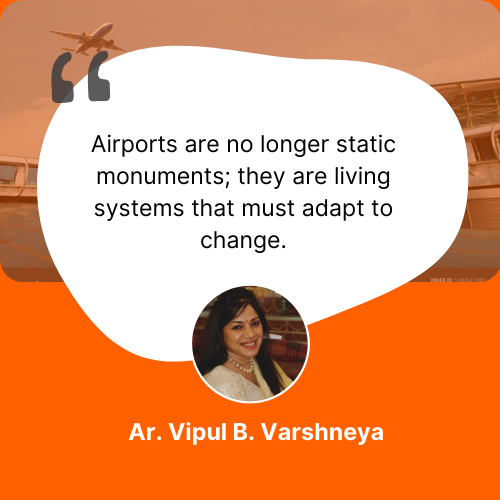
For Ar. Vipul B. Varshneya, Co-Founder, STHAPATI, this shift runs deeper than aesthetics. Airports, he argues, can no longer be conceived as static monuments. They must operate as “living systems,” capable of absorbing technological change, evolving mobility patterns, and unforeseen global disruptions.
Architecture sits at the intersection of infrastructure, technology, and human behaviour. It must be resilient not only structurally but programmatically, ready to adapt as travel itself evolves.
SPEED WITHOUT LOSING SOUL
The pressure to build quickly adds another layer of complexity. Many terminals today are delivered under compressed timelines and, in some cases, within live airport environments. Steel construction offers a crucial advantage here. Its compatibility with off-site fabrication allows complex elements to be manufactured in controlled settings with high precision. On-site work shifts toward assembly rather than fabrication, reducing congestion, improving safety, and accelerating delivery.
In environments where operational continuity is non-negotiable, this predictability becomes invaluable. Yet speed has not diluted identity. Contemporary Indian airport architecture demonstrates that iconic expression and modular discipline can coexist. Modularity governs the structural backbone like grids, bays, and services, while identity emerges through form, materiality, light, and spatial sequencing.
“An airport must expand without pausing and evolve without disruption.”
ROOTED IN PLACE, DESIGNED FOR SCALE
Sikka points to the Netaji Subhas Chandra Bose International Airport, Kolkata, as an example where culture is embedded in structure rather than applied superficially. The roof draws inspiration from Bengal’s handloom traditions, translating cross-weaving patterns into structural language. Subtle references to literature and art allow the building to speak of place without compromising clarity.
Similarly, at Ayodhya Airport, a modular structural system supports an entrance inspired by the Nagara style. Standardisation enables efficiency and scalability, while intricately articulated toran dwars root the terminal in regional memory. The system remains rational; the experience remains contextual.
WHEN STRUCTURE BECOMES EXPRESSION
Across projects, a shared philosophy is emerging. Structure is no longer concealed behind finishes, it becomes part of the narrative. Steel, glass, and engineered cantilevers create a vocabulary of openness and confidence. Rather than relying on applied ornamentation, the building’s logic itself communicates ambition.
As India’s airports grow in scale and complexity, architecture is being asked to do more than shelter movement. It must translate national scale into human experience. It must feel grand without being overwhelming, efficient without feeling mechanical, and memorable without becoming theatrical.
Above all, it must remain flexible, ready to expand and adapt alongside a nation in motion.
ENGINEERING THE IMPOSSIBLE
If architecture gives airports identity, engineering gives them legitimacy. The drama of a soaring roof or luminous concourse rests on rigorous structural logic beneath, designed to perform under immense demands of load, movement, time, and uncertainty. What feels effortless to passengers is the product of exacting engineering judgement.
THE UNSEEN BACKBONE
Modern airport terminals are among the most structurally demanding public buildings being realised today. They stretch across vast footprints, carry heavy service and crowd loads, resist wind and seismic forces, and remain adaptable across lifecycles measured in decades.
Unlike conventional buildings, they also operate in direct dialogue with aircraft, aligning with boarding bridges, respecting wing clearances, and maintaining strict separations between airside and landside zones. In such an environment, precision is not desirable; it is indispensable.
For the contemporary airport engineer, the challenge is no longer simply to make a structure stand. It is to ensure the structure never becomes a constraint. A misplaced column can distort passenger flows. A rigid grid can obstruct future expansion. An inefficient system can slow construction in a live airport. Every structural decision carries operational consequences.
WHEN SPAN BECOMES STRATEGY
Long spans, therefore, are not architectural indulgences; they are operational tools. They allow terminals to reorganise functions, reconfigure security zones, and absorb passenger surges without structural surgery. Flexibility, once a bonus, is now a baseline requirement.
As Praveen Rai, Design Head – Airports, L&T Construction, observes, airports rarely reach a final “end state.” “Passenger demand grows, airlines expand, and regulations evolve,” he notes. Designing for a static future, he implies, risks early obsolescence. Structural grids today are therefore conceived to “stretch, plug in, or extend in phases without disturbing operations.” The airport, in this logic, is planned as a sequence rather than a conclusion.
“Steel allows terminals to remain open while they grow.”
DESIGNING FOR GROWTH WITHOUT PAUSE
This has made phased expansion a defining engineering philosophy. Instead of designing for an imagined final capacity, engineers plan for calibrated growth. Foundations, column grids, and roof systems are aligned for incremental additions. The objective is not merely to add space, but to preserve continuity. An airport, by nature, cannot pause to rebuild itself.
This produces a rare condition where construction and operation coexist. Parts of a terminal function while others are still rising. Such environments demand erection methods that are predictable, clean, and minimally disruptive. Here, steel moves from material choice to strategic enabler.
PRECISION, OFF-SITE AND ON-TIME
Off-site fabrication allows components to be produced under controlled conditions with high accuracy. What arrives on site is ready for assembly rather than prolonged fabrication. This reduces congestion, shortens erection cycles, and limits disruption to passengers and flight schedules.
In an ecosystem where every hour of closure carries economic implications, time saved is not convenience, it is value.
ENGINEERING FOR RESILIENCE
Performance expectations are also sharpening. Indian airport projects increasingly align with advanced limit state design approaches, where structures are evaluated against real behavioural thresholds rather than broad safety margins. The focus is resilience, frames that retain integrity under buckling, lateral forces, and unexpected stress.
Seismic design, in particular, has gained urgency. With airports classified as critical infrastructure, structural systems must demonstrate ductility, controlled deformation, and energy absorption. The ambition is not merely to prevent collapse, but to ensure post-event functionality. An airport must remain usable when it is needed most.
MATERIALS THAT MATCH THE MISSION
Long-span roof systems introduce their own complexities, resisting wind uplift, accommodating thermal movement, and supporting dense service networks without visual clutter. Hollow structural sections and high-strength steels are increasingly deployed to achieve strength-to-weight efficiency while preserving architectural lightness.
From a materials standpoint, the industry itself is evolving. As Subrat Panda points out, the airport boom is pushing producers toward “higher precision manufacturing, advanced metallurgy, and performance-oriented sections.” He notes that fire-resistant steels, weather-resistant grades, and engineered hollow sections are gaining relevance as airports demand durability, safety, and lifecycle efficiency alongside speed.
FROM STRUCTURES TO SYSTEMS
Yet the most significant shift may be philosophical. Engineering for airports today is less about designing static objects and more about designing responsive systems. Structures must anticipate change such as new security technologies, biometric processing, evolving passenger behaviour, and even next-generation aircraft.
In this light, the airport terminal is no longer a finished building. It is a framework for evolution. Steel, with its adaptability and recyclability, aligns naturally with this mindset. It allows expansion, adaptation, and reconfiguration without erasing what already exists.
Engineering the modern airport, therefore, is not about solving complexity once. It is about preparing for complexity that will keep arriving. And in that quiet preparedness lies the true sophistication of today’s airport structures.
RACING AGAINST TIME
If airport engineering is an exercise in precision, airport execution is an exercise in orchestration. The contemporary Indian terminal is not only large in scale but also compressed in time. Delivery windows of 24–36 months for mega-terminals, once considered exceptional are steadily becoming the industry norm. The airport of today is defined as much by delivery speed as by physical scale.
BUILDING IN MOTION
What makes this acceleration remarkable is the context in which it unfolds. Many airport projects do not rise on empty land; they grow within live aviation ecosystems. Aircraft continue to taxi, passengers continue to flow, and airlines continue to operate even as steel frames rise and systems are installed in carefully demarcated zones.
Unlike a greenfield commercial project, an airport rarely enjoys isolation. It must expand while functioning and adapt while performing.
CONSTRUCTION AS CHOREOGRAPHY
This reality turns construction into a discipline of choreography. Sequencing becomes strategy. Coordination becomes currency. Risk management becomes routine. Structural works, MEP systems, façades, baggage handling networks, and airside infrastructure often advance in parallel rather than neat sequence.
In such environments, a delay in one trade rarely remains local, but it cascades. Precision in planning becomes as critical as precision in fabrication.
As Nandita Bhatt emphasises, the real challenge in delivering today’s terminals is “less about isolated engineering and more about orchestration complexity.” Land readiness, inter-agency coordination, regulatory clearances, and last-mile connectivity, she notes, often influence timelines as much as construction itself. The airport project, in her view, is a convergence of multiple systems, each with its own dependencies.
DESIGNING CERTAINTY INTO SPEED
In this context, design stability gains unusual importance. An early design freeze is no longer a managerial preference; it is a project safeguard. Without upstream clarity, downstream coordination weakens. Phasing strategies are therefore developed with rigour, allowing expansions and upgrades to be slotted into operational calendars without disturbing passenger flows or airline schedules.
Digital oversight is quietly reshaping execution culture. BIM-linked dashboards, live progress tracking, and performance-based reporting are replacing retrospective reviews. The emphasis is shifting from correction to anticipation. Issues are increasingly addressed before they become visible on site.
In a time-sensitive environment, foresight becomes a competitive advantage.
STEEL AND THE LOGIC OF SPEED
It is in this compressed, high-stakes setting that steel reveals its pragmatic strengths. Off-site fabrication moves labour-intensive processes away from crowded sites into controlled environments. Components arrive ready for assembly rather than prolonged fabrication.
This reduces congestion, improves safety, and minimises disruption. Predictable erection cycles allow teams to align work windows with flight schedules and passenger peaks.
From an EPC standpoint, constructability now sits at the centre of decision-making. As Praveen Rai observes, structural systems are judged not only by strength or aesthetics but by how efficiently they can be erected in constrained, operational settings. “Every day saved on site,” he implies, reduces operational, financial, and reputational exposure.
SPEED WITHOUT COMPROMISE
Yet speed does not equate to haste. The tolerance for error in airport projects is extremely narrow. Safety, quality, and operational continuity remain uncompromising benchmarks. The real expertise lies in compressing timelines without compressing discipline in moving quickly without losing control.
There is also a symbolic dimension to this urgency. Airport projects often carry public visibility and emotional weight. They are tied to regional pride, national milestones, and sometimes political timelines. A delayed airport is not merely a delayed building; it is a deferred promise. The pressure to deliver is therefore both professional and public.
A NEW CULTURE OF DELIVERY
What emerges from this environment is a new culture of execution that is data-driven, tightly synchronised, and relentlessly schedule-aware. Teams operate with the understanding that time is not an abstract metric; it is a structural parameter.
Airports today are built against the clock, but not recklessly. They are delivered through a calibrated balance of speed, foresight, and industrial discipline.
In this choreography of steel, systems, and schedules, execution itself becomes a form of engineering, one that transforms ambition into arrival.
AIRPORTS AS LIVING STRUCTURES
If there is one idea that unites India’s new-generation airports, it is this: they are no longer conceived as finished objects, but as evolving systems. The earlier notion of a terminal reaching a final, static state is steadily dissolving. In its place emerges a more fluid philosophy, one that treats growth, change, and uncertainty not as disruptions, but as design parameters.
Airports today are designed with the certainty that tomorrow will differ from today. Passenger volumes will rise. Technologies will redefine movement. Security frameworks will evolve. Climate pressures will intensify. Flexibility is no longer a design virtue; it is a structural mandate.
DESIGNING FOR CHANGE, NOT JUST COMPLETION
This mindset begins at the drawing board. Terminals are increasingly conceived as expandable frameworks rather than closed compositions. Structural grids anticipate future wings. Service corridors are sized for retrofits. Roof systems are planned to accommodate daylight strategies, renewable energy integration, and next-generation building technologies. The airport, in effect, becomes less a building and more a long-term spatial strategy.
As Nandita Bhatt has emphasised, a future-ready airport must be “flexible, resilient, and digitally native,” capable of expanding seamlessly while remaining operational. The goal, she underscores, is not merely to meet forecast demand but to remain agile when forecasts shift.
THE 2035 TERMINAL
Looking toward 2035, expectations from Indian airports will be significantly higher. Terminals are envisioned as digitally intelligent environments where biometrics streamline journeys, AI-enabled systems support operations, and predictive maintenance minimises downtime. Frictionless movement will increasingly define passenger experience. Multimodal integration, linking airports with metro, rail, highways, and cargo networks, will define functional relevance. Sustainability will move beyond checklists to become embedded logic.
Airports will not simply process passengers; they will anticipate them.
ROOTED YET EXPANDABLE
From a design standpoint, architects such as Ar. S.R. Sikka and Ar. Vipul B. Varshneya have consistently argued that the next generation of terminals must balance identity with adaptability. As they note in different ways, airports must remain culturally rooted even as they scale, allowing modular systems to support growth without erasing local expression. The terminal must belong to its place while remaining ready for its future.
From an engineering lens, Praveen Rai highlights that adaptability is now embedded into structural planning itself. Terminals are no longer engineered for a fixed end-state but for phased evolution, where expansion can occur without operational disruption.
From a materials perspective, Subrat Panda points out that advances in steel grades, fire-resistant properties, and precision manufacturing are enabling structures that are “safer, lighter, and more durable” across extended lifecycles. Performance today is measured not only in strength, but in longevity and resilience.
STEEL AS THE ENABLER OF EVOLUTION
Within this broader narrative, steel’s role has been both foundational and understated. It has enabled speed without fragility, span without heaviness, and adaptability without waste. It allows terminals to remain operational while they expand and robust while they evolve. Steel has given physical form to the idea of flexibility itself.
Its recyclability, precision, and structural efficiency align naturally with the philosophy of airports as living systems rather than static monuments.
GATEWAYS TO A MOVING NATION
India, therefore, is not merely constructing airports. It is engineering gateways for a flying civilisation, one that is more mobile, more interconnected, and more aspirational than ever before. Each terminal rising across the country signals that mobility is no longer peripheral to development; it is central to it.
India is not merely constructing airports. It is engineering gateways for a flying civilization, one that is more mobile, interconnected, and aspirational than ever before. Each terminal rising across the country reinforces a clear message: mobility is now central to development. Under the long spans of steel and light, India is not only preparing for its next flight, but is defining the infrastructure grammar of its future.
SSMB POV
India’s airport story is ultimately a story of infrastructure maturity. It marks a shift from building for need to building with vision where scale, speed, and quality must coexist. Few project types test the steel ecosystem as rigorously as airports. They demand precision, discipline, and lifecycle thinking in equal measure. For the steel construction fraternity, airports are becoming benchmarks. They reward technical depth, modular intelligence, and coordinated execution. As India’s aviation network expands, steel is not simply enabling these gateways, it is shaping how they are imagined, delivered, and future-proofed. The direction is unmistakable: the future of Indian steel construction is already taking form under the sweeping spans of its airports.