

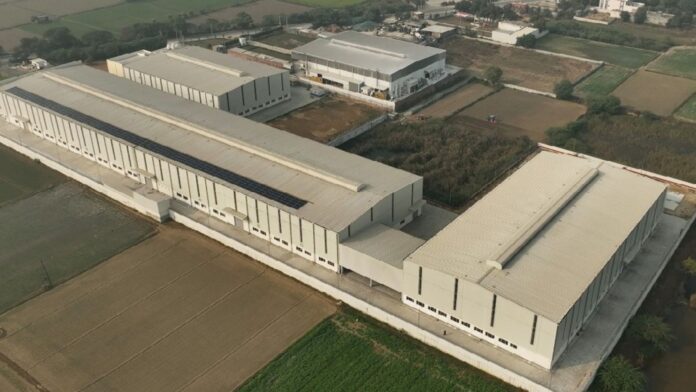
As India’s manufacturing footprint expands, industrial buildings are being asked to do more than produce, they must also consume less, adapt faster, and care better for the people who inhabit them. Set on a 6.43-acre site in Jhajjar, Haryana, this safety shoe manufacturing facility presents a grounded response. Planned as a greenfield campus and aligned with IGBC Green Factory Building principles, it shows how efficiency, sustainability, and worker comfort can be embedded into industrial design from day one.
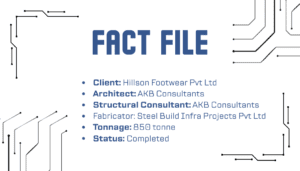
Industrial buildings are rarely celebrated for restraint. They are built to perform, to produce, to scale, often at the cost of land, energy, water, and human comfort. Yet, on a 6.43-acre industrial plot in Village Soldha, Tehsil Bahadurgarh, District Jhajjar, a safety shoe manufacturing facility is attempting something more deliberate. Instead of asking how fast or how big an industrial building can become, the project asks a quieter, more difficult question: how responsibly can it grow?
Planned as an integrated manufacturing campus, the facility is designed to support high-volume safety footwear production for both domestic and export markets. But beyond its operational brief, the project positions itself as a response to India’s evolving industrial reality, one where efficiency, sustainability, and workforce well-being must coexist, not compete. Aligned with the IGBC Green Factory Building Rating System, the development demonstrates how sustainability can be embedded into industrial architecture as a foundational strategy rather than a corrective exercise.
PLANNING A CAMPUS BEFORE DESIGNING BUILDINGS
From the outset, the project was envisioned as a greenfield industrial development within a designated industrial zone. This allowed sustainability considerations to shape the master plan itself, rather than being constrained by legacy decisions. The campus is organised into multiple manufacturing blocks like cutting and stitching, assembly and injection moulding, quality testing, packaging, and warehousing, each housed within Pre-Engineered Building (PEB) structures and zoned to maintain uninterrupted production flow.
The layout prioritises clarity of movement of materials, people, and services, reducing internal travel distances and energy-intensive material handling. More importantly, it respects the site as a living system. Existing natural features were not erased for convenience; a pre-existing pond on site was retained, cleaned, and converted into a groundwater recharge reservoir. Beyond its functional role, it is intended to evolve into an aesthetic and ecological asset, reinforcing the idea that industrial landscapes need not be environmentally barren.
“Sustainability delivers the greatest value when it is planned, not retrofitted.”
SUSTAINABILITY DESIGNED, NOT ADDED
A defining strength of the project lies in how early sustainability entered the decision-making process. Architectural, structural, and MEP planning were guided by IGBC-aligned benchmarks from day one, ensuring that energy efficiency, water conservation, and environmental compliance were not isolated objectives but interlinked outcomes.
The choice of PEB construction was central to this approach. Off-site fabrication reduced construction waste, shortened timelines, and improved material efficiency. Precision engineering lowered embodied energy while enabling faster commissioning, an often-overlooked sustainability metric in industrial projects. Modular construction also ensured that future expansion could occur without demolition-heavy interventions, preserving both resources and operational continuity.
STEEL AS A QUIET ENABLER OF GREEN INDUSTRY
Steel, deployed through PEB systems, plays a pivotal role in the facility’s environmental performance. Its high strength-to-weight ratio allows for large clear spans essential for manufacturing flexibility, while using less material than conventional RCC systems. This translates directly into reduced foundation sizes, lower material consumption, and faster construction.
Equally significant is steel’s recyclability. At the end of its service life or during future modifications, the structural material retains value rather than becoming waste. In an industrial context where adaptability is critical, steel enables reconfiguration without structural compromise, aligning long-term operational needs with environmental responsibility.
“In industrial buildings, efficiency and environmental responsibility are deeply interconnected.”
DESIGNING THE ENVELOPE BEFORE DESIGNING SYSTEMS
Rather than relying on energy-intensive mechanical solutions, the project prioritises passive design strategies to achieve thermal comfort. Building orientation was optimised to maximise daylight penetration and cross-ventilation, reducing dependence on artificial lighting and cooling.
The envelope plays a critical role. Walls are constructed using 80 mm thick rockwool sandwich panels, while roofs incorporate 50 mm rockwool insulation, significantly limiting heat ingress. This insulation-first approach stabilises indoor temperatures and reduces energy loads before mechanical systems are even considered. High Solar Reflectance Index (SRI) glass further mitigates heat gain, improving indoor comfort across production areas.
MEASURED ENERGY PERFORMANCE, NOT ASSUMED EFFICIENCY
Energy efficiency was validated through simulation rather than assumption. Shading analysis helped identify opportunities for external shading devices, improving comfort in both indoor and outdoor work zones. Daylight simulations informed the architectural form and lighting strategy, ensuring maximum utilisation of natural light while preventing overdesign of artificial systems.
Inside the production halls, High Volume Low Speed (HVLS) fans maintain air circulation across large floor plates, delivering thermal comfort at substantially lower energy consumption than conventional cooling systems. Rooftop solar panels contribute to on-site renewable energy generation, reducing reliance on grid power and lowering operational carbon emissions.
An integrated Building Management System (BMS) monitors energy and water consumption in real time. This shifts sustainability from static intent to active management, enabling corrective action, optimisation, and long-term performance tracking.
“Steel and PEB construction allow speed, adaptability, and sustainability to work together.”
WATER TREATED AS A FINITE ASSET
Water management within the facility follows a closed-loop philosophy. Rainwater harvesting systems capture and store runoff for reuse, while RO systems purify and recycle water for operational needs. An on-site Sewage Treatment Plant (STP) allows wastewater to be treated and reused, significantly reducing freshwater dependence.
Landscape irrigation is handled through drip irrigation systems fed by harvested rainwater, minimising losses through evaporation and runoff. These measures collectively reduce pressure on municipal water supplies while supporting groundwater recharge and long-term site resilience.
GREEN BUILDINGS MUST WORK FOR PEOPLE
Environmental performance is inseparable from social sustainability. The facility’s design prioritises worker comfort through abundant daylight, natural ventilation, thermally stable interiors, and clear circulation routes. Hygienic sanitation blocks, canteens, rest areas, and shaded pedestrian pathways contribute to a healthier workplace, reducing fatigue and improving productivity.
By addressing comfort passively, through planning, orientation, insulation, and ventilation, the project reduces operational energy demand while enhancing daily user experience. Sustainability here is not abstract; it is felt during every working hour.
DESIGNED FOR GROWTH WITHOUT WASTE
Industrial growth is inevitable, but wasteful growth is not. The structural system has been designed with additional load capacity and predefined expansion joints, allowing new blocks to be added without disturbing existing operations. Utilities including electrical panels, water supply, and drainage have been sized with scalability in mind, ensuring future expansion does not require resource-intensive retrofitting.
This foresight transforms sustainability into a lifecycle strategy rather than a one-time achievement.
Why It Matters:
This safety shoe manufacturing facility in Jhajjar shows that green industrial infrastructure is no longer just an environmental choice, it is a business imperative that enhances efficiency, resilience, workforce well-being, and global competitiveness. In doing so, it quietly sets a benchmark for how India can build industry without amplifying impact and grow manufacturing capacity without exhausting the resources that support it.