


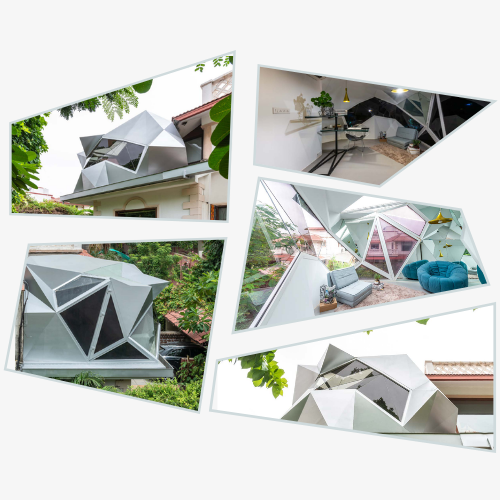
In the ordered stillness of a gated neighbourhood, where homes follow familiar geometries and predictable expressions Symbiotic Parasite designed by Architect Hiloni Sutaria, Founder, HSC Designs emerges as a deliberate disruption. Not loud, not excessive, but precise enough to provoke a pause. It does not attempt to blend in, nor does it aggressively stand apart. Instead, it attaches itself to an existing bungalow with an almost biological logic that is dependent, responsive, and quietly transformative.
“The Symbiotic Parasite behaves like an organism that is dependent, yet transformative.”
– Hiloni Sutaria, Founder, HSC Designs
A QUIET DISRUPTION IN A PREDICTABLE LANDSCAPE
In the ordered stillness of a gated neighbourhood, where homes are composed in familiar geometries, restrained palettes, and predictable spatial expressions, Symbiotic Parasite emerges not as an intrusion, but as a calculated disruption. It does not announce itself with scale or spectacle, yet it unsettles the visual rhythm with an intensity that is difficult to ignore. Its presence is subtle in size, but assertive in intent.
Rather than blending into its surroundings or attempting to harmonise through imitation, the intervention chooses a more provocative stance. It attaches itself to an existing bungalow with a logic that feels almost biological, dependent on its host for structure and continuity, yet transformative in the way it alters the experience of that host. It is not an object placed beside architecture; it is an entity that embeds itself within it.
THE PROVOCATION OF A NAME
The project begins with a name that deliberately resists comfort. The term parasite challenges the conventional optimism associated with residential design, forcing a reconsideration of what an extension fundamentally represents. In its truest sense, an extension borrows, attaches, and relies, it is inherently dependent on an existing structure.
However, the narrative here is not left in that state of dependency. It is reframed through the lens of symbiosis. What initially appears as an act of architectural attachment evolves into a mutually beneficial relationship. The intervention draws from the bungalow, yet in return, it enhances spatial quality, introduces calibrated daylight, and redefines the identity of the home without compromising its original character.
This is not an extension that quietly follows the language of the existing structure. It is an extension that questions, reinterprets, and ultimately elevates it.
“It behaves like a contemporary organism dependent on its host, yet transforming how the host is lived in and perceived.”
ANCHORING MEMORY, INTRODUCING CONTRAST
The existing bungalow retains its role as the anchor, rooted in familiarity, scale, and memory. Its architectural language remains intact, undisturbed, and clearly legible. The intervention does not attempt to blur this identity through mimicry or forced continuity. Instead, it introduces a deliberate contrast.
This contrast is not abrupt; it is measured and controlled. At the points of connection, restraint becomes the governing principle. The extension is carefully proportioned to remain compact, ensuring that it does not overpower the existing structure. Yet, in its form and expression, it asserts a distinctly contemporary identity.
The result is a layered dialogue between two architectural timelines. The old continues to speak of permanence and familiarity, while the new introduces a language of experimentation and precision. Together, they create a relationship that is not based on visual harmony, but on conceptual clarity.
“Respect is not imitation. It is the clarity of difference.”
REWRITING THE LIMITS OF A MICRO INTERVENTION
At just 100 sq ft, the project confronts one of architecture’s most persistent assumptions that smaller interventions must inherently be simpler, quieter, and spatially limited. Instead of accepting this constraint, the design treats the compact footprint as an opportunity for intensified exploration.
Geometry becomes the primary tool, not merely for form-making, but for shaping perception. The faceted surfaces are carefully calibrated to fragment and redirect light, creating a dynamic interplay between illumination and shadow. Reflections extend the visual boundaries of the space, while framed openings construct layered views that reach beyond the physical limits of the enclosure.
The result is a space that resists its own scale. It does not feel confined or reduced. Instead, it expands optically, experientially, and atmospherically. Daylight is treated not as an external condition, but as an active design element. It is captured, diffused, and redirected through the geometry of the form. In the morning, light enters softly, spreading across surfaces with a controlled luminosity. By midday, it sharpens, intensifying the spatial experience. As evening approaches, the space transforms once again, with shadows deepening and edges becoming more pronounced.
The architecture is therefore not static; it is continuously evolving in response to time.
“The form is not designed to be seen, it is designed to change how light is experienced.”
EXTENDING SPACE THROUGH PERCEPTION
Within this compact envelope, mirrors and windows are positioned with deliberate precision. They are not introduced as decorative elements but as instruments of spatial expansion.
Mirrors extend sightlines beyond the physical boundaries, creating an illusion of continuity and depth. Windows are carefully oriented to frame specific views, introduce diagonals, and layer visual experiences. Together, they ensure that the eye is constantly in motion.
This continuous movement reduces the perception of enclosure. The space begins to feel volumetric rather than confined, expansive rather than limited. It is not the addition of more elements that creates this effect, but the strategic placement of fewer, more intentional interventions.
MIND-BOGGLING ASPECT
When Scale Becomes Secondary
- A 100 sq ft intervention that redefines the identity of an entire residence
- Geometry that manipulates perception to exceed physical limits
- Daylight treated as a dynamic, design-driving material
- A private extension that generates public curiosity and dialogue
- An architectural object that engages both human users and the surrounding ecosystem
NEGOTIATING SCEPTICISM THROUGH PRECISION
Situated within a gated community, the project initially encountered resistance. Its unconventional geometry and departure from familiar forms raised questions about its appropriateness within the neighbourhood context.
The response, however, was not to dilute the design but to reinforce its intent. Each design decision was clearly articulated not as an aesthetic indulgence, but as a functional and experiential necessity. The geometry was explained as a calibrated response to light, privacy, and spatial quality.
Equally important was the discipline of execution. The construction process was carefully managed to ensure minimal disruption, reinforcing the project’s credibility within its context.
Over time, perception began to shift. What was initially perceived as disruptive started to be understood as deliberate and controlled. The project transitioned from being an anomaly to becoming a point of engagement.
“Curiosity is architecture’s most powerful outcome.”
BEYOND THE INTENDED USER
One of the most compelling outcomes of the project lies in its ability to extend beyond its immediate function. While designed as a private extension, it gradually began to engage a wider set of users.
Children were drawn to its form, interacting with it as an object of curiosity rather than a defined space. Its geometry invited exploration, while its surfaces encouraged engagement.
More unexpectedly, the intervention began to influence its immediate ecological context. Edges became perches for birds, shaded areas created microclimates, and the interplay of light and form subtly altered environmental conditions.
In this way, the architecture transcended its intended role, becoming part of a broader ecosystem.
REINTERPRETING THE ESSENCE OF TRADITION
Rather than replicating traditional architectural motifs, the project seeks to reinterpret the underlying qualities that define old-world charm. These qualities are not rooted in ornamentation alone, but in the experience of space, its intimacy, its layers, and its crafted specificity.
Through calibrated thresholds, curated views, and a dynamic interplay of light, these qualities are translated into a contemporary language. The bungalow retains its warmth and familiarity, while the extension introduces a new sensibility that is precise, cinematic, and intentionally distinct.
The past is not imitated; it is understood and rearticulated.
“The project does not imitate history, it extracts its essence.”
PRECISION AS A NECESSITY, NOT A CHOICE
At a micro scale, the success of architecture is determined not by its overall form, but by the precision of its detailing. Every junction, every edge, and every alignment carries visual and structural significance.
The faceted geometry amplifies this requirement. Even minor deviations can disrupt the continuity of planes and compromise the intended reading of the form. As a result, the execution demanded a high level of coordination between design, fabrication, and construction.
This level of precision transforms detailing from a secondary consideration into a primary design tool. It ensures that the playfulness of the form is supported by the rigour of execution.
HSC Designs’ Design Ethos
- Contrast over imitation
- Context as a collaborator, not a constraint
- Light as a primary architectural material
- Geometry as a tool of perception
- Detailing as the foundation of design integrity
A LABORATORY OF ARCHITECTURAL THOUGHT
Working within a 100 sq ft footprint allowed the project to function as a concentrated laboratory of ideas. Concepts related to geometry, light, perception, and detailing were explored with a level of intensity that is often diluted in larger projects.
Every design decision carried immediate and visible consequences. This compression of ideas revealed a fundamental insight that architectural impact is not dependent on scale, but on clarity of intent and precision of execution.
“In 100 sq ft, architecture becomes distilled, every decision amplified, every idea exposed.”
THE TRUE MIND-BOGGLER
What ultimately defines Symbiotic Parasite is not merely its form or conceptual clarity, but the disproportionate impact it generates. A minimal intervention reshapes the identity of an entire residence. It challenges the visual norms of its context. It creates a spatial experience that exceeds its physical dimensions.
In doing so, it demonstrates that architecture does not require scale to achieve significance. It requires clarity, intent, and the willingness to question established conventions.
Editor’s Note:
Symbiotic Parasite stands as a compelling reminder that architecture is not measured in square footage, but in the intensity of its ideas. In a profession often driven by expansion and scale, this project redirects attention toward precision, perception, and the power of focused intervention. It challenges conventional notions of residential extensions and reframes them as opportunities for experimentation, dialogue, and reinterpretation. Through this project, HSC Designs demonstrates that the future of architecture may not lie in building more, but in building with greater intent, clarity, and sensitivity.