

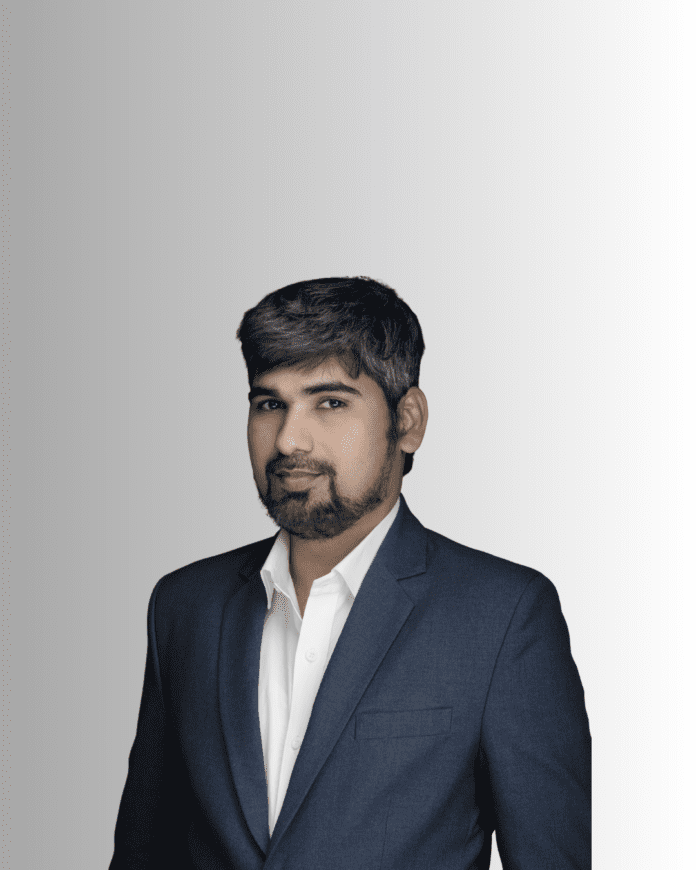
Intro: Every engineer’s journey begins long before the first drawing is issued or the first structure rises on site. For Mirza K. Baig, the path into structural engineering was shaped not by a single moment of inspiration, but by a growing curiosity about how structures behave, how decisions translate on site, and how responsibility deepens with experience. In this edition of TALES, he reflects on mentorship, mistakes, steel-intensive projects, and the slow transition from following codes to exercising judgment.
The Quiet Making of a Structural Engineer
Featuring Mirza K. Baig, Founder & Managing Director, Proconstruct Design & Engineering
Your College Name and Place: Nawab Shah Alam Khan College of Engineering and Technology, Hyderabad.
Total Years of Experience: 13+ years.
Your Idol: M.Z. Baig (Father)
Your Mentor: R.B. Rajesha
Your Mantra for Success:
Build Trust Every Time.
You want to be remembered as:
A practical engineer who challenged the status quo.
Steel Projects you currently working on:
- Campa Cola Beverage Facility, Khordha
- Hetero Drugs Pharmaceutical Facility, Hyderabad
- Youngone Textile Facility, Warangal
- TVS Automobile Facility, Oragadam
- Patanjali Food Processing Facility, Nalgonda
- Valeth Aerospace, Hyderabad
- Turbo Turbine Engineering Facility, Sangareddy
Every engineering journey has a quiet starting point. Looking back, what first drew you towards structural design and engineering? Was there a defining moment, project, or mentor that shaped your early direction?
My inclination towards structural engineering developed gradually rather than through a single defining moment. During my academic years, I was always more interested in understanding why structures behave the way they do, rather than limiting myself to calculations alone. Observing buildings, bridges, and industrial structures around me sparked a curiosity about the unseen forces governing their performance.
A significant influence on my professional growth was R. B. Rajesh, who was then Vice President at Structures at Semac Consultants Pvt Ltd. His emphasis on strong fundamentals, practical design approaches, and real-world engineering judgment left a lasting impact on me. His guidance strengthened not only my technical understanding but also my sense of responsibility as an engineer. I remain deeply grateful for his mentorship.
Another formative experience was my involvement in the Maruti Suzuki Automobile Facility project at Becharaji, Gujarat. Working on a large-scale industrial project exposed me to coordination challenges and practical design considerations, helping me bridge the gap between theory and execution.
“Codes guide you, but judgment defines you as an engineer.”
As your career evolved, when did you feel you truly began developing your own design thinking and engineering identity?
That shift happened during my involvement in the Independent Water Project at Barka, Oman, a large-scale desalination facility supplying drinking water to Muscat. Early in my career, like most young engineers, I relied heavily on codes and followed them rigorously. However, working closely with execution and site teams on this project exposed me to realities beyond design-office calculations.
Continuous interactions with site teams, participation in value-engineering discussions, and addressing construction challenges helped me understand the intent behind code provisions. That experience marked my transition from blindly following codes to interpreting them with confidence and responsibility.
As Head of Design at Proconstruct, how do you balance creativity, safety, constructability, and commercial realities, particularly in fast-track, steel-intensive projects?
Safety and code compliance are non-negotiable and form the foundation of every design decision. Creativity enters the process through optimisation, achieving efficient solutions that are practical, economical, and safe to build.
A notable example is the Heritage Foods Corporate Office project in Hyderabad, where German composite technology involving composite beam–column systems was introduced in India.
The structure experienced high lateral sway, which we controlled by introducing elevation bracing using 325-mm-diameter hollow circular steel sections, bringing the sway within permissible limits. The entire design was reviewed and approved by IIT Bombay.
Early decision-making, conceptual clarity, and close coordination among stakeholders allowed us to reduce the project timeline by nearly 40 per cent without compromising quality or safety.
Steel has increasingly become the material of choice for complex and time-sensitive projects. From a designer’s perspective, what excites you most about working with steel, and what misconceptions do you often encounter?
What excites me most about steel is its versatility and flexibility, both structurally and practically. Steel enables fast, precise, and adaptable solutions, which is invaluable for complex and time-sensitive projects. Its high strength-to-weight ratio, ease of prefabrication, and ability to achieve large spans give designers significant freedom.
A common misconception is that steel is suitable only for industrial buildings where aesthetics are secondary. In reality, steel construction has evolved tremendously. Today, steel structures can be both highly functional and architecturally refined.
This was evident in projects such as Hetero Biopharma and Hetero Drugs facilities. In pharmaceutical environments, where dust control and strict environmental standards are critical, steel proved to be an efficient, safe, and adaptable solution, extending its relevance far beyond traditional industrial applications.
“A design is successful only when it can be built safely and efficiently.”
Design often meets its real test on site. Can you share an experience that fundamentally changed how you approach design today?
Early in my career, I once designed a connection that was structurally sound and code-compliant, but extremely difficult to execute due to limited access and complex welding requirements. The site team’s feedback was blunt, and it taught me an important lesson: a design is only successful if it can be built safely and efficiently.
Since then, I have approached every detail with erection feasibility, site access, and construction sequencing in mind. This philosophy was reinforced during the Telangana Police Commissionerate project, where massive trusses weighing nearly 120 MT had to be erected at a height of 65 m to connect multiple towers.
The project demanded careful consideration of erection loads, temporary members, and specialised connection detailing. Successfully executing those lifts reshaped how I define completeness in design.
In high-stakes projects, how do you navigate situations where multiple technically correct solutions exist?
In such cases, I look beyond structural adequacy. Execution feasibility, construction timelines, cost implications, and end-user priorities become critical factors.
In one of our Hetero Drugs projects, we prioritised execution speed by proposing longer spans to reduce the number of columns, even though this increased initial steel quantities. This significantly reduced foundation work and earthworks. To maintain aesthetics without excessive bracing, we adopted star columns and 18-metre-long beams designed for high live loads using optimised built-up sections. The final solution balanced performance, constructability, and architectural intent.
With advanced analysis tools, BIM, and digital workflows becoming mainstream, how has technology transformed your role as a design leader?
Technology has significantly enhanced coordination, accuracy, and visualisation. However, it must be supported by strong fundamentals. Young engineers play a crucial role in leveraging advanced tools, but senior guidance ensures that models are grounded in sound engineering logic.
In the Mongol Oil Refinery project at Sainshand, Mongolia, BIM-enabled workflows improved constructability, coordination, and delivery. The digital models enabled early clash detection, clear communication of design intent, and stronger alignment between design and site teams, ultimately improving buildability and efficiency.
How do you nurture young engineers within your team, and what qualities matter beyond technical brilliance?
Design excellence is always a collective effort. I encourage young engineers to engage openly with seniors, ask questions, and spend time on site to understand how drawings translate into reality. Ownership of work builds confidence and judgment.
Qualities such as curiosity, discipline, accountability, and a positive attitude matter more than technical brilliance alone. Technical skills can be developed, but responsibility and willingness to learn define a successful engineer. A design engineer is incomplete without strong detailing support, as design intent must ultimately reach the site clearly.
“Steel gives engineers freedom when used responsibly.”
Engineers rarely talk about failure. Was there a professional setback that shaped you?
Early in my career, having design decisions questioned during execution led to moments of self-doubt. Over time, I realised these moments were invaluable learning experiences. They taught me to be better prepared, articulate design intent clearly, and support decisions with sound logic.
Confidence does not come from avoiding mistakes, but from understanding challenges deeply and addressing them directly.
Beyond calculations and drawings, what do you find most fulfilling today?
Seeing a project successfully completed on site is deeply fulfilling. Watching a concept evolve into a safe, efficient structure gives immense satisfaction. Equally rewarding is mentoring young engineers and witnessing their growth into confident professionals.
Why It Matters:
In an era of automation, software, and speed, Mirza K. Baig’s journey is a reminder that engineering maturity is forged slowly—through site realities, mentorship, and accountability. His reflections underline a timeless truth: structural engineering is as much about judgment and responsibility as it is about calculation.