

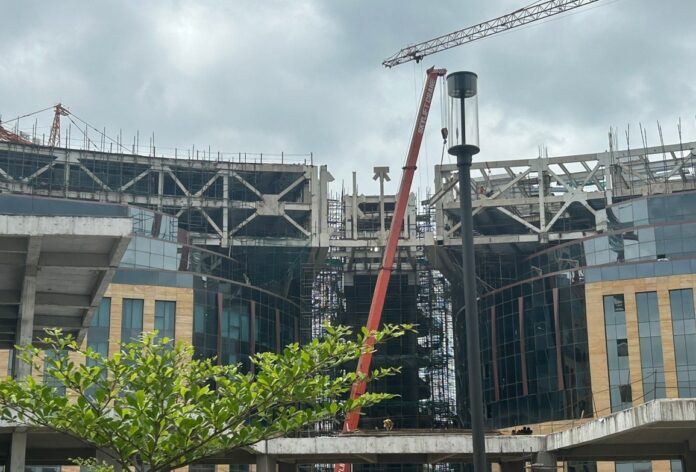
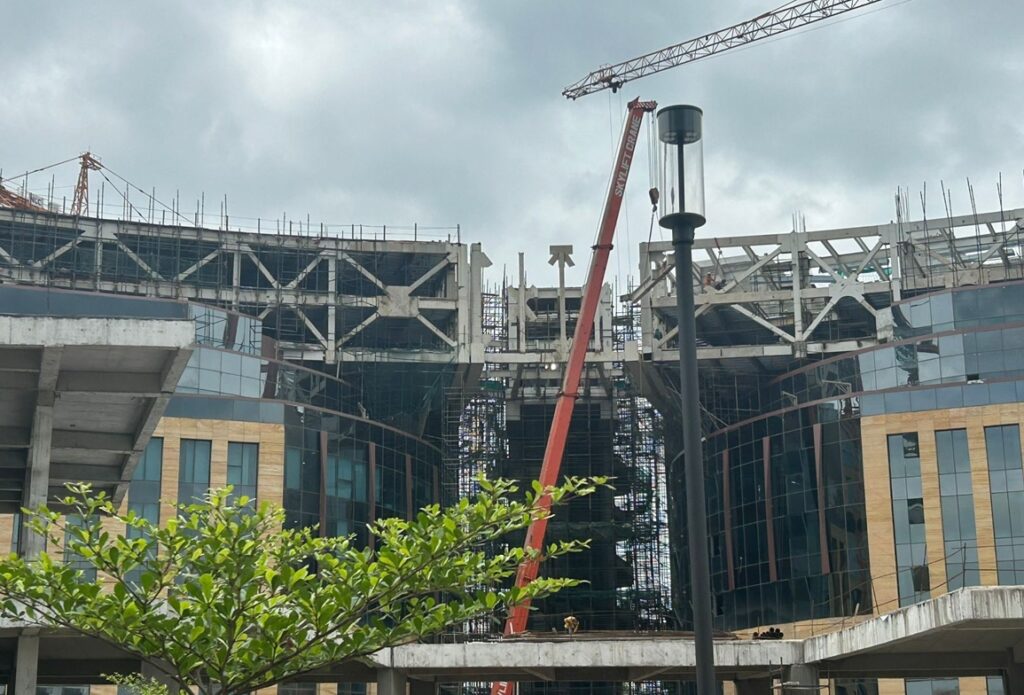
Between the 8th and 9th floors of Towers F and G at the World Trade Centre, New Delhi, something improbable happens. A restaurant leaves the comfort of gravity and chooses instead to exist in dialogue with it. The Sky Bridge Restaurant does not sit, rest, or lean. It spans. It hovers. It connects two towers while quietly challenging every assumption about where architecture should end and where structure must begin. Engineered by SACPL, this suspended volume is not merely a connector, it is a demonstration of how steel, when disciplined by analysis and imagination, can transform deflection into experience.
FACT FILE
Client: NBCC
Architect & Project Management: Collage Design
Structural Consultant: SACPL
Fabricator: Eurocoustic Products Ltd
Supplier: Jindal Steel
Tonnage: 700 MT
Status: Completed
A BRIEF THAT REFUSED SIMPLICITY
The structural mandate was deceptively straightforward: design an elevated dining and lounge facility that would link two towers while becoming an iconic architectural element in its own right. The reality, however, was layered with constraints that resisted conventional answers. The bridge had to span a significant distance without intermediate supports, be constructed at height within a live, fast-moving construction site, and be delivered within a tight twenty-four-month EPC window as part of a six-million-square-foot development.
Add to this the demands of Seismic Zone IV, a design wind speed of 47 m/s, and severe limitations on scaffolding and crane movement, and the project began to resemble a structural paradox more than a design brief. What emerged was not a single solution, but a carefully choreographed strategy, one that balanced speed with stability, lightness with strength, and architectural ambition with structural discipline.
WHY STEEL BECAME THE ONLY LANGUAGE THAT WORKED
At this elevation and scale, material choice was not an aesthetic decision but a structural inevitability. Reinforced concrete, while robust, carried a mass penalty that would have complicated seismic performance and prolonged construction timelines. Steel, by contrast, offered a rare convergence of advantages. Its strength-to-weight ratio reduced dead load, its prefabrication potential compressed schedules, and its adaptability allowed the structure to respond gracefully to movement, vibration, and force.
Steel did not work alone. RCC cores anchored the bridge into the towers, receiving loads and resisting laterals with quiet authority. Together, steel and concrete formed a hybrid system that allowed the bridge to appear light while behaving with calculated restraint.
“The Sky Bridge was never about defying gravity, it was about understanding it well enough to negotiate with it.”
Sachin KC
Chief Operating Officer, SACPL

THE ANATOMY OF A FLOATING STRUCTURE
The Sky Bridge derives its visual calm from a complex internal logic. Vierendeel trusses define its periphery, chosen not only for their structural capacity but for their refusal to intrude. By eliminating diagonals, they preserve spatial openness, allowing interiors to remain uninterrupted while still managing bending and shear. These trusses extend two floors deep, enabling long spans to be negotiated with controlled deflection and minimal perceptible movement.
At either end, cantilevered action transfers forces into the RCC cores, creating the illusion of suspension without the drama of cables or props. Expansion joints mediate the relationship between bridge and towers, allowing differential movement due to temperature variation and seismic activity. What appears effortless to the diner is, in reality, a finely balanced exchange of forces, one that must remain stable across time, load, and motion.
STEEL THAT PERFORMS, STEEL THAT ENDURES
The structural steel, sourced from Jindal Steel, conforms to IS 2062 standards, with grades such as E350 selected for their balance of strength and ductility. These properties were critical in a seismic context, where energy absorption matters as much as capacity. Connections were treated with equal seriousness. High-strength bolting and controlled welding ensured that load paths remained predictable and performance remained uncompromised. Even surface finishes were considered, as structure here was never meant to be hidden, but it was part of the architectural expression.
CONSTRUCTING IN MID-AIR, AMID MOTION
Erecting a suspended structure inside a dense commercial complex demanded a construction philosophy as rigorous as the design itself. Limited clearances between towers restricted crane movement. The working height amplified safety risks. Parallel construction activities meant that sequencing had to be synchronised down to the smallest operation. The solution lay in prefabrication and precision. Structural elements were shop-welded in segments, transported with exacting tolerances, and assembled on site primarily through bolting to minimise welding at height. Temporary staging frames and alignment jigs ensured accuracy during erection. Lifting operations were confined to daylight hours, safety systems were layered and redundant, and every movement was rehearsed before being executed. In such conditions, logistics became an extension of structural design.
DESIGNING FOR FORCES YOU CAN’T SEE
The Sky Bridge was designed in accordance with IS 875, IS 800, and IS 1893, but code compliance was only the baseline. Deep trusses were calibrated to control deflections under static and dynamic loads. Composite deck floors added mass and damping, mitigating vibrations induced by occupant movement. RCC cores absorbed lateral forces, while expansion joints relieved stress from thermal and seismic actions.
Advanced simulations played a critical role. Vibration analyses evaluated human comfort under walking loads. Serviceability checks validated deflection and drift criteria. These studies did more than confirm safety, they optimised member sizes, refined connections, and ensured that the bridge would feel as stable as it was strong.
“Vierendeel trusses allowed us to keep the space open while letting the structure work relentlessly in the background.”Sadaf Quadri
Principal Engineer, SACPL

WHEN STRUCTURE AND ARCHITECTURE SPEAK THE SAME LANGUAGE
From inception, SACPL worked in close collaboration with architectural and MEP teams, treating integration not as a coordination exercise but as a
design principle. Beam depths were aligned to protect ceiling heights. Services were threaded through truss openings. BIM became the shared workspace where clashes were resolved before they exist on site.
The wider World Trade Centre campus, with its twelve towers and multi-level basements, imposed its own constraints on access, storage, and movement. Engineering solutions were developed alongside logistics planning, ensuring that no intervention disrupted parallel construction zones. Every prefabricated element arrived knowing exactly where it belonged.
A HORIZONTAL PAUSE IN A VERTICAL CITY
Suspended between towers, the Sky Bridge Restaurant introduces a rare horizontal gesture into a skyline defined by vertical ambition. It connects not just buildings, but people and experiences, transforming structural necessity into public space. Its floating appearance is not an illusion, but a consequence of disciplined engineering, a reminder that lightness is never assumed, only earned.