


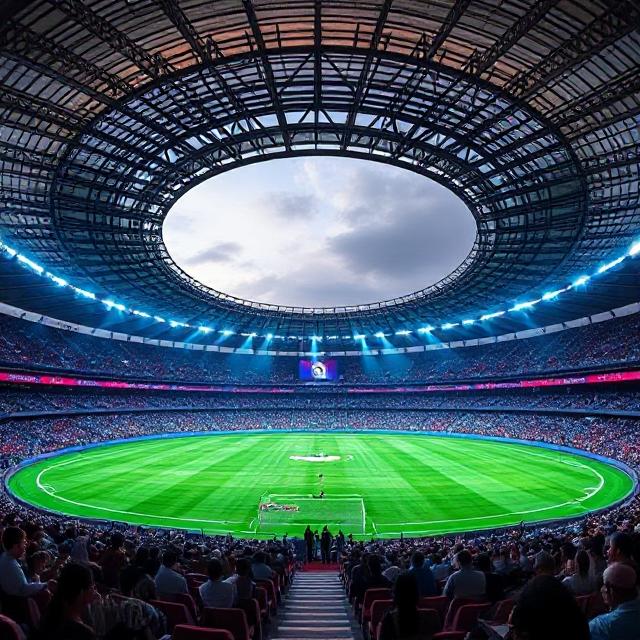
Introduction: Stadiums are far more than mere sporting arenas. With the world watching our every move and timelines rapidly shrinking, the pressure is mounting to deliver structures that are not just massive in scale, but profoundly meaningful in their design and legacy. The looming question is not about our intent – that’s clear. It is about our readiness.
But how ready are we, really? SSMB engaged with leading architects, visionary designers, and seasoned experts who are actively shaping India’s sports infrastructure.
A NEW EPOCH FOR INDIAN SPORT
India is no longer content to merely play host to regional tournaments or cheer from the sidelines. The nation is now boldly asserting its formidable presence on the global sports stage, from the compelling bid for the 2036 Olympics in Ahmedabad to rolling out the red carpet for prestigious FIFA-level events. As this ambition scales unprecedented heights, so too must the physical arenas designed to house it.
The conversation has irrevocably shifted from whether India should build world-class stadiums to the more potent question of how we can, and indeed, if we truly can. Our sports infrastructure is entering a pivotal era, characterised by an urgent demand for steel-intensive, future-forward venues, meticulously crafted to global codes. The race is unequivocally on, and at stake is not just fleeting prestige, but enduring performance, global perception, and indispensable long-term utility.
FUELLING THE RENAISSANCE
This palpable momentum gripping India’s sports infrastructure is no mere accident. It is the direct outcome of a robust and proactive policy landscape. Government-led initiatives such as Khelo India, the Smart Cities Mission, and the expansive National Infrastructure Pipeline are powerfully converging, laying down a formidable framework for sports-centric urban development across the country. When coupled with the aggressive infrastructure pushes championed by states like Odisha, Gujarat, and Karnataka, India appears poised on the precipice of a genuine stadium renaissance.
However, policy, potent as it may be, is merely the starting gun. The true crucible lies in flawless execution. Can we consistently deliver modular, fast-tracked, and steel-led structures that not only adhere rigidly to global compliance standards but also refuse to compromise on architectural aesthetics or, critically, their indispensable ‘afterlife’ functionality? This is precisely where the sophistication of our design philosophy becomes paramount.
FROM VENUES TO CIVIC ASSETS
Over the last decade, the very lens through which stadiums are conceived in India has undergone a profound expansion. No longer envisioned as utilitarian, single-purpose concrete bowls, today’s stadiums are now seen as integrated urban infrastructure – dynamic hubs interweaving sport, entertainment, and vibrant community engagement.
Dikshu Kukreja, Managing Principal at CP Kukreja Architects, views this seismic shift as absolutely essential. “The IPL was a definitive turning point, injecting vital entertainment value and fostering commercial synergies within Indian stadium design,” he notes. “But it was the FIFA U-17 World Cup that truly raised the bar on critical aspects like efficient crowd flow, paramount safety standards, and rigorous compliance.” Kukreja highlights a crucial metamorphosis: “What we are witnessing today is an evolution from ‘event-based architecture’ to infrastructure with a civic afterlife.” He points to Yashobhoomi (India International Convention and Expo Centre), a project designed by his firm, as a stellar embodiment of this new ethos. “While not a sports venue per se, its sheer scale, sophisticated crowd-handling capabilities, highly modular halls, and particularly its long-span steel roofing all perfectly reflect the ambitions now central to contemporary stadium design. It is fully adaptable for concerts, conferences, and even high-calibre indoor sporting events. This, truly, is the new design ethos: flexible, multifunctional, and deeply rooted in long-term utility.”
THE UNSEEN ENABLER
Design is intrinsically about form, but it’s true genius lies in material intelligence. And in this profound transformation of stadium typology, steel has emerged as the silent, yet indispensable, enabler, unlocking unprecedented scale, accelerating construction speed, and fostering a fluidity in design previously unimagined.
Jayesh Hariyani, Managing Director at INI Design Studio, powerfully articulates how steel is meticulously shaping this stadium evolution. “We have fundamentally shifted from designing largely capacity-driven structures to crafting immersive, globally benchmarked environments,” he emphasises. “Spectator comfort, luxurious VIP zones, seamless accessibility, and intelligent integration with urban mobility networks are now non-negotiable elements.” Hariyani is quick to underscore steel’s pivotal role: “Steel is the material that allows for unobstructed views across vast expanses, facilitates dynamic architectural forms, and enables rapid construction timelines. At the Eden Gardens Cricket Stadium refurbishment, for example, the new steel-supported façade and metallic-clad roof elegantly unified the stadium’s form while significantly enhancing its legacy value. Similarly, at Shiv Nadar University, steel trusses and pavilions offered the perfect triad: optimal cost-efficiency, impressive speed of construction, and superior structural performance.”
A MISSED AESTHETIC OPPORTUNITY?
Yet, the chorus of progress is not universally optimistic. Habeeb Khan, past President of the Council of Architecture, offers a sharp and thought-provoking critique that serves as a vital reality check. “India’s stadiums haven’t truly evolved aesthetically as they should have,” he asserts bluntly. “We still don’t instinctively view them as grand design opportunities. Look at architectural marvels like those from Beijing, Qatar, or Barcelona, those are truly iconic. In India, regrettably, our stadiums often lack an inherent soul and a signature identity. We are undeniably missing a profound opportunity to create iconic structures that people remember and cherish, not merely visit.” His candid perspective serves as a potent reminder that amidst the drive for compliance and capacity, aesthetic ambition must not be overlooked.
THE GLOBAL-LOCAL BALANCE
Swati Singh, Architect Director at BDP, believes India is firmly on the cusp of a significant transformation in its sports infrastructure. “Earlier, our stadiums were largely utilitarian, with scant attention paid to audience engagement or year-round functionality,” she observes. “That paradigm is now definitively changing. The burgeoning rise of concert culture, the demand for flexible seating configurations, and the necessity for truly multipurpose venues are collectively driving us closer to global norms.” Singh concludes that the rigorous standards laid out by international federations are “no longer distant checklists; they are becoming deeply embedded in our design and construction approach.”
The connective thread across all expert insights? Steel not just as a material, but as an enabler of modernity. From lightweight roofing to modular pavilions and cantilevered stands, steel is allowing India’s designers to marry form, function, and future-readiness, a must in the age of Olympics-grade scrutiny.
When it comes to designing stadiums that can truly compete and comply on the world stage, global norms serve as far more than mere guidelines. They are the foundational bedrock for credibility, ensuring uncompromised safety, and enabling crucial scalability. Yet, as India meticulously builds for its future, it must deftly strike a delicate balance: that between stringent international compliance and astute local contextuality. This is a critical tightrope walk demanding both unyielding engineering rigour and profound cultural empathy.
For leading architects, global benchmarks are not simply blueprints to replicate, but rather intelligent systems to be reinterpreted to seamlessly suit India’s extraordinarily dynamic urban fabric, its dense demographics, and its unique user behaviours. Dikshu Kukreja passionately emphasises adaptation over imitation: “Rather than merely replicating global models, our approach involves adapting their underlying logic to the specific Indian conditions. While insights from the spatial planning of the London Olympic Park or the mixed-use success of Melbourne’s MCG precinct offer invaluable guidance, our unique urban realities, our climate, population density, and prevalent informal economies demand precise recalibration.”
He illustrates this with a compelling example from Yashobhoomi: “We referenced best practices from Messe Frankfurt and Fira Barcelona for sophisticated crowd dispersion, but then meticulously fine-tuned them to account for distinctive Indian behaviours like staggered entry, the prevalence of family groupings, and a strong last-mile reliance on public transit or two-wheelers. While international codes like NFPA, IBC, or UEFA guidelines are undeniably important, our true norms must organically emerge from how Indians genuinely move, gather, and engage, not solely from global manuals.”
Jayesh Hariyani firmly believes that aligning with international standards is a non-negotiable imperative, but always with a vision finely tailored to India’s future-readiness. “Our designs typically draw extensively from FIFA, ICC, IOC, and IAAF standards for critical aspects such as field dimensions, unobstructed sightlines, comprehensive accessibility, and rapid evacuation protocols,” he states. “Structurally, we consistently refer to Eurocodes and AISC standards, ensuring safe and highly efficient long-span steel design.”
For the colossal Sardar Vallabhbhai Patel (SVP) Sports Enclave in Motera, Hariyani reveals, “Our early master planning was rigorously focused on creating venues unequivocally capable of handling international broadcasting requirements, stringent security mandates, and remarkably fast evacuation scenarios. Equally critical was the intelligent integration of smart infrastructure, including advanced energy efficiency measures, comprehensive IoT readiness, and fundamental modularity because the stadiums of tomorrow are not just built; they are intricately connected.”
Swati Singh powerfully underscores the critical importance of federation-level alignment and unwavering code compliance throughout the entire design process. “Whether it’s a FIFA sanctioned match or an ATP-sanctioned tournament, every single venue must comply meticulously with its respective international federation guidelines, as well as all national norms,” she asserts. “In the Tennis Stadium at the SVP Sports Enclave, we extensively consulted ATP, ITF, and Olympic standards, and coordinated directly with federation officials for all necessary clearances. Equally vital is comprehensive evacuation planning, not just for emergencies, but for the fluid, routine movement of large crowds. We adhere strictly to The Green Guide, national fire codes, and all local building norms. Because a truly world-class venue isn’t merely measured by its aesthetics; it is judged by how safely and seamlessly it moves people.”
As India builds ahead, it’s not just the steel spans or soaring canopies that define readiness; it is the invisible frameworks: compliance, contingency, and cultural intelligence. When global benchmarks become local baselines, that’s when readiness turns real.
Global vs. Local: Stadium Design Standards at a Glance
| Parameter | Global Benchmarks | Indian Adaptation / Response |
|---|---|---|
| Field Dimensions & Layout | FIFA, ICC, IAAF, ATP/ITF, IOC standards | Adopted per sport; coordinated with national federations |
| Structural Codes | Eurocodes, AISC (American Institute of Steel Construction) | National Building Code (NBC 2016), IS Codes, customized Eurocode elements |
| Evacuation & Crowd Safety | The Green Guide (UK), NFPA, IBC, UEFA Stadium Safety Guidelines | State Fire Safety Rules + NBC + city-specific mobility and egress norms |
| Accessibility | ADA Standards (USA), BS 8300 (UK) | NBC accessibility guidelines; growing emphasis on universal design |
| Material Standards | BS EN for steel, ASTM/AISC for strength, sustainability, fire resistance | IS 2062, IS 800, IS 875; steel grade upgrades per structural demands |
| Environmental Protocols | LEED, BREEAM, IOC Sustainability Strategy | IGBC, GRIHA, local EC clearances; passive design increasingly integrated |
| User Experience | Smart infrastructure, digital ticketing, immersive lighting/audio | Urban-specific tech adoption; digitalization catching up across metros |
Global codes are the foundation, but true readiness lies in culturally contextualising them. India’s future stadiums must serve not just events, but everyday citizens, seamlessly.
THE SILENT STAR OF STADIUM DESIGN
Behind every iconic stadium silhouette, every soaring roofline, and every fluid, captivating curve, lies a material that makes it all gloriously possible: steel. In India’s determined push to match the world’s best in sports infrastructure, steel has emerged not merely as a construction material but as a dynamic design enabler, fundamentally reshaping how we imagine space, orchestrate movement, and express architectural form.
Whether it’s delivering breathtaking 100 m column-free spans or ingeniously housing retractable roofs and dramatic cantilevered galleries, steel consistently empowers unparalleled architectural freedom without ever sacrificing critical structural performance. It is this inherent flexibility of creative, functional, and inherently future-ready that firmly establishes steel as the undisputed backbone of next-generation stadiums.
Dikshu Kukreja offers a compelling articulation of steel’s profound role, stating, “Steel is not just a material; it is a structural strategy. At Yashobhoomi, our plenary halls span over 100 m without any intrusive columns, ensuring absolute clear sightlines and pristine acoustic integrity. The same fundamental logic applies to stadiums supporting sophisticated retractable roofs, monumental cantilevered galleries, and adaptive skins that scale dynamically with demand. What truly excites us is how steel allows architecture to breathe freely. With cutting-edge materials like ETFE membranes, kinetic façades, and elegant diagrid roof shells, steel enables a truly responsive architecture, one that is finely attuned to both the nuances of climate and the dynamic behaviour of crowds. It is, quite literally, structure meeting poetry.”
Jayesh Hariyani brings the critical performance lens into sharp focus. He asserts, “Steel empowers us to deliver expressive, high-performance stadiums. It makes vast, long-span roofs possible, which is absolutely critical for unblemished clear sightlines and robust weather protection, all without any intrusive columns. At Nirma University, we utilised steel space frames to span expansive indoor courts with remarkably minimal structural depth. The Shiv Nadar University Cricket Stadium stands as another prime example, where its 3,000-seat structure features cantilever cable-stay roofing. Here, steel cables suspended from elegant masts support the sheet roofing, creating a truly bold architectural statement. Even the indoor stadium, with its gracefully curvilinear steel canopy and transparent glazing, perfectly blends visual lightness with inherent strength. Steel unequivocally allows us to build fast, light, and bold.”
In his characteristically candid and incisive style, Habeeb Khan cuts straight to the chase, stating, “Steel has to be there. If you desire true flexibility, vast long spans, dramatic cantilevered roofs, or completely visually unobstructed interiors, there is simply no other way. Steel is the only material capable of realising the dynamic forms we associate with the world’s most iconic stadiums. Without it, those architectural marvels simply wouldn’t exist. Steel isn’t optional; it’s absolutely essential.”
Swati Singh echoes this resounding consensus. “Steel offers unmatched creative flexibility,” she affirms. “Its high strength-to-weight ratio allows for spectacular column-free spans and inherently lightweight, expansive roofs. It’s also highly fabricable, making complex forms and truly expressive facades readily possible. Crucially, it’s inherently adaptable, seamlessly supporting sophisticated retractable roofing systems, versatile modular seating configurations, and vital provisions for future expansion. In many ways, the very kind of stadiums we are designing today can only be brought to life through the unparalleled capabilities of steel.”
|
From Flexibility to Futureproofing As India boldly stakes its claim on the global sporting map, the importance of adaptive, fast-track, and resilient stadium design cannot be overstated. Steel is not merely enabling the present; it is profoundly future proofing the infrastructure of Indian sport, allowing architects and engineers to respond with remarkable speed and sophistication to evolving demands, whether climatic shifts, complex crowd management scenarios, or diverse event types. |
ENGINEERING STADIUMS FOR INDIA’S EXTREMES
Designing a stadium represents a formidable structural challenge anywhere in the world, but in India, that challenge is magnificently magnified. Our nation presents a dynamic confluence of climatic volatility, seismic diversity across its vast landscape, intense cultural density, and a constantly evolving construction ecosystem. While the fundamental laws of physics are universal, the practical realities of context are anything but universal. Indian structural engineers are, by necessity, increasingly pushing the envelope, meticulously crafting stadiums that are not merely resilient, but profoundly context-responsive. From torrential monsoonal deluges and unpredictable seismic tremors to usage patterns that extend far beyond traditional sport, stadium engineering in India demands more than sheer strength; it demands a deep-seated adaptability.
Abhijit Shah, Senior Principal & Country Managing Director, Walter P Moore India, eloquently underscores the profound complexity of context over pure engineering theory. He states, “While the structural demands of stadiums like extreme weather and seismic risks are universal, India’s unique delivery context sets it apart. Here, aggressive timelines, varied resource availability, and high budget sensitivity heavily influence design decisions. Moreover, stadiums must serve multiple roles, hosting not just sports but also concerts, political rallies, and community events demanding exceptional flexibility in design and operations. Success lies in early, integrated collaboration between architects, engineers, and MEP teams. Stadium design in India isn’t just about structural performance; it’s about innovation, adaptability, and precise coordination making these projects both challenging and immensely rewarding.”
On the other hand, Hiten Mahimtura, Managing Director, Mahimtura Consultants, offers a granular breakdown of India’s unique climate-structural interplay. According to him, “India’s climatic diversity is simply dramatic, ranging from the scorching 45°C heat of central India to the salt-laden humidity of our vast coastal belts. This formidable range impacts everything – from the precise detailing of thermal expansion joints to the crucial considerations of corrosion protection. The monsoon, with its sheer intensity and notorious unpredictability, demands roofs meticulously designed for water stagnation, significant uplift, and potential impact loading. Add to this the high seismicity prevalent in zones like the Northeast and the Himalayas, where flexible connections, advanced base isolation systems, and inherent ductility become absolutely critical.”
Beyond these technicalities, Mahimtura stresses, “Cultural crowd behaviour must also be rigorously factored in, considering high-density movement, potential stampede risks, and diverse civic usage habits. These realities unequivocally necessitate stadiums with wider, more robust exits, highly efficient evacuation systems, and exceptionally durable materials, meticulously suited to withstand both continuous wear and India’s challenging weather.”
Nikhil Shanghvi, CEO at SACPL, presents a holistic structural outlook, seamlessly bridging global codes with specific Indian contingencies. He states, “Structurally, India demands significantly more from its stadiums than many temperate-zone countries. Stringent seismic codes like IS 1893 are non-negotiable, requiring meticulous ductile detailing, robust base isolation systems, and comprehensive soil-structure interaction studies, especially critical in seismic zones IV and V. On our coastal fronts, powerful cyclonic wind loads emerge as a critical design driver, often exceeding even conservative European wind standards. When you layer on top of this the realities of prevalent manual construction practices, varying material grades, and the absolute need for multi-functional usage, you begin to grasp why Indian stadiums inherently demand an entirely different design mindset. Our stadiums are not merely places for sport; they are powerfully evolving into essential community infrastructure. They must absorb shocks, fiercely resist corrosion, sustainably endure intensive usage, and gracefully flex with profound purpose.”
Legacy in Motion: Global Stadiums and Their Afterlife
| Year | Stadium & Host City | Event | Legacy Use |
|---|---|---|---|
| 2000 | Stadium Australia, Sydney | Olympics | Transformed into a multi-sport venue; used for rugby, concerts, AFL, and FIFA matches. |
| 2004 | Olympic Stadium, Athens | Olympics | Mostly abandoned; high maintenance costs, poor public integration. |
| 2008 | Bird’s Nest Stadium, Beijing | Olympics | Used occasionally; struggles with long-term programming and sustainability. |
| 2010 | Soccer City (FNB Stadium), Johannesburg | FIFA World Cup | Major football venue; regular use by national team & club matches. |
| 2012 | London Olympic Park | Olympics | Successful legacy planning; now hosts Queen Elizabeth Olympic Park, housing, and community spaces. |
| 2014 | Arena da Amazônia, Manaus | FIFA World Cup | Rarely used post-tournament; dubbed a “white elephant.” |
| 2016 | Maracanã Stadium, Rio de Janeiro | Olympics & FIFA World Cup | Mixed legacy; historic value but faced neglect and funding challenges. |
| 2020 | Tokyo National Stadium | Olympics | Designed with legacy in mind; hosting national sporting events and public access. |
| 2022 | Lusail Stadium, Qatar | FIFA World Cup | Future use uncertain; designed for partial deconstruction and repurposing. |
Legacy planning is not a footnote; it is the foundation. The most successful stadiums are those that evolve from icons of a moment to anchors of community.
DESIGNING FOR LEGACY, NOT JUST GLORY
The thrilling spectacle may conclude in a fortnight, but the majestic structure stands for decades. This simple yet profound truth elevates legacy planning to one of the most critical, and often tragically overlooked, facets of stadium design. What truly happens after the final whistle blows and the crowds disperse? Can a stadium sustain its purpose beyond its headline event, or does it risk falling into the long, silent shadow of redundancy?
Globally, and with increasing urgency in India, the concept of legacy is being hardwired into every aspect of stadium geometry, programmatic planning, and public integration. The overarching goal is clear: a stadium should not just host an event; it must actively host a city’s future.
Dikshu Kukreja passionately speaks of legacy as an inherent design ethos, never an afterthought. He asserts, “In a country like India, where land is scarce and civic budgets are consistently stretched, a stadium that cannot justify its continued existence post-event is, unequivocally, a planning failure. Legacy must be deeply embedded in the very materiality and spatial logic of the venue itself. We strongly advocate for program stacking elite events situated above, with vital civic infrastructure seamlessly integrated below. A stadium can and should house dynamic training academies, modern gyms, essential health centers, or even vocational institutes beneath its grand stands. It should fundamentally become a place of the people, not just for them. The truly critical question we must relentlessly ask ourselves is: What does the site genuinely become when the cameras go away?”
Jayesh Hariyani places significant emphasis on mixed-use integration and fostering long-term urban vitality. He states, “Legacy use begins, fundamentally, with adaptability. We have starkly seen what happens when mega-event venues, like those from the Athens 2004 Olympics, are tragically left to decay. To rigorously avoid such a fate, a stadium must serve as a vibrant, multi-purpose civic hub. This implicitly means integrating diverse elements such as retail, F&B outlets, museums, health centres, hotels, and vibrant open public spaces directly into the venue plan. At the SVP Sports Enclave, for instance, we envision a continuous urban engagement – walkable streets, active frontages, and seamless public transport – all meticulously designed to make the stadium an integral part of daily life, not merely confined to highlight reels.”
Habeeb Khan brings a characteristically pragmatic and even provocative perspective to the discussion, boldly questioning both cultural and financial assumptions. He states, “There are two fundamental ways to approach legacy. One is to broadly multi-purpose the venue, hosting concerts, community events, and so forth. The other is far more radical: to design dismantlable stadiums that can be effectively reused elsewhere. In India, unfortunately, most stadiums often lie unused after their moment in the spotlight. You simply can’t host a major football match in a cricket stadium, and professional sports are not yet a broadly viable career path for many. Until that ingrained mindset truly changes, until we genuinely embrace sport as both a culture and a profession, massive infrastructure investments risk becoming expensive financial white elephants. We desperately need policy, we need awareness, and crucially, we need designers to fundamentally rethink permanence. Modular, re-usable, or even transportable stadiums could very well be the definitive solution for our evolving needs.”
Swati Singh eloquently brings the discourse back to human-scale relevance. “Legacy use is not merely desirable; it’s absolutely essential,” she concludes. “Our core approach begins by meticulously identifying inherent community value: can the venue organically transform into a training center, a dynamic event space, or a vital urban park post-event?” She emphasises, “Flexible design unequivocally allows large spaces to adapt and transform, while integrated hospitality lounges and strategic commercial overlays ensure consistent year-round revenue. Legacy isn’t about merely holding onto a stadium; it’s about constantly reimagining it, in selfless service of the public good.”
|
The New Measure of Success Today, the true success of a stadium is no longer judged solely by the grandeur of its opening ceremonies or the impeccable quality of its turf. It is profoundly judged by its afterlife. Can it genuinely educate, entertain, and engage its community long after the medals have been handed out and the crowds have dispersed? India’s monumental journey towards global sporting relevance must therefore be inextricably paired with a parallel, significant investment in civic vision. Only then will stadiums transcend their role as mere monuments of a moment and truly become monuments of enduring meaning. |
ENGINEERING ARCHITECTURAL CROWNS
In stadium design, the roof is far more than a mere cap. It is simultaneously a structural marvel and a powerful symbolic crown. As demands relentlessly grow for larger capacities, breathtaking panoramic sightlines, and dramatic architectural flair, engineering long-span steel roofs has emerged as the defining element of modern sports infrastructure in India. And it is not merely about sheer size. These massive cantilevers and bowl-topping spans must ingeniously marry ambitious aesthetics with unwavering seismic resilience and pragmatic buildability, all while remaining cost-effective, remarkably fast to assemble, and exquisitely capable of handling India’s highly diverse and often extreme climate.
Hiten Mahimtura meticulously unpacks the underlying structural strategy. He states, “Cantilevered roofs are unequivocally the gold standard today, delivering that pristine, column-free ‘window view’ to every single seat. But with those clean visuals come inherently complex forces. The critical challenge lies in precisely managing the immense bending moments and minute tip deflections, especially pronounced in bowl-shaped seating configurations where the load paths gracefully curve in three dimensions. We frequently employ cable-stayed systems, innovative tensegrity structures, and carefully pre-cambered steel trusses to meticulously keep these deflections within serviceable limits. A hybrid structural approach, combining a robust concrete bowl with a lightweight, elegant steel roof, often offers both significant weight advantages and superior cost-efficiency.”
To ensure impeccable weather resilience and a compelling visual lightness, Mahimtura explains, modern roof materials often include advanced PTFE tension membranes and high-performance galvalume sheeting, each meticulously engineered for thermal movement, robust uplift resistance, and efficient water runoff. Critical ring beams, seamlessly integrated within the bowl, play a vital role in effectively distributing and absorbing the massive roof loads, ultimately channelling them down through foundations meticulously adapted to the site-specific soil conditions.
Abhijit Shah, however, views the roof as a profound structural choreography. He quantifies, “Designing long-span stadium roofs is a fine balancing act, combining structural efficiency, architectural vision, and construction practicality. Steel remains the material of choice for its high strength-to-weight ratio, rapid erection, and aesthetic flexibility. At Walter P Moore, we use advanced parametric modelling, form-finding techniques, and integrated workflows to create roof systems that are lightweight, visually striking, and modular for ease of fabrication. In cantilevered roofs, managing deflections under live loads and temperature changes is critical, as these structures are highly visible and susceptible to serviceability issues like ponding or movement. At Narendra Modi Stadium, we replaced the traditional trichord compression ring with a planar truss, reducing both weight and cost.”
He elaborates on the intricate complexities: “Materials like PTFE, ETFE, and ViewScape membranes allow for large column-free spans, preserving clear sightlines while meeting structural demands. In bowl-shaped stadiums, complex radial and circumferential forces, especially under wind and seismic loads require nuanced analysis and design. Our approach blends computational modelling with physical insight to optimise structural depth and material use, ensuring these iconic roof systems are both efficient and elegant.”
Nikhil Shanghvi breaks it down to the essential structural bones. He states, “We are frequently designing roofs that span well over 200 m, cantilever up to a remarkable 30 m, and weigh thousands of tonnes, yet they must inherently look effortless. These ambitious designs fundamentally rely on a sophisticated mix of cantilevered trusses, advanced tension-compression ring systems, intricate space frames, and lightweight tensile membranes, each precisely calibrated to the stadium’s unique geometry.”
Shanghvi highlights that the structural complexity dramatically increases with radial load distribution, significant thermal expansion, and the absolute necessity for precise vibration control in cantilevers. “We frequently integrate dampers, sliding bearings, and meticulously designed expansion joints,” he explains. “And we rigorously analyse roofs for everything from subtle wind flutter to powerful seismic pulses. It is all part of making these massive systems behave like a perfectly tuned instrument.”
BUILDING THE GIANT
The ultimate success of these colossal roof structures depends as much on how they are built as how they are designed. With Indian construction methods increasingly evolving towards advanced prefabrication, engineers must meticulously plan for complex logistics, precise erection sequencing, and uncompromised on-site safety at an unprecedented scale. Typical methods deployed include:
- Segmental Crane Lifting: Precision lifting of pre-assembled sections.
- Strand-Jack Hoisting: For raising massive, heavy components vertically.
- Incremental Launching: Pushing segments horizontally into place.
- Temporary Shoring Towers: Essential for supporting large spans during assembly.
Crucially, quality control remains paramount, especially in intricate welding, robust bolted connections, and maintaining exacting alignment tolerances across the entire structure.
THE CHALLENGE OF RETRACTABLE STRUCTURES
As India increasingly dares to dream bigger in its relentless pursuit of global sporting events, the compelling question of integrating kinetic architecture from fully operable roofs to dynamic retractable façades naturally enters the spotlight. Globally, such features are synonymous with cutting-edge innovation and unparalleled user-centricity, fundamentally transforming venues from static arenas into adaptive, immersive, and truly responsive experiences. But can India genuinely replicate this level of sophistication at scale, and, perhaps more importantly, can it reliably sustain it?
Abhijit Shah remains cautiously optimistic. He prudently cautions, “Like with any emerging technology, the key is to design and successfully build the first one. Yes, there are challenges in integrating retractable or kinetic systems, especially in India’s climate and construction ecosystem, but none that are insurmountable. Close coordination between mechanization consultants and structural engineers is critical from the early stages. While India is still building its own experience in this area, we can and should leverage proven global teams that have delivered such systems elsewhere. That collaboration helps de-risk the first few projects while building local capacity. A practical approach is to start with smaller, targeted kinetic elements like operable canopies, retractable panels, moving façades, or large-scale doors and video screens, rather than full-scale retractable roofs. In fact, globally, there’s already a shift toward clear or translucent fixed roofs with smaller retractable portions to balance daylight, weather protection, and operational complexity.” He points to exemplary cases like SoFi Stadium in Los Angeles, which employs a sophisticated hybrid approach, fixed transparent roofs combined with precisely controlled ventilation elegantly blending architectural drama with operational reliability.
Hiten Mahimtura, however, offers a more cautionary, grounded perspective. He states, “In the Indian context, I firmly believe that retractable roofs are currently a premature proposition, especially given our unique climatic, regulatory, and maintenance realities. These advanced systems inherently involve extremely complex mechanical components, which are almost invariably imported. Once installed, they demand incredibly precise and routine maintenance, a level of diligence that is often challenging to consistently guarantee in many Indian contexts. Our pervasive high humidity, persistent pollution, and prevalent corrosive environments, particularly in coastal or industrial areas, significantly accelerate material fatigue and potential system failure.”
He further adds, “From a code and compliance standpoint, India’s current regulatory framework is simply not ready yet. Our IS Codes do not yet fully account for moving structures, and approvals can often become frustratingly mired in ambiguity.” His pragmatic verdict: India should prudently defer the widespread adoption of large-scale kinetic systems until both its core infrastructure and its institutional ecosystems have matured sufficiently.
Nikhil Shanghvi strikes a carefully balanced view, acknowledging the undeniable potential while flagging very real-world hurdles. He asserts, “Retractable and kinetic systems undeniably offer immense design flexibility and profound experiential value, but they are technically demanding within India’s unique context. Consider our challenging conditions: pervasive dust, extreme temperature fluctuations, often unreliable power supply, and high seismicity. These elements pose very real threats to long-term operability and safety. Moving components absolutely require meticulous weather-sealed joints, robust anti-corrosion coatings, and reliable backup power protocols. Then there’s the critical sourcing issue: most core parts and sophisticated software systems are imported, and the pool of adequately trained technicians for ongoing maintenance remains limited.”
Shanghvi also draws critical attention to code and seismic considerations:
- Heavy moving roofs act as significant mass dampers, fundamentally altering structural behaviour during seismic events.
- IS 1893 does not yet provide specific guidelines for these complex moving structures, compelling engineers to refer to international codes like AISC Design Guide 28, meticulously backed by rigorous performance-based assessments.
“Unless these systems are meticulously engineered and reliably maintained, they regrettably risk becoming expensive liabilities rather than invaluable assets,” he concludes soberly.
Kinetic Systems in Indian Stadiums: What’s Holding Us Back?
| Challenge | Details |
| Climate Stress | Dust, humidity, monsoons, and extreme temperature fluctuations accelerate wear and tear. |
| Corrosion Risk | Coastal and polluted zones demand advanced protective coatings and material choices. |
| Seismic Load Impacts | Moving roofs alter mass distribution; design must ensure dynamic seismic safety. |
| Maintenance Intensity | Frequent inspections, cleaning, and precise recalibration of moving parts are essential. |
| Technological Dependence | Key components and control software are often imported; limited domestic vendor base. |
| Skill Gaps | Insufficient local expertise for specialized installation and long-term lifecycle management. |
| Regulatory Gaps | Indian Standards (IS codes) lack specific provisions; reliance on international standards. |
| Cost Sensitivity | High capital expenditure (Capex) and operational expenditure (Opex) are challenging to justify in cost-conscious projects. |
While India may not yet be structurally or institutionally ready to widely roll out large-scale retractable systems across every new stadium, starting small with kinetic shading devices, dynamic façades, or partial roof segments can strategically set the stage for crucial future readiness. It is not merely about building structures that move; it is about moving the entire ecosystem forward, encompassing regulations, essential skills, robust maintenance protocols, and an evolving design culture.
PLANNING FOR INDIA’S OLYMPIC MOMENT
If India successfully wins the bid to host the 2036 Olympic Games, it will be far more than just a sporting milestone; it will stand as a profound, defining test of our cities, our systems, and our collective shared vision for the future. For a country poised on the cusp of becoming a global infrastructure leader, this represents an unparalleled opportunity to fundamentally reimagine urbanism through the powerful lens of sports, comprehensive sustainability, and enduring legacy.
Urban Design for Legacy, Not Just Legacy Venues: “The real opportunity lies not in delivering a mere showpiece stadium, but in powerfully proving that infrastructure can serve both grand spectacle and vital society,” emphasises Dikshu Kukreja. He passionately urges a decisive break from the outdated model of isolated Olympic enclaves. Instead, he advocates for transit-oriented, distributed clusters that intelligently work with the existing fabric of city assets. Planning, he stresses, must begin with legacy inherently in mind: Can an Athletes’ Village seamlessly transition into much-needed low-income housing? Can vital transport upgrades serve marginalised peri-urban communities for decades to come? “The real question we must ask ourselves is: What does the site genuinely become when the cameras go away?”
Future-Ready Olympic Cities: “The Sardar Vallabhbhai Patel Sports Enclave already embodies a modular, transit-linked, and sustainable design ethos. It is now time our cities caught up with this progressive vision,” concludes Jayesh Hariyani.
Hariyani highlights core planning priorities essential for this future:
- Modular stadiums that can seamlessly scale up for the Games and efficiently scale down for versatile civic use.
- Net-zero energy strategies and circular economy principles meticulously embedded into all venue operations.
- Mixed-use Olympic parks that intelligently combine sports facilities with vibrant retail, wellness centers, and cultural amenities.
- Robust digital infrastructure for advanced crowd safety, smart ticketing solutions, and immersive fan experiences.
He also strongly advocates for enhancing existing public assets like picturesque riverfronts, rich cultural precincts, and vital open spaces, ensuring that Olympic investments are firmly anchored in long-term urban renewal.
CANDID REALITIES
“We absolutely have the talent to pull it off. But can we truly execute at the immense scale and with the absolute precision the Olympics demands? That’s the real question,” states Habeeb Khan. He delivers a pragmatic reality check: while India undeniably possesses the design and construction muscle, we must rigorously introspect on critical aspects like execution discipline, long-term maintenance strategies, and seamless policy coordination. Reflecting on the legacy of the Commonwealth Games, he pointedly asks: “What happened to the Games Village afterward? Are we prepared to meticulously avoid history repeating itself?” He strongly advocates for a collaborative, multidisciplinary planning model, one that extends far beyond merely building for a 15-day event and profoundly focuses on sustainable, human-centric urban development.
INTEGRATING SPORT INTO CITY FABRIC
“The Olympics possess the power to truly reshape a city’s destiny, but only if transport infrastructure, last-mile access, and year-round utility are prioritised from Day One,” claims Swati Singh. She emphatically emphasises integrating sports infrastructure directly into city life, rather than detaching it. Sustainable development, robust last-mile connectivity, and inclusive access are absolute non-negotiables if Olympic venues are to remain relevant and valuable long after the Games have concluded.
|
The New Measure of Success Today, the true measure of a stadium’s success is no longer judged solely by the grandeur of its opening ceremonies or the impeccable quality of its turf. It is profoundly judged by its afterlife. Can it genuinely educate, entertain, and engage its community long after the medals have been handed out and the crowds have dispersed? India’s monumental journey towards global sporting relevance must therefore be inextricably paired with a parallel, significant investment in civic vision. Only then will stadiums transcend their role as mere monuments of a fleeting moment and truly become monuments of enduring meaning. |
ARE WE TECHNICALLY READY?
The consensus among our experts is clear: Indian firms are undeniably capable of delivering Olympic-grade infrastructure. However, true readiness transcends mere capacity; it demands specialised expertise, precisely coordinated delivery, and robust systemic accountability. Hiten Mahimtura, with a measured optimism, concludes, “India has the design and construction prowess. We are building monumental tunnels, complex bridges, even the world’s tallest railway arch. The fundamental capability is unequivocally there.”
Yet, Mahimtura also identifies critical gaps in specialised sports engineering that India must proactively close:
- High-precision acoustic design for optimal spectator experience and broadcast quality.
- Advanced timing and scoring systems compliant with international federation standards.
- Comprehensive adherence to diverse international sports federation compliance protocols (FIFA, IOC, etc.).
He further emphasises the need for stronger post-event planning and robust green certifications to genuinely justify the long-term ROI of these significant investments.
Abhijit Shah, in an optimistic tone, states, “There is no doubt that India has the design talent and project ambition to deliver Olympic-grade stadiums. In fact, the Narendra Modi Stadium is a testament to what is possible with the right partnerships and vision. Indian offices of multinational architectural and engineering firms are as Indian as local firms. They excel in adaptability, resourcefulness, and scaling fast under challenging conditions. Structural engineers here are exposed to the best global practices and digital tools like parametric design, and performance-based engineering. However, as an overall AEC community in India there are areas that need further maturity:
- Integrated project delivery across design, fabrication, and construction still lags compared to global benchmarks.
- Quality control and consistency in steel fabrication and erection can vary widely across vendors.
- Lifecycle thinking – including maintenance, adaptability, and sustainability – needs to be embedded earlier in the design process.
“With continued investments in technology, training, and collaboration with international experts, Indian firms can not only match but eventually lead in delivering next-gen sports infrastructure”, Abhijit Shah concludes.
Nikhil Shanghvi concludes with a powerful assertion: “We have successfully executed mega projects ranging from the iconic Motera Stadium to expansive metro rail networks and state-of-the-art airports. But Olympic infrastructure demands a new level of integrated, technology-led execution.”
Shanghvi pinpoints where India’s strengths definitively lie:
- Advanced structural analysis capabilities.
- Deep seismic design expertise.
- Proficient BIM-based coordination.
- Remarkable adaptability to diverse local geographies.
However, he strongly believes that gaps persist in areas such as retractable structures, precision manufacturing, smart systems integration, and comprehensive international code alignment. According to Shanghvi, substantial investment in R&D, sophisticated smart crowd control technologies, and next-generation sustainability tech must scale up to meet future demands.
OLYMPICS AS A NATION-BUILDING CATALYST
India is not just capable of hosting the Olympics; it is uniquely ripe for redefining what the Olympics truly means in the Global South. A successful 2036 bid must transcend mere sporting celebration; it must fundamentally transform cities, empower communities, and showcase infrastructure that unequivocally serves its citizens before, during, and long after the Games. With an abundance of talent, a clear vision, and unwavering accountability, India’s Olympic dream has the potential to ignite nothing short of its urban design revolution.
Editor’s Note:
The Olympics is more than a breathtaking spectacle of strength; it is a profound mirror held up to a nation’s soul. It tests not only our athletes, but the very fabric of our cities. It measures our collective ability to dream big, to build wisely, and to leave behind something far more enduring than fleeting applause. India stands at a momentous crossroads. With the potential to host the 2036 Games, we are not merely bidding to bring the world here; we are bidding to fundamentally transform how we live, how we connect, and how we grow.
This cover story has meticulously explored the many intricate dimensions of that challenge. Yes, we have the steel. We have the brilliant minds, the advanced machines, and the undeniable momentum. But beyond material, the Olympics demands a deeper intent – a profound commitment to build not just temporary monuments but living infrastructure that endures in meaning long after the medals are won.
EXPERTS SPEAK:
“We must think in legacy-first terms: can the Athletes’ Village become low-income housing? Can Olympic transit upgrades serve peri-urban commuters for decades? If done right, the 2036 Games can be remembered not for one venue, but for the transformation of how Indian cities think about public infrastructure.”
Dikshu Kukreja, Managing Principal, CP Kukreja Architects
“India unequivocally possesses the engineering, material, and construction capabilities required to build Olympic-grade stadiums. With concentrated effort, seamless coordination, and targeted investment, India is fully poised to meet the challenge of hosting Olympic-level sporting events.”
Hiten Mahimtura, Managing Director, Mahimtura Consultants
“Our vision for the SVP Sports Enclave anticipates a model based on an exhaustive study of global-standard sports facilities from past Olympics and Asian Games, learning not only from their successes but also addressing their limitations through a context-sensitive, future-ready master plan.”
Jayesh Hariyani, Managing Director, INI Design Studio
“India is more than ready to deliver Olympic-grade sports infrastructure. We have the engineering expertise, design innovation, and collaborative spirit to meet global benchmarks and exceed them. With the right partnerships, combining global expertise with local experience, we can create world-class stadiums that are not only structurally advanced but also culturally iconic. The next generation of global sporting venues can, and should, rise from India.”
Abhijit Shah, Senior Principal & Country Managing Director, Walter P Moore India
“We possess the talent to execute these ambitious projects. The crucial element, however, lies in meticulous implementation and careful planning. Since the Commonwealth Games, our capabilities have grown by leaps and bounds. Without a doubt, we are entirely ready.”
Habeeb Khan, Principal Architect, SHK Architects
“Successful execution of highly complex, technologically advanced features often requires strategic partnerships with global leaders, focused investment in niche expertise and a commitment to meticulous quality control throughout the project lifecycle. India’s bid for the 2036 Olympics marks a significant and strategic step in this direction.”
Nikhil Shanghvi, CEO, SACPL
“The Olympics can change the trajectory of growth for any city, and the impact goes far beyond building new sports venues. If India wins the 2036 Olympic bid, planning will have to look well beyond just creating infrastructure.”
Swati Singh, Architect Director, BDP