

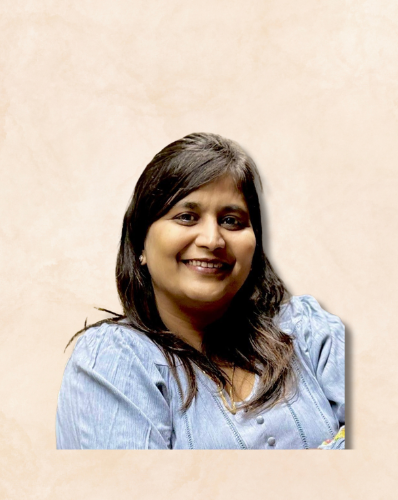
Architect Pooja Kapadia, Co-founder of Pooja & Piyush Associates, has built her practice on a quiet yet deeply powerful conviction, that meaningful design is shaped not by expensive materials, but by thoughtful intent. For her, architecture is ultimately about crafting experiences that respond honestly to people, context, and purpose. This philosophy has informed every project, every client interaction, and every material decision undertaken by her practice. In this conversation with SSMB, she reflects on her journey through constraints and clarity, the role of steel in responsible construction, and why architecture, for her, always begins with empathy.
Your journey as an architect and co-founder has evolved over time. What were the defining moments that shaped your design philosophy?
My journey has been shaped far more by real-world constraints than ideal conditions. Working within limited budgets taught me a valuable lesson very early, that good design is not defined by expensive materials, but by how thoughtfully different elements are brought together to create meaningful and efficient spaces. It is never the richness of the material palette that defines a project, but the synergy within the space and how effectively it serves the people who inhabit it.
Many of our projects reinforced this belief, where limitations became opportunities to design intelligently without compromising spatial quality. Equally important has been building trust with clients, understanding their aspirations, concerns, and lifestyles. For me, architecture begins with empathy. Once that relationship is established, the design process becomes a shared journey rather than merely a professional service.
This philosophy was strongly reflected in Yash Villa, where the client aspired to build in steel without visually expressing it, and that idea became the project’s central design driver.
Rather than merely speaking about sustainability, we believe in demonstrating it through built work. Projects like Nuts and Bolts illustrate how sustainable strategies can be integrated practically and economically without compromising design intent. Over time, these experiences have shaped my philosophy into one that balances practicality, empathy, and responsibility while creating awareness through action.
Your projects reflect strong contextual sensitivity. How do you decode a site before beginning the design process?
Our approach begins with people. Design, for me, is inherently user-centric. The way people move, interact, and inhabit a space informs the planning, circulation, and overall spatial logic. Functionality becomes the foundation, ensuring that the environment works intuitively.
One of the biggest lessons has been relentless commitment to the work. In the early stages of a practice, you are responsible for everything, from design and presentations to site coordination and administration, before you gradually build a team.
Another reality young architects must accept is that rejection is part of the journey. In the beginning, perhaps 75 percent of proposals may not convert into projects. The real test lies in whether you continue despite that. Persistence becomes the defining factor.
“Design for me is about imagining an idea and then carefully bringing it to life through detail.”
How would you describe the design philosophy guiding your practice?
Our approach begins with people. Design, for me, is inherently user-centric. The way people move, interact, and inhabit a space informs the planning, circulation, and overall spatial logic. Functionality becomes the foundation, ensuring that the environment works intuitively.
Layered onto this is the expression of brand identity. Through materials, colours, textures, and spatial rhythm, we translate the client’s values into a built language that feels authentic rather than imposed
The emotional dimension emerges through balance and coherence. A space should feel calm, intuitive, and engaging. When functionality, identity, and emotion align, the result is an environment that performs efficiently while also resonating with its users.
How do you perceive steel as an architectural medium beyond its structural role?
The first step is always to place ourselves in the client’s position. Understanding lifestyle, aspirations, and local context becomes the foundation for shaping space rather than imposing preconceived ideas onto a site.
For us, sustainability is never an add-on. It is rooted in the principles of reducing, reusing, and responding intelligently to what already exists.
At the design stage, we continuously question every decision: What are we doing? Why are we doing it? And how will it perform over time? This process creates both clarity and confidence. Rather than presenting multiple directions, we believe in presenting the most appropriate solution, one that genuinely aligns with the client, the context, and long-term performance.
Alongside this, we carefully study airflow and ventilation, sun movement, orientation, spatial experience, Vastu principles where relevant, and the climatic behaviour of materials. For me, design is ultimately about creating spaces that feel intuitively and experientially right.
What role does materiality play in your work, particularly with steel or hybrid systems?
Materiality defines both experience and performance. Materials carry their own language, and when they are used truthfully, they bring a certain innocence to architecture that allows spaces to remain timeless.
If there is one material I continually return to, it is steel, often used alongside concrete so that each material is allowed to perform at its highest potential. In Heer Radha, this honesty of material has aged beautifully. Even after years of inhabitation, the space continues to feel alive, with natural light filtering through pivoted aluminium fins and interacting with textured stone floors, wood, greenery, and everyday life.
In Nuts and Bolts, the structure itself becomes the architectural expression, clear, honest, and efficient. Materials are never merely finishes. They define character, performance, and longevity. Whether it is steel, wood, or concrete, the key lies in understanding the nature of each material and allowing it to perform authentically within the design.
“Materials speak their own language, and when used truthfully, they bring a certain innocence to design that keeps it timeless.”
Steel is redefining modern construction. How do you see its role in contemporary architecture in India?
Steel represents a larger shift in mindset. Projects like Yash Villa demonstrate how steel can move beyond industrial associations and integrate seamlessly into residential architecture.
In the Indian context, steel offers significant advantages in terms of speed, precision, quality control, reduced construction waste, and compatibility with prefabrication systems. Beyond performance, however, it allows us to rethink how we consume resources and reduce waste, making the built environment more responsible and future-ready.
The work of architects like Zaha Hadid has long demonstrated what structural ambition can achieve when a material is deeply understood, and that spirit of structural honesty is very much part of what continues to draw us towards steel.
Compared to conventional materials, where does steel offer the most design freedom?
Steel offers immense freedom in span, scale, and adaptability. It enables slender structural systems, larger flexible spaces, and faster execution with greater precision. More importantly, it supports long-term adaptability.
Buildings today must evolve over time. Steel allows spaces to be modified, reused, and extended without major structural disruption, unlike many conventional systems. It also reduces demolition waste because the material itself can be reused and recycled, making it advantageous both economically and environmentally.This fundamentally changes how architects think about buildings, shifting the conversation from static structures to evolving systems.
What are the key gaps in the adoption of steel in mainstream practice?
The largest gap continues to be awareness and familiarity. Steel is still widely perceived as either expensive or limited primarily to industrial applications.
Challenges also include limited exposure within architectural education, insufficient collaboration with fabricators, and a broader hesitation to move beyond conventional construction systems. Bridging this gap requires more built examples, and as practitioners, we contribute to that shift one project at a time.
“Sustainability is not a feature added to a building. It begins much earlier, with the discipline to build less, consume less, and choose better systems.”
Do you believe the industry is becoming more inclusive? What changes have you observed?
The industry is evolving gradually, but meaningfully. Women today are no longer merely participating, they are leading practices, shaping conversations, and bringing diverse perspectives into architecture.
Balancing home and profession are often described as a challenge, but in my experience, it has been a strength. It builds empathy, discipline, and clarity, qualities that directly influence the design process itself.
One of the biggest misconceptions about women in architecture is that they must choose between professional growth and personal life, which is simply untrue.
I have also been fortunate to receive constant support from Architect Piyush Kapadia, whose encouragement has enabled me to confidently navigate multiple responsibilities. There is certainly a long way to go, but meaningful change has begun, and these voices are increasingly being heard.
What advice would you give to young women architects aspiring to lead their own practices?
Start before you feel fully ready. Build knowledge consistently and take responsibility early, because your work eventually becomes your strongest voice, often more powerful than anything you could say about yourself.
Balancing life and professional practice is not a limitation. In many ways, it becomes the very thing that strengthens resilience, sharpens empathy, and broadens perspective. With clarity and commitment, both are absolutely possible.
What advice would you offer to young women architects entering the field today?
I would encourage young architects to nurture both their creative voice and their understanding of the broader design ecosystem. Strong fundamentals, curiosity, and attention to detail are essential.
At the same time, developing leadership skills like project management, communication, and decision-making is equally important. These abilities allow designers to shape projects more holistically.
Most importantly, remain authentic and resilient. Architecture benefits from diverse perspectives, and meaningful design emerges when creativity is supported by clarity and strong professional values.
THE QUICK TAKE
- One material you love working with: Steel with concrete
- A building that inspires you endlessly: Fire Station designed by Zaha Hadid
- A design rule you love breaking: Symmetry with purpose
- Your biggest creative influence outside architecture: Nature
IN HER WORDS
“For me, architecture is…”
About creating meaningful experiences through thoughtful spaces.
“Steel, as a material, allows me to…”
Build efficiently while exploring new possibilities in design.
“The biggest misconception about women in architecture is…”
That they must choose between professional growth and personal life.
“Design is not about being louder, it is about being more meaningful.”
Why It Matters:
Pooja Kapadia’s work champions architecture rooted in empathy, material honesty, and lived sustainability. At a time when steel is still finding wider acceptance in mainstream architecture, her projects demonstrate its potential through built outcomes rather than claims. Equally, her grounded and fearless perspective offers an inspiring voice for the next generation of architects navigating a changing industry.