

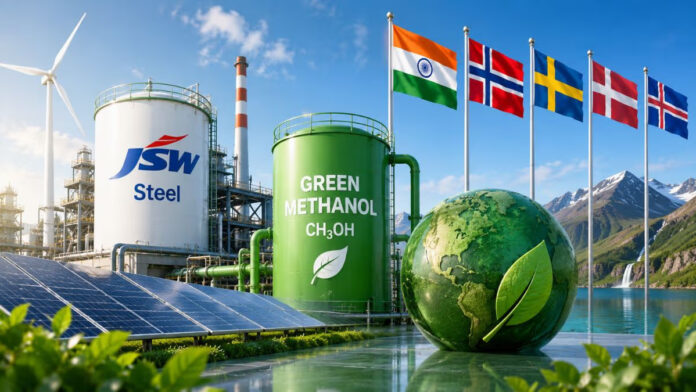
JSW Steel Ltd, Bharatia and Carbon Iceland International have signed a Memorandum of Understanding to jointly explore the development of a large-scale green methanol project in India. The agreement was formalised in Oslo, Norway, on the sidelines of the 3rd India-Nordic Summit, marking a significant step in India’s industrial decarbonisation journey.
The proposed project targets a capacity of 300 kilo-tonnes per annum and will utilise carbon dioxide emissions generated from JSW Steel’s manufacturing operations in Raigad district, Maharashtra. These captured emissions will be converted into e-methanol using green hydrogen produced from renewable energy sources, establishing a carbon capture and utilisation pathway that could serve as a replicable model for the broader steel and heavy industry sector.
At its core, the initiative aims to demonstrate how industrial emissions, typically a liability, can be transformed into low-carbon fuels and chemical feedstocks. Beyond the immediate project, the collaboration is designed to support India’s wider energy transition goals and contribute to decarbonising one of its most emissions-intensive industries.
The three partners bring distinct but complementary strengths to the table. JSW Steel contributes large-scale industrial infrastructure and operational capacity as one of India’s leading steel manufacturers. Bharatia, a non-profit foundation operating the Bharat Technology and Impact Accelerator platform anchored with institutions including IIT Kanpur, will lead project development, ecosystem integration and financing architecture. Carbon Iceland International brings specialised expertise in CO₂ capture, e-fuel production and industrial decarbonisation, with a track record of deploying scalable, low-risk green fuel projects globally.
As part of the initial scope, the project will evaluate the use of an existing high-purity CO₂ stream from JSW Steel’s Raigad facility, while also assessing opportunities to capture additional emissions from broader steelmaking operations. The MoU outlines a phased development pathway, beginning with feasibility assessment and technical validation before progressing toward potential commercial-scale implementation.
The project arrives at a time when India is actively seeking scalable solutions to reduce the carbon footprint of its industrial base. If successfully developed, the Raigad green methanol facility could position India as a meaningful player in sustainable industrial transformation, offering a blueprint for how heavy industries elsewhere can convert emissions into economic and environmental value.