

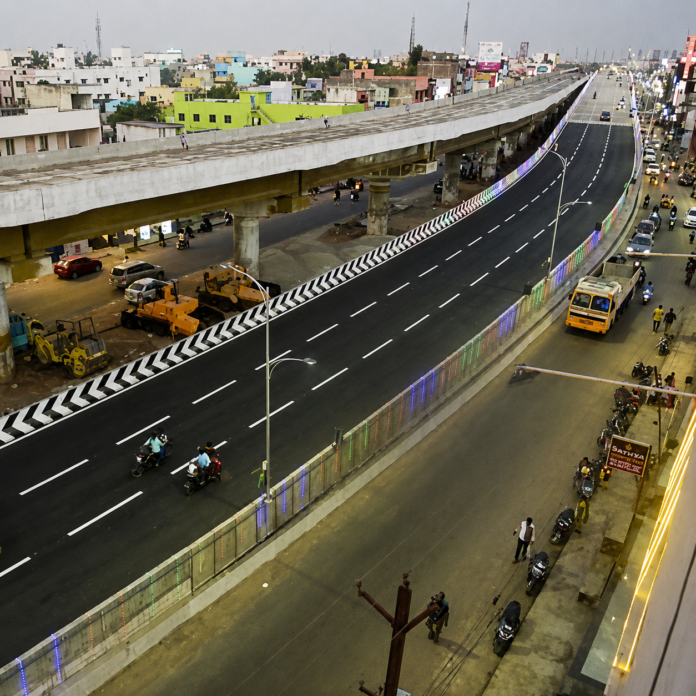
Chennai’s long-awaited elevated corridor along Anna Salai is finally entering its final stretch, with civic authorities indicating the Saidapet–Teynampet stretch could open to traffic by September 2026. The project promises to transform one of the city’s most congested arterial routes, where daily gridlock has long eaten into commute times, fuel efficiency and public transport reliability.
The 3.2-km steel flyover, built above existing road infrastructure, is technically one of Chennai’s more challenging urban construction projects. Over two-thirds of the work is now complete, including significant progress in piling and structural assembly. A key complexity has been its alignment directly above operational metro rail tunnels, which has demanded careful coordination and slowed the pace of heavy structural installation. Many precast segments and steel assemblies are being fabricated outside Tamil Nadu and transported to Chennai, underlining the specialised nature of the project.
Anna Salai sits at the heart of Chennai’s commercial and institutional belt, making this flyover one of the city’s most closely watched infrastructure interventions. Traffic volumes along the corridor have climbed steadily over the past decade, driven by southern neighbourhood growth and rising private vehicle use. Delays along this stretch have carried wider economic consequences, affecting logistics efficiency and raising transport costs for businesses operating in central Chennai.
Construction had earlier lost momentum due to labour shortages, rising material costs and supply-chain pressures on steel and fuel. Officials now say work has picked up noticeably, with deck installation accelerating across multiple sections. Once operational, the flyover is expected to cut signal delays and reduce travel time between Saidapet and Teynampet, especially during peak hours.
However, urban planning voices urge caution. Experts note that flyovers address short-term traffic flow but cannot resolve deeper mobility stress in fast-growing cities. Sustainable urban development calls for stronger integration between road projects, pedestrian networks, public transport and non-motorised connectivity. The Anna Salai flyover also arrives at a moment when Indian cities are increasingly questioning the long-term environmental cost of automobile-centric infrastructure.
For Chennai, the real measure of this project’s success will go beyond cutting commute times. The larger challenge will be whether the city can pair high-capacity road infrastructure with climate-conscious, people-first mobility planning as it continues to grow.