

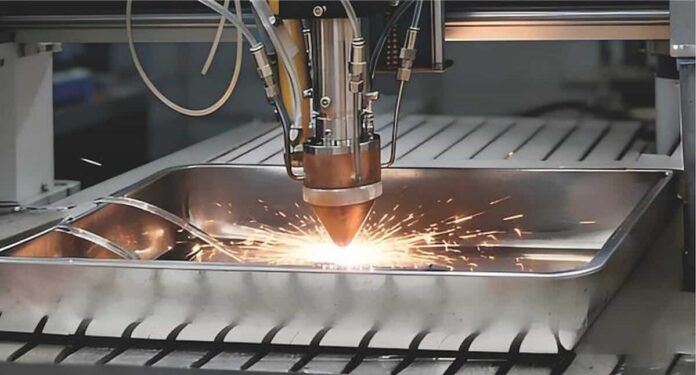
Researchers from the University of South China, in collaboration with Purdue University, have developed a new AI-designed steel tailored for 3D printing, combining ultra-high strength, ductility, and corrosion resistance with significantly reduced processing time.
Published in the International Journal of Extreme Manufacturing, the study highlights how interpretable machine learning can fast-track alloy design by analysing core physicochemical properties. The approach eliminates reliance on expensive elements like cobalt and molybdenum, instead optimising a cost-effective composition based on iron and chromium with minor additions.
The alloy, produced using laser-directed energy deposition, achieves a strength of 1,713 MPa with 15.5% ductility after a single six-hour heat treatment, delivering around 30% higher strength than its as-printed state. Its microstructure features nanoscale precipitates that enhance durability while preventing structural failure.
Notably, the material also demonstrates superior corrosion resistance, outperforming conventional grades such as AISI 420 stainless steel.
The development signals a shift towards data-driven metallurgy, offering scalable potential for aerospace, marine, and energy applications.