

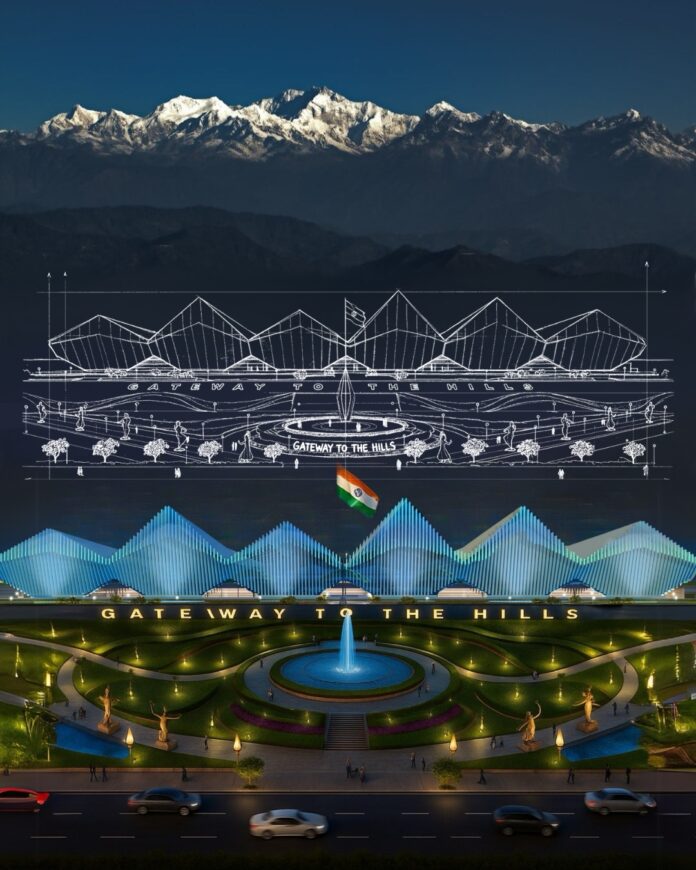
Some buildings announce themselves through scale. Others through speed. Bagdogra Airport does something rarer, it announces where you are. At the edge of the Eastern Himalayas, this new terminal transforms infrastructure into an experience of landscape, culture, and climate, powered quietly by steel and guided by a Net-Zero ambition that goes far beyond compliance.
DESIGNING ARRIVAL, NOT JUST INFRASTRUCTURE
For CP Kukreja Architects, Bagdogra Airport was never envisioned as a conventional aviation terminal. Positioned as the gateway to the Eastern Himalayas, the project demanded an architectural language that could absorb its geography rather than overpower it. The ambition was clear from the outset: to design an airport that performs at a global scale, yet, feels unmistakably rooted in North Bengal.
Every arrival here is meant to signal transition, not just from air to land, but from movement to place. The architecture responds to this idea by shaping a sense of arrival that is spatially generous, visually open, and emotionally grounded in the region’s natural and cultural context.
“We wanted Bagdogra to feel like a gateway, one that announces the Eastern Himalayas, not just an airport terminal.”
MODERN AVIATION MEETS REGIONAL MEMORY
Balancing the demands of a high-performance aviation hub with the responsibility of contextual sensitivity became the project’s defining challenge. Efficiency, security, and passenger comfort for millions had to coexist with subtler narratives of tea estates, mountain contours, and Bengal’s cultural identity.
This duality informs the terminal’s planning and form. Advanced technology operates seamlessly in the background, while the architecture foregrounds memory and landscape. The result is a terminal where modernity does not erase context, but rather amplifies it.
NET-ZERO AS A MEASURABLE COMMITMENT
At Bagdogra, sustainability is neither symbolic nor superficial. The Net-Zero carbon ambition is translated into tangible design and execution strategies. Energy demand is first reduced through intelligent orientation, envelope optimisation, and passive design, before being met through renewable sources and carbon-conscious systems.
Efficient HVAC planning, responsible material selection, integrated waste management, and on-site renewable energy generation together ensure that sustainability is embedded across the project lifecycle. Here, Net-Zero is not a label; it is a performance metric.
“Net-Zero here is a measurable design commitment, not a symbolic gesture.”
RESPONDING TO CLIMATE, NOT FIGHTING IT
Bagdogra’s climatic context is unforgiving: heavy rainfall, high humidity, and a flood-prone terrain. Instead of resisting these realities, the design works with them. Passive cooling strategies, deep overhangs, orientation-driven planning, controlled daylighting, and a carefully engineered building envelope reduce heat gain and reliance on artificial systems.
Thermal comfort is achieved through form, materiality, and airflow, allowing the terminal to remain energy-efficient while responding sensitively to its subtropical environment.
A FAÇADE THAT READS THE LANDSCAPE
One of the terminal’s most distinctive features is its façade, an architectural translation of the region itself. Inspired by the rhythmic geometry of tea gardens and the undulating contours of the Eastern Himalayas, the façade employs parametric aluminium fins to create a contemporary second skin.
This layer performs multiple roles. Functionally, it acts as a shading device, reducing solar gain. Symbolically, it evokes the terrain and plantations that define the region. The result is a façade that is at once climatic, cultural, and computational.
STEEL AS STRUCTURE, SPACE, AND EXPERIENCE
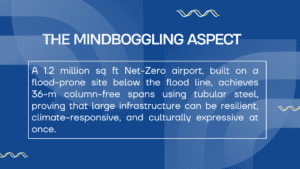
Steel plays a defining role in shaping Bagdogra’s spatial character. Tubular steel columns enable uninterrupted spans of up to 36 m, creating expansive, column-free interiors essential for modern terminal planning. Passenger circulation improves, sightlines remain clear, and the architecture feels light rather than imposing.
The slender steel members establish a structural rhythm that enhances openness without visual clutter. Beyond efficiency and durability, steel allows the roof to assume a fluid, elevated form, subtly echoing the Himalayan skyline beyond the terminal walls. Here, structure is not hidden; it participates in storytelling.
“Steel enabled openness, adaptability, and lightness, all the qualities essential for a terminal of this scale.”
ENGINEERING RESILIENCE BELOW THE SURFACE
Perhaps the most complex challenges at Bagdogra lie beneath ground level. The 1.2 million sq ft terminal sits on a site nearly 10 metres below the flood line, intersected by four natural streams. Addressing this required a robust, integrated stormwater management strategy.
Swales, retaining systems, and underground drainage networks work together to manage monsoon flows, ensuring operational continuity even during extreme weather events. Resilience, in this case, is as much an engineering triumph as it is an environmental necessity.
SCALING FOR THE FUTURE, WITHOUT LOSING IDENTITY
Designed to handle 12.5 million passengers annually, the terminal relies on intuitive circulation, modular planning, and adaptable infrastructure. Retail, waiting, and service zones are seamlessly integrated, while backend systems such as baggage handling and security screening are optimised for high throughput.
Yet, despite its scale, the building never feels generic. Through material choices, spatial openness, and contextual references, Bagdogra Airport remains unmistakably tied to its geography.
“At Bagdogra, infrastructure does not dominate the landscape, it listens to it.” – Dikshu Kukreja
Steel & Structure
- 36-m clear spans using tubular steel columns
- Column-free interiors for flexible terminal planning
- Slender steel members enhance durability and speed of construction
- Structural form echoes the Himalayan landscape
Editor’s Note:
Bagdogra Airport challenges the idea that large-scale infrastructure must be anonymous. Through steel, sustainability, and context-driven design, it demonstrates how engineering can serve identity as much as efficiency. In an era of rapid airport expansion across India, Bagdogra stands out not for its size alone, but for its restraint, resilience, and sense of place.